A deep cycle battery load tester answers the question a voltmeter cannot: is this bank still able to deliver current under load, or is it only holding a voltage? A battery can show a healthy resting voltage and still collapse the moment a real load is applied — the failure mode that strands an inverter at the worst moment. This guide covers what the tester measures, the three rating families buyers confuse, the test procedure on lead-acid and lithium banks, and how to read the result.
Voltage tells you about charge; only load tells you about capacity. The two questions get confused constantly, and the confusion is expensive.
What a load tester actually measures
A load tester applies a controlled electrical load — a heavy current draw for a short, defined interval — and watches what happens to the terminal voltage while that load is applied. A healthy bank holds its voltage through the interval; a degraded one sags, sometimes steeply, because its internal resistance has risen or its active material has been lost. The instrument then reports the result either as a voltage held under load or, on more capable units, as a capacity estimate derived from the sag.
That distinction matters because it is the same physics an inverter or a motor experiences. A bank that passes a deep cycle battery load tester check will start a compressor; a bank that fails one will not, no matter what its resting voltage suggested. The 100 amp hour deep cycle battery guide explains why the nameplate over-promises; the tester is how you find out what is left.
CCA, reserve capacity and amp-hours: three different numbers
Labels carry three rating families and they are not interchangeable. Cold cranking amps describe a starting battery’s ability to deliver a large current for a short burst in cold conditions — relevant for engines, largely irrelevant for deep-cycle duty. Reserve capacity describes how long a battery can sustain a modest current before falling to a cutoff voltage, which is closer to what a deep-cycle user cares about. Amp-hours describe charge delivered at a reference rate, which is the closest to an energy measure but still rate-dependent.
A load tester designed for starting batteries reports in CCA and will not tell you the state of a deep-cycle bank’s capacity. A conductance tester estimates internal condition without applying a heavy load, which is convenient for a quick screen but less decisive. For deep-cycle work, the meaningful test applies a load proportionate to the bank’s rating and reads the result against a capacity estimate, not a cranking number. Confusing the two is the most common reason a “tested good” battery fails in service.
| Instrument | What it applies | Best use | Limitation |
|---|---|---|---|
| Carbon-pile load tester | Heavy controlled current for a short interval | Decisive capacity screen on lead-acid | Bulkier; needs a charged bank |
| Conductance tester | Small AC signal, no heavy load | Quick screen, repeated checks | Estimates condition, less decisive |
| DC load bank + logger | Programmed discharge over hours | True capacity measurement | Time-consuming; shop equipment |
| Inverter under real load | The actual duty load | End-to-end system check | Qualitative; no number |
Running the test on a lead-acid bank
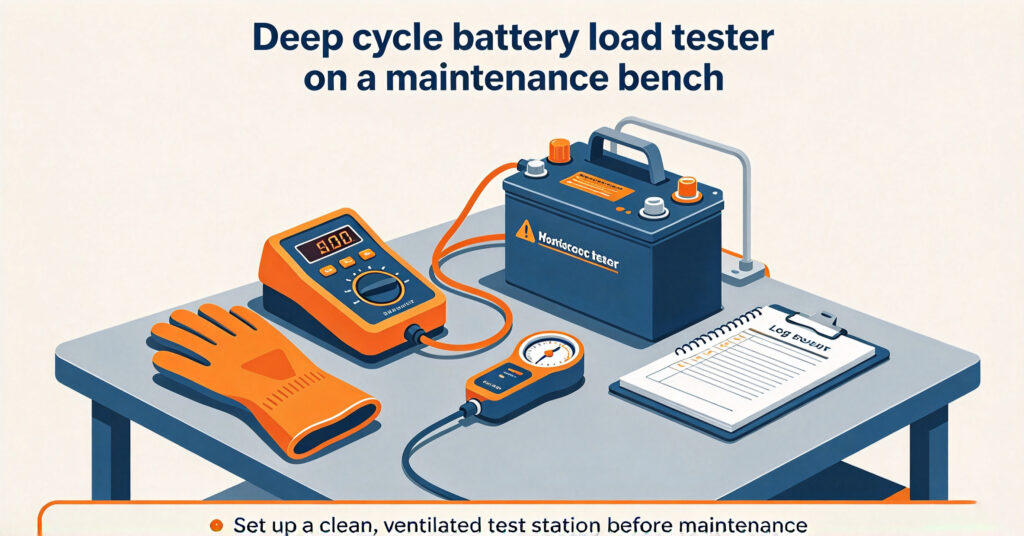
The procedure is straightforward but order matters. Start with a fully charged bank — a load test on a partially charged battery produces a failing result that means nothing. Connect the tester’s leads to the battery posts, not to a cable end, because corroded terminals can fake a bad battery. Select the load appropriate to the bank’s rating, apply it for the specified interval — typically on the order of ten to fifteen seconds — and read the voltage while the load is still applied, not after it is released.
A healthy bank holds a voltage comfortably above the fail threshold for the full interval. A bank that sags below the threshold during the test has high internal resistance or lost capacity, and the number is the diagnosis. On a multi-battery bank, test each battery individually and then the bank as a whole: a bank that passes individually but fails together usually has a connection problem rather than a battery problem, and that is a different and cheaper repair.
Running the test on lithium
Lithium banks change the rules. Their internal resistance is far lower, so a lead-acid load tester’s thresholds do not apply, and a bank with a BMS may cut output mid-test for its own protection — producing a result that reflects the protection logic rather than the cells. Most lithium home batteries cannot and should not be load-tested with automotive equipment at all.
The correct approach on lithium is to use the battery’s own reporting. A BMS that logs state of charge, current and cell balance is a continuous load test in disguise: a bank that reaches its cutoff early under a known load has a capacity problem, and one whose cells diverge under load has a balance problem. The remote battery monitoring apps guide covers how to read those logs. Where a lithium bank must be tested directly, the manufacturer’s procedure and a suitable DC load bank are the right tools, and the how lithium ion charging works guide explains why the charging behaviour around the test matters too.
Reading the result: pass, marginal, replace
The result falls into one of three bands, and the middle band is where money is either saved or wasted. A clear pass means the bank held voltage through the interval and can be trusted for another cycle of service. A clear fail means it cannot deliver under load and should be replaced — no conditioner, no desulfator and no equalisation will bring back lost active material. A marginal result — a voltage that holds but only just — is the judgment call: the bank will start an engine on a warm day and fail on a cold one, or run an inverter until the load peaks.
For a marginal bank, the deciding factors are the duty and the cost of failure. A bank in a backup application where failure is inconvenient gets a shorter leash than one where failure is dangerous. In fleet or commercial service, marginal banks are typically replaced on schedule because unplanned failure costs more than the battery. The deep cycle lead acid battery guide covers what the chemistry can and cannot recover from, and a deep cycle battery load tester used at a fixed interval is what turns that judgment into a schedule rather than a guess.
Test interval and record keeping
A load test is most valuable as a series. Testing at a fixed interval — seasonally for seasonal installations, monthly for daily-duty commercial banks — and writing down the number turns a pass/fail snapshot into a trend. Capacity that declines a little each test is a bank on a known trajectory; capacity that falls off a cliff between tests is a bank that failed without warning, which is the outcome the testing programme exists to prevent.
Keep the log simple: date, bank identifier, resting voltage, loaded voltage, load applied, result. Over a couple of seasons the log tells you when to budget replacements and, just as usefully, when a “failing” bank is actually a charging problem wearing a disguise. The AGM versus LiFePO4 deep cycle upgrade comparison is a sensible next read when the log says it is time to change chemistry.
Q. deep cycle battery load tester?
A deep cycle battery load tester applies a controlled heavy load to a battery and reads the voltage under that load, revealing whether the bank can actually deliver current rather than merely holding a charge.
Q. Can I test a deep cycle battery with a multimeter?
Only partially. A multimeter shows resting voltage, which indicates charge but not capacity. A bank can read a healthy voltage and still collapse under load — the failure a load tester exists to catch.
Q. How often should I load test my batteries?
Seasonally for seasonal use, monthly for daily-duty commercial banks, and before any long trip or storm season. The trend across tests is more informative than any single reading.
Q. Do load testers work on lithium batteries?
Automotive load testers are designed for lead-acid thresholds and are usually inappropriate for lithium, whose BMS may cut output mid-test. Use the battery’s own logged data or a manufacturer-approved procedure instead.
Q. What voltage should a 12V battery hold under load?
A healthy bank holds comfortably above the tester’s fail threshold for the full test interval — commonly quoted around the mid-9 volts or higher on a fully charged 12V lead-acid bank, depending on the tester’s convention. Follow the instrument’s chart.
Q. My bank fails as a whole but passes individually — what does that mean?
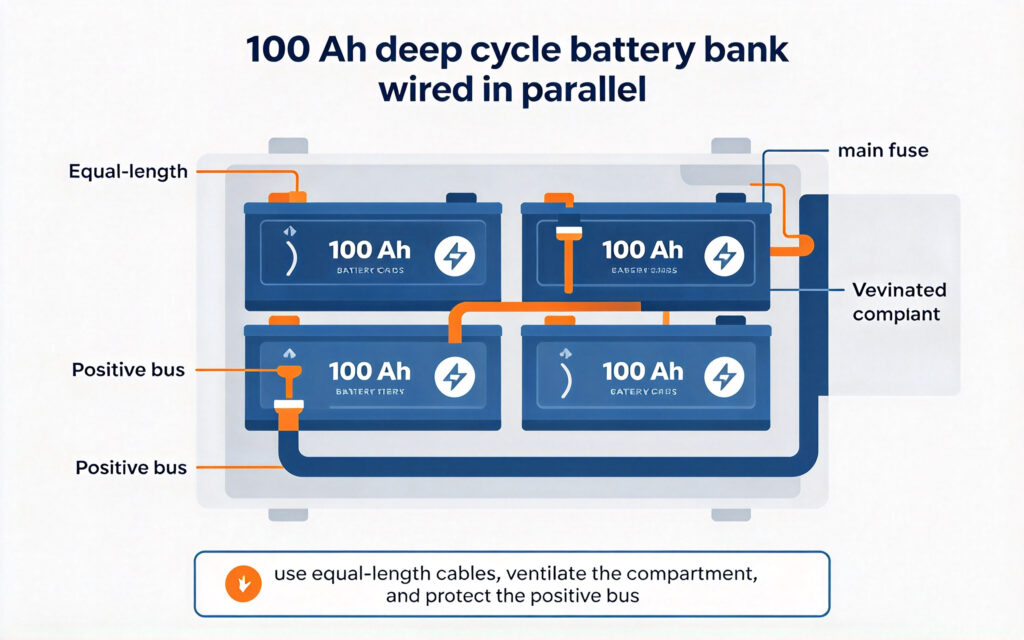
Almost always a connection problem: corroded terminals, underspecified cables or a loose bus. Clean and torque the connections, equalise cable lengths, then retest before buying batteries.
Q. Is a conductance tester good enough?
For a quick screen, often yes. It estimates internal condition without a heavy load, which suits repeated checks, but a marginal decision on a critical bank deserves a real load test.
Next step: test before you trust
Whether an existing bank is worth keeping is a measurement, not an opinion. Send the bank configuration and the duty, and we can help interpret the readings.
- Understand the rating first with the group 27 deep cycle battery guide
- Match the case size with the group 24 deep cycle battery guide
- For chisidal, send your usage and site details, and we will come back with product prices, lead time and warranty information.