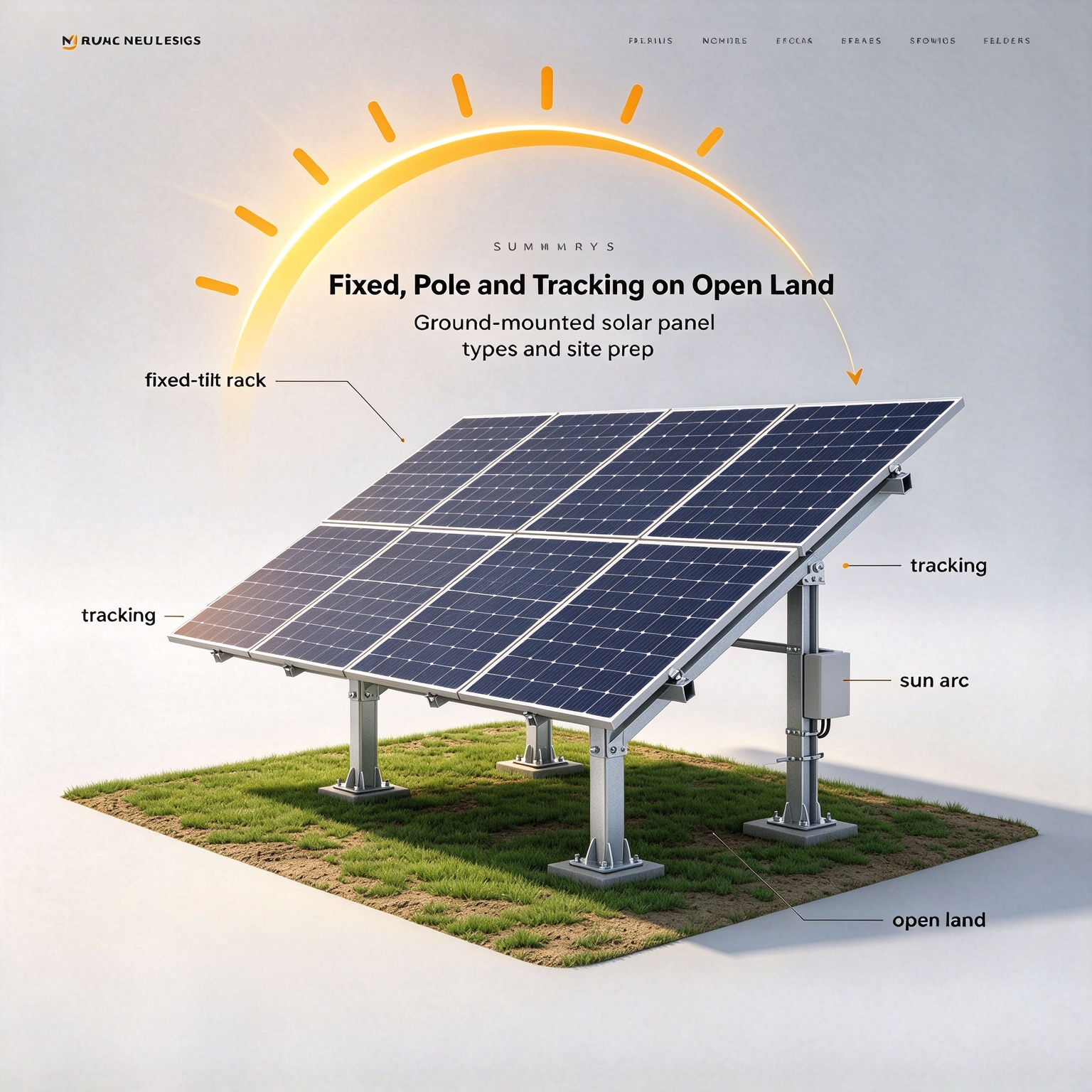
ground mounted solar panels are photovoltaic arrays installed on the ground — on fixed-tilt, pole or tracking racks, or on ballasted frames — rather than on a building roof. This guide covers the main ground-mount types, the site assessment that decides if ground mounting is even worth it, the racking and foundation choices, and the permit and cost factors that shape the build.
Roof space is not always the best place for solar. A shaded, small or structurally weak roof pushes the array to the ground, where you can aim it, clean it and expand it far more easily. The trade is land, racking and permitting — and that is exactly what this guide helps you weigh before you commit.
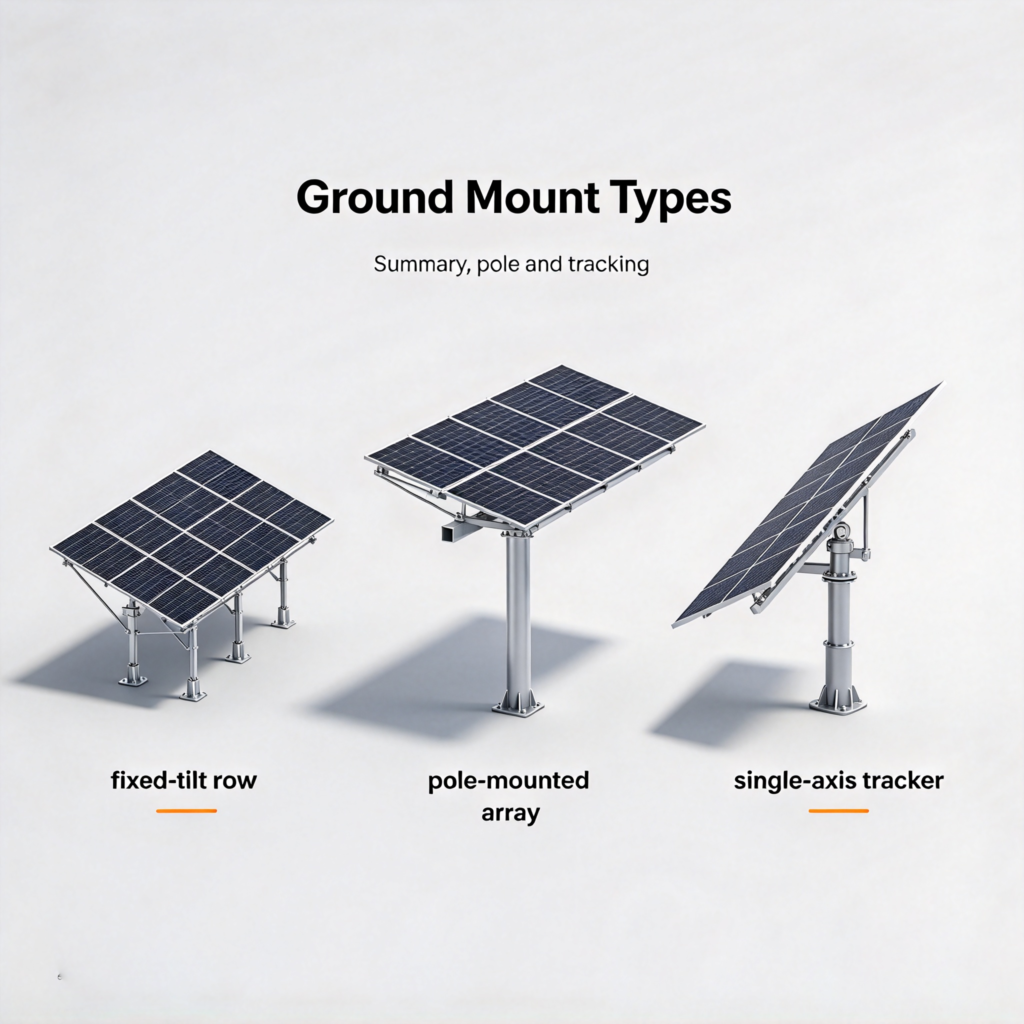
The ground-mount types you will meet
A ground mounted solar panels system takes one of a few forms. Fixed-tilt racks hold the array at a set angle and are the cheapest and most common. Pole mounts lift a smaller array off the ground for less shading and easier snow shed. Single-axis trackers follow the sun for more yield at higher cost and maintenance. Ballasted frames use weight instead of penetrations, useful on flat, strong ground. The best pv module guide module-selection guide and the solar panel dimensions guide dimensions guide set the panels that go on these racks.
Site assessment before you commit
A ground mounted solar panels build lives or dies on the site. Check solar access first — a clear, unshaded run from morning to evening beats a slightly bigger array in shadow. Then assess soil and load for the foundation, drainage so water does not pool under the rack, and setbacks and easements that limit where you can build. The solar panel drawing panel-drawing guide helps translate a site sketch into a layout.
| Factor | Why it matters | Typical action |
|---|---|---|
| Solar access | Sets yearly yield | Trim shade, aim array |
| Soil & load | Sets foundation | Choose driven, screwed or ballasted |
| Drainage | Prevents corrosion | Grade and lift the rack |
| Setbacks | Legal limit | Confirm with authority |
Racking and foundation choices
How you fix a ground mounted solar panels to the ground depends on soil and rules. Driven or screwed posts are common on firm ground; concrete footings suit heavy or tracker loads; ballasted systems avoid penetration where the ground or lease forbids it. Match the racking to the panel size and wind zone — the solar panel dimensions guide dimensions guide feeds the spacing math — and the solar panel mc4 connectors guide MC4 guide covers the connectors that link the strings once mounted.
Permits, cost and the roof comparison
A ground mounted solar panels usually costs more than a rooftop array in hardware because you buy racking, foundations and trenching, but it can cost less in labor where the roof is awkward or unsafe. Budget for permit fees, inspection, and any grid-interconnection charge. The solar panel installer jobs installer-jobs guide and the solar panel removal removal guide bracket the lifecycle, while the solar panel cleaning brush cleaning guide covers ongoing upkeep once it is up.
For chisidal projects, send the site photo, the available land, the soil type and the target output, then ask for the panels and racking matched as one documented ground-mount package, with the sol ark inverter installation guide inverter-integration path planned alongside.
Site prep, racking and spacing
A ground mounted solar panels array starts with the site, not the modules. Clear the footprint, confirm the soil can hold post foundations or ballast, and keep row spacing wide enough that winter sun does not let the front row shade the row behind it. A ground mounted solar panels layout that ignores tilt and seasonal angle loses output exactly when you need it.
Racking choice follows the ground: driven posts for firm soil, ballasted blocks for protected surfaces, and adjustable tilt frames if you want to chase the seasons. Run conduit before you set the frames, not after, and label every string so maintenance is a map, not a guess. Shading is the silent killer: a single tree or vent pipe casting a line across one module can depress a whole string, so map shadows across the worst day of the year. For chisidal-supplied systems, the racking and the modules are specified together so the array arrives install-ready.
Permits, setbacks and as-builts
Many jurisdictions limit array height, require fencing around live parts, and demand a disconnect reachable from the grid connection. Pull the rules before you dig; rework after inspection is far costlier than a phone call upfront. Document the as-built layout so future service stays simple, and keep the spacing you designed rather than squeezing rows to save a few feet of land.
Monitoring, snow, seasonal tilt and site care
A ground mounted solar panels array earns more when you can see it work. A simple string monitor or per-string current sensor shows a failing module or a soiled row before output quietly sags for a season. Wire the monitoring into the same conduit run you planned earlier, not as an afterthought draped over the frames.
Snow and seasonal angle decide winter yield. A steep winter tilt sheds snow that would otherwise blanket a shallow array for weeks, and a tilt adjust every season recovers the low-sun angle without moving the whole row. Brush snow with a soft tool, not a metal edge that scars the glass. Vegetation control is part of the design: grass and weeds under the array trap humidity against the frames and invite rodents, so a gravel or trimmed border keeps the site dry. For chisidal-supplied systems, the ground mounted solar panels kit ships with the monitoring points and the tilt hardware specified together.
Vegetation, perimeter and seasonal checks
Keep a clear, graveled or trimmed perimeter around the array so grass and weeds do not trap humidity against the frames or hide rodent damage to conduit. A tidy border is not cosmetic; it protects the rating and shortens the service walk. Inspect the perimeter each season and after storms, because a shifted post or a dug-under tunnel shows up there first. For chisidal-supplied ground mounted solar panels kits, the layout leaves the clearance built in so the site stays dry and inspectable.
Bottom line
In practice, a ground mounted solar panels array rewards the boring details — spacing, racking, monitoring, and a clear perimeter — more than any premium module does, so invest in the site before you chase the spec sheet.
Choosing modules and running the cabling
Module choice for a ground mounted solar panels array is less about brand and more about match to the site. Monocrystalline gives the most watts per square metre for a tight footprint; bifacial adds yield from light reflected off the ground; thin-film shrugs off heat and shade. Pick the one whose strength fits your constraint, not the one with the biggest number on the box.
Cabling and combiners decide whether the array’s yield reaches the inverter. Use the right gauge for the run and the current, keep parallel strings fused at the combiner, and route conduit so it cannot pool water at a low point. A neat, labelled combiner turns a tangle into a serviceable system. For chisidal-supplied kits, the module type and the cabling are chosen together so the ground mounted solar panels array performs as specified.
Q. ground mounted solar panels?
Ground mounted solar panels are photovoltaic arrays installed on the ground on fixed-tilt, pole, tracking or ballasted racks instead of on a building roof. The term describes the mounting location, not the panel technology.
Q. What are the types of ground mounted solar panels?
The main types are fixed-tilt racks (cheapest, most common), pole mounts (less shading, easier snow shed), single-axis trackers (more yield, more cost) and ballasted frames (no ground penetration). The right one follows the site and budget.
Q. Is ground mounting cheaper than a roof array?
Hardware is usually dearer because of racking, foundations and trenching, but labor can be lower where the roof is awkward or unsafe. Net cost depends on the specific site and the permits involved.
Q. What site factors decide a ground mount?
Solar access (shade-free daylight run), soil and load for the foundation, drainage, and legal setbacks or easements. Poor solar access or weak soil can make ground mounting the wrong call despite the open land.
Q. Do ground mounted solar panels need permits?
Almost always yes — building, electrical and often zoning or utility interconnection approvals apply. Confirm the local requirements before you break ground, because they shape cost and timeline.
Q. How do I maintain a ground mount array?
Keep the array clear of soil splash and vegetation, wash panels when soiling cuts yield, and inspect racking and foundations after storms. The cleaning guide covers the routine once it is installed.
Next step: assess the site before you build
A ground mount trades roof simplicity for land and racking. Confirm solar access, soil and permits before you commit the hardware.
- Read the best pv module guide best PV module guide before choosing panels
- For chisidal, send your usage and site details, and we will come back with product prices, lead time and warranty information.