Solar panel snow removal is a winter operations question disguised as a maintenance one. Snow blocks output while it lasts, partly reflects light when it is thin, and becomes a hazard the moment anyone climbs a ladder to clear it. The safe answer is almost always tools from the ground, not boots on the roof. This guide explains what snow actually does to production, when to clear it and when to leave it, which tools work, how hail is rated, and what to document after a storm.
Winter arrays fail in two directions: lost production under snow, and damage from clearing it badly. Both are avoidable with the right sequence and the right tools.
What snow actually does to output
A fully covered module produces nothing, and the loss compounds with every day the snow sits. A partly covered module is more interesting: the clear sections keep producing, and light bouncing off snow can raise the irradiance reaching the glass, so a dusting on a bright day can occasionally beat a clean panel’s output. That albedo bonus is real but small, and it never offsets a full cover.
The two failures that matter are cover and slide. Cover is the obvious one. Slide is the dangerous one: snow melting at the panel’s warm surface releases the whole sheet at once, and a roof-height avalanche of ice and snow takes racking, gutters and anything beneath it with it. The solar panel tilt angle guide covers how steepness governs both effects, and the shoulder-season version of the same planning is covered in the cloudy-day guide.
When to clear snow and when to leave it
The default should be to leave it. Most snow events are short, most arrays are steep enough to shed naturally, and the production lost to a two-day cover is far less than the production lost to a cracked module or an injured owner. Solar panel snow removal earns its keep in three situations: a long-duration cover after a heavy storm, a low-tilt array that will not shed on its own, and a freezing rain event that glazes the glass.
Two rules override convenience. Never pour warm water on a cold module — the thermal shock can crack glass, and the refreeze at the edges creates an ice dam that is worse than the snow. And never scrape or chip ice off the surface — the tool that dislodges ice takes the anti-reflective coating with it and voids the warranty. If the snow will not leave on its own and cannot be swept safely from the ground, waiting is the professional answer.
Production data settles most of these arguments. A covered module shows a visible step down in output on the monitoring dashboard, and the trend across a snow event tells the owner whether the array is shedding, holding or somewhere in between. Where the data shows output recovering on its own within a day, the snow was never the problem; where it shows a flat line for days, the array is a candidate for clearing — or for a mount adjustment that solves the next twenty events instead of this one.
Tools and technique for solar panel snow removal
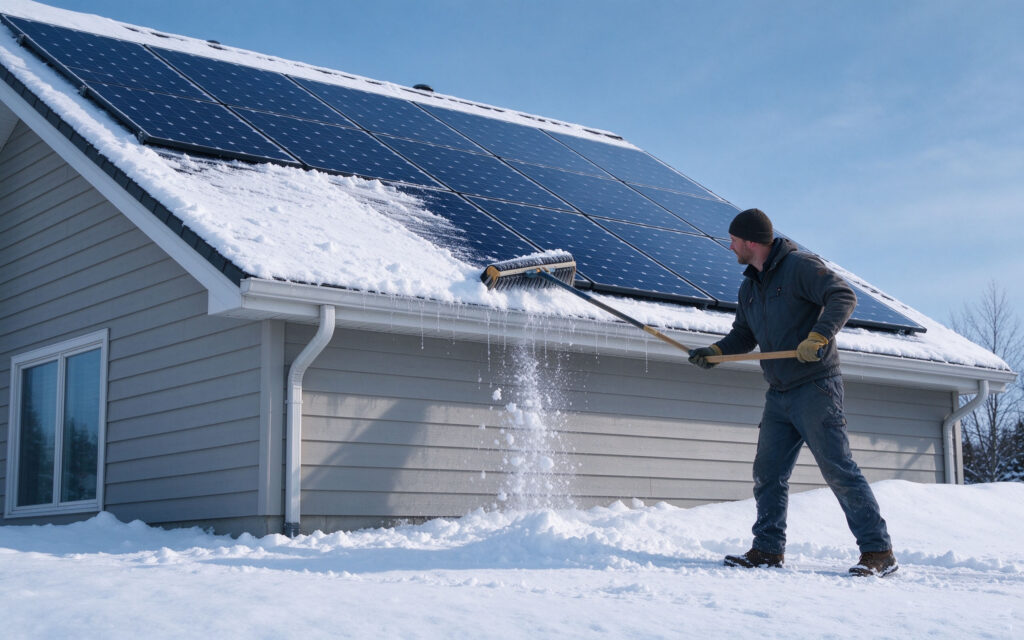
The right tool is a long-handled rake with a soft, non-abrasive head, used from the ground. Telescoping handles reach most single-storey eaves without a ladder, and the soft head clears snow without touching the coating. The technique is horizontal sweeps along the panel face rather than downward drags, working from the eave upward so cleared snow falls away from the operator rather than onto them.
Three mistakes account for most winter damage. Metal blades and stiff brushes scratch the glass. Downward dragging catches the frame edge and cracks cells. And roof access in icy conditions turns a maintenance task into an emergency — the industry’s own guidance is that ground-based tools are the default precisely because roof work in winter is where the injuries happen. The solar panel maintenance guide covers the general maintenance calendar this sits inside.
Snow guards and shedding hardware
Prevention beats clearing. On roofs where the array sits above walkways, doors or parked cars, snow guards — the small fences used on metal roofs to break snow into manageable pieces — belong on the roof surface above the array, not on the modules. They are a roofing accessory, specified by the roofer, and their job is to stop the sheet release rather than to manage module output.
For ground-mounted arrays the hardware answer is geometry: a steep mount sheds snow without help, while a shallow one holds it. Where the site’s climate makes winter cover a recurring cost, the mount’s seasonal adjustability matters more than any clearing tool, because a steeper winter angle both sheds snow and aims the low sun better. The solar panel mounting brackets guide covers the hardware options, and the ground-mount case is covered in its own guide.
Hail: what it does and what the standards mean
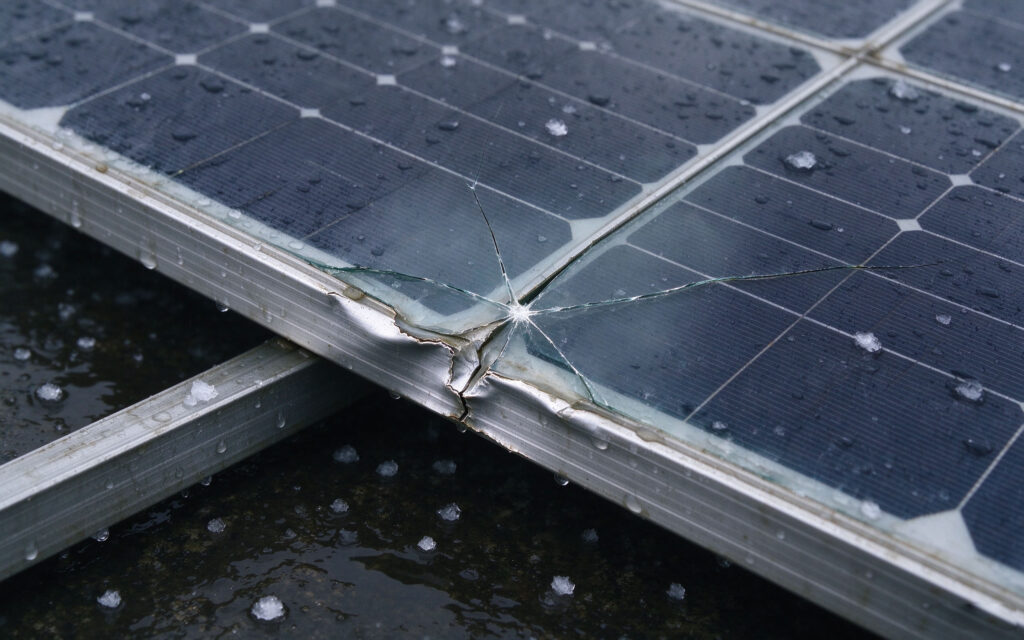
Hail is a different problem with a different failure mode. Snow blocks light; hail breaks glass. The industry’s qualification testing includes a hail impact test — an ice ball of defined size dropped from a defined height onto the module — and modules that pass carry a real, if blunt, assurance against ordinary storm hail. The test does not make a module hailproof: a large stone at terminal velocity beats the test’s ice ball, and the frame, glass edges and junction box remain the vulnerable points.
What buyers can act on is tier. Mainstream modules from established manufacturers pass the standard test and carry insurance-recognised warranties; unbranded modules of unknown provenance may not, and the difference only shows up in the storm that matters. After any hail event, the sequence is inspection before reconnection — look for glass cracks, frame dents and cell discolouration, photograph everything, and have the installer or insurer assess before assuming the array is fine. The solar panel lifespan guide guide covers the long-term view of storm damage.
After a storm: inspection and documentation
Storms end, and the work that decides whether an insurance claim succeeds happens in the following days. Photograph the array from several angles before touching anything, including close-ups of any visible damage. Record the date and the storm. Keep the production data from the monitoring system, because a step-change in output after the storm is evidence even when nothing is visible from the ground.
Three outcomes are possible, and they price differently. Cosmetic frame damage with intact glass and unchanged output is usually a documentation exercise. Cracked glass or a dented frame is a module replacement, which is where the replacement-market logic of the 300 watt solar panel guide becomes relevant. And a silent output drop with no visible damage points to microcracks in the cells, which only show up under electroluminescence imaging or IV-curve testing — a job for the installer, not the owner. In every case, the photograph taken on day one is what the claim rests on.
solar panel snow removal?
Solar panel snow removal means clearing accumulated snow from modules — safely, with ground-based tools — so the array resumes production. In most cases leaving snow to shed naturally is the better default.
Q. Do solar panels work with snow on them?
Fully covered, no. Partly covered, yes, and light bouncing off snow can briefly raise output on the clear sections. A long-duration cover is the case worth clearing.
Q. Should I remove snow from my solar panels?
Only for long covers, low-tilt arrays or freezing rain. Short events shed themselves, and the risk of cracked glass or injury from clearing usually outweighs the lost production.
Q. Can I pour warm water on snow-covered solar panels?
No. The thermal shock can crack the glass, and the meltwater refreezes at the edges into an ice dam. Ground-based sweeping with a soft-headed tool is the safe method.
Q. Does hail damage solar panels?
It can. Qualified modules pass a standardised hail impact test that covers ordinary storm hail, but large stones at speed can still crack glass or dent frames. Inspect and photograph after any event.
Q. How do I keep snow from sliding off my solar panels all at once?
Snow guards fitted on the roof above the array break the sheet release. They are a roofing accessory, specified by the roofer, and they protect what is below rather than the modules.
Q. Is snow damage covered by solar insurance or warranty?
Storm damage is usually an insurance matter, not a warranty one. Photograph the array before touching it, keep production data, and have the installer assess before reconnecting anything.
Next step: default to leaving it, plan for the exceptions
Winter operations are a sequence decision before they are a tool decision. Send the array tilt, roof access and the local storm profile.
- Compare the mainstream module in the 400 watt solar panel guide
- Plan the strings with the solar panels in series or parallel guide
- For chisidal, send your usage and site details, and we will come back with product prices, lead time and warranty information.