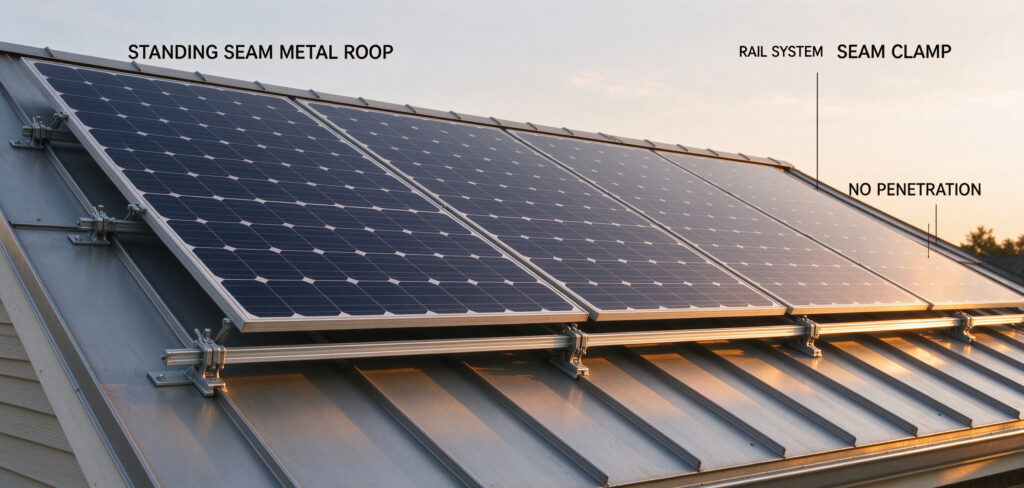
solar panels on metal roof are a good match: the roof is strong, long-lived and usually outlasts the asphalt alternative, and modern clamps attach to the seams or ribs without a single penetration. The decisions are the clamp type for your profile, how the penetrations — if any — get sealed, and whether the roof carries the load. This guide covers standing seam, corrugated and screw-down profiles, the waterproofing question, and the wind and thermal checks that decide the job.
Metal roofs are the easiest roofs to mount on and the easiest to get wrong, because the failure mode is a leak that shows up two winters later rather than a panel that falls off.
Why a metal roof is a different mounting problem
Solar panels on metal roof installations start from a different assumption than shingle jobs: the roof itself is the weather barrier, and it is expected to outlast the array sitting on it.
An asphalt shingle roof is a disposable surface over a deck; a metal roof is the weather barrier itself, and it is usually expected to last as long as the panels sitting on it. That single difference drives everything else. On shingles the installer lags through the surface into the rafters and seals each hole. On metal, every new hole is a future leak in a roof that would otherwise have stayed dry for decades, so the whole industry moved toward clamps that grip the standing seams or the ribs instead.
The second difference is movement. A metal roof expands and contracts with temperature every day, and by much more than a shingle roof does. Any attachment that fights that movement will eventually work loose or ovalise its own holes. Clamps that grip a seam allow the panel to slide along the seam; fixed penetrations through the sheet do not, which is why penetration-free mounting is the default wherever the profile allows it. The solar panel mounting brackets guide covers the hardware families in general terms; this one stays on the metal-roof case.
Standing seam, corrugated and screw-down profiles
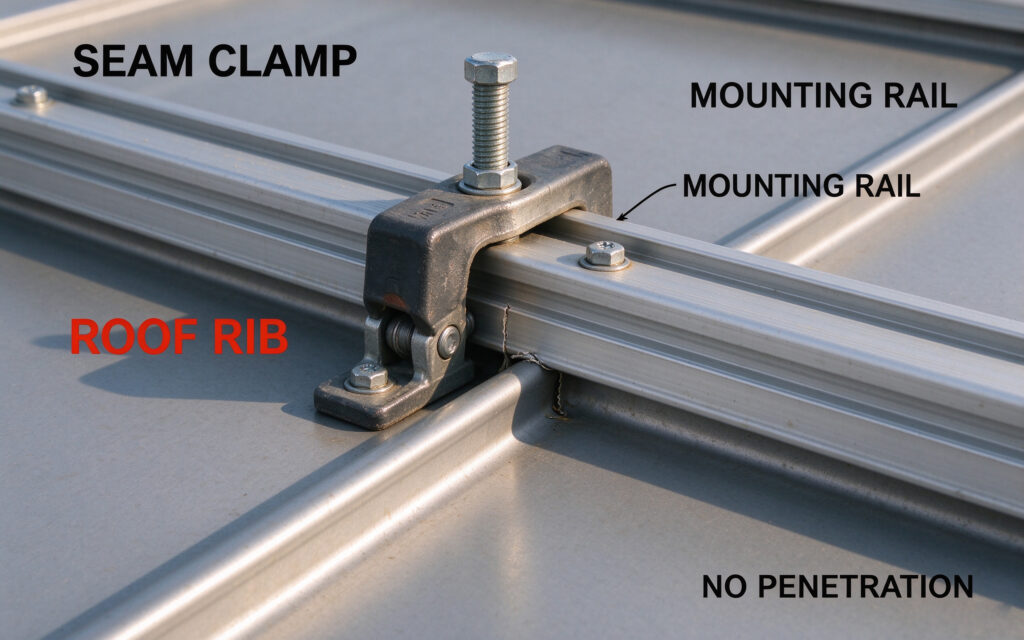
Three profiles cover almost every metal roof, and each has its own attachment answer. A standing seam roof has raised seams running up the slope, and the seam itself is the structural grip: a clamp set bolts around the seam and never touches the flat of the sheet. It is the cleanest case, the most expensive hardware, and the one where the roof warranty usually survives intact.
| Profile | How the clamp grips | Penetrations | What to confirm |
|---|---|---|---|
| Standing seam | Seam clamp around the raised rib | None | Seam height and shape; clamp compatibility with the seam profile |
| Corrugated / trapezoidal | Clamp or bracket over the rib, or fixed to the rib crest | Sometimes, at rib crests | Rib spacing versus rail spacing; sheet thickness at the fixing |
| Screw-down (through-fastened) | Bracket fixed through the sheet into the purlin | Yes, one per bracket | Sealing method and fastener replacement; purlin location |
The trap is assuming the profile from a photograph. Corrugated sheets come in several pitches, standing seams come in several heights and locking styles, and some “metal” roofs are stone-coated steel tiles that behave more like shingles than like a seam. Confirm the profile on site before ordering hardware, because a clamp that nearly fits is the most common cause of a return visit.
Waterproofing and the penetration question
For solar panels on metal roof jobs, waterproofing is the question that decides whether the roof warranty survives. Every fixing through the sheet is a hole in the weather barrier itself.
Where the profile forces a penetration — screw-down sheets are the usual case — the detail matters more than the hardware. The fixings have to land in the structural purlin rather than in the sheet alone, they have to be sealed with a system compatible with the roof coating, and the original fastener should be replaced rather than simply added alongside. Oversized holes, mismatched metals and sealants that cure hard on a moving roof are the three failure modes that show up later.
Galvanic corrosion deserves a specific check. Aluminium rails on a steel roof, or steel fasteners in an aluminium sheet, set up a corrosion couple in the presence of water, and the remedy is isolation — a gasket, a compatible alloy, or a barrier between the metals. Roof manufacturers publish compatible material lists for exactly this reason. And on any profile, the panel and rail layout should keep water moving: nothing should dam a channel or trap debris against a seam. The solar panel maintenance guide covers what to look at during inspection.
Load, thermal movement and wind uplift
Solar panels on metal roof arrays are usually well within the roof’s capacity on weight, but wind uplift is the case that governs the design rather than the downward load.
Metal roofs are usually strong enough — a steel sheet over purlins carries distributed load well — but the load path still has to be checked, and wind uplift is the governing case rather than downward weight. An array acts as a sail, and the uplift on the roof edge and corners is higher than in the middle of the field. Clamps are spaced to suit that: closer at the perimeter, wider in the interior, and always to a spacing the clamp manufacturer has tested rather than one that looks reasonable.
Thermal movement is the other check. A long rail run fixed to a seam-clamped roof should be allowed to slide rather than being rigidly locked at every point, because the sheet underneath is moving under it every day. Rails that fight the movement telegraph stress into the clamps. On roofs in climates with a wide temperature swing, that detail decides whether the array is still tight in year ten. The solar panel lifespan guide guide is the right companion read for thinking about which component ages first.
Grounding and electrical details on metal roofs
A metal roof is conductive, which makes grounding simpler in principle and easier to get wrong in practice. The frame and rail system has to be bonded, and the array has to bond to the building’s grounding electrode system through a path that will survive — a path that depends on a clamp staying tight for two decades is not a grounding path. Bonding hardware designed for the job, with the metal surfaces prepared rather than painted over, is the standard answer.
Two more details decide whether the electrical side behaves. Cable management keeps the DC runs off the hot sheet and out of the water channels, because a cable lying in a seam channel will chafe and eventually fail. And the roof’s own lightning exposure matters: a large metal roof with an array on top is a prominent strike target in some regions, so the surge protection and bonding question belongs in the design rather than in the commissioning conversation. The solar panels in series or parallel guide covers the string side of the layout, and the solar panel tilt angle guide the geometry that follows from a roof-mounted, profile-limited tilt.
Buying notes for a metal roof mount
Solar panels on metal roof projects fail on one detail more than any other: hardware ordered before the profile was measured. Start with the sheet, not the catalogue.
Three questions decide the hardware order, and the first is the profile — measure the seam or the rib pitch before speaking to a supplier, because the clamp has to match the sheet, not the other way round. The second is the roof warranty: some manufacturers void cover if any penetration is made, which rules out screw-down brackets regardless of how well they are sealed. The third is who signs off the structural and wind case, because an array on a roof is a change to the building, not an accessory.
On the commercial side the procurement logic shifts: the same roof at factory scale is a different job, and the solar panels for commercial buildings guide covers that frame. Where the site has the ground available instead, the ground mounted solar panels route avoids the roof question entirely. And for the array on a flat section of the same building, the solar panels on a flat roof guide handles that case, since ballasted mounting has its own rules.
Q. solar panels on metal roof?
Yes. Solar panels on metal roof installations are among the most durable combinations available, because the roof usually outlasts the array and modern seam clamps attach without penetrating the weather barrier.
Q. Do you have to drill holes in a metal roof to fit solar panels?
Not on a standing seam roof, where clamps grip the raised rib. On corrugated and screw-down profiles some fixings usually do go through the sheet, and those have to land in the purlin and be sealed with a compatible system.
Q. What is the best clamp for a standing seam roof?
The one tested for your seam profile and height. Seam clamps are not universal — they are matched to the seam shape — so confirm the profile on site and buy the clamp specified for it rather than the closest match.
Q. Will a solar array damage a metal roof or void the warranty?
A correctly clamped seam-mounted array should not damage the roof or void the warranty. Penetrating fixings are the risk: some manufacturers void cover if the sheet is drilled, so check the roof warranty before choosing hardware.
Q. How is wind uplift handled on a metal roof array?
By clamp spacing tested by the manufacturer, tighter at the roof edges and corners where uplift is highest. The array behaves as a sail, so the governing load case is uplift rather than the weight of the panels.
Q. Do metal roofs need special grounding for solar?
The array frame and rails must be bonded and connected to the building’s grounding electrode system through a durable path. Because the roof itself is conductive, bonding hardware should be purpose-made and fitted to prepared metal surfaces.
Q. Can a metal roof carry the weight of solar panels?
In most cases yes — a steel sheet over purlins carries distributed load well — but the load path still needs checking, and the wind uplift case usually governs rather than the panel weight.
Next step: confirm the profile before ordering hardware
Metal roof jobs go wrong on clamp-to-profile mismatch. Send the roof profile, seam or rib pitch and the array size.
- Check the general hardware types in the solar panel mounting brackets guide
- See the low-slope case in the solar panels on a flat roof guide
- For chisidal, send your usage and site details, and we will come back with product prices, lead time and warranty information.