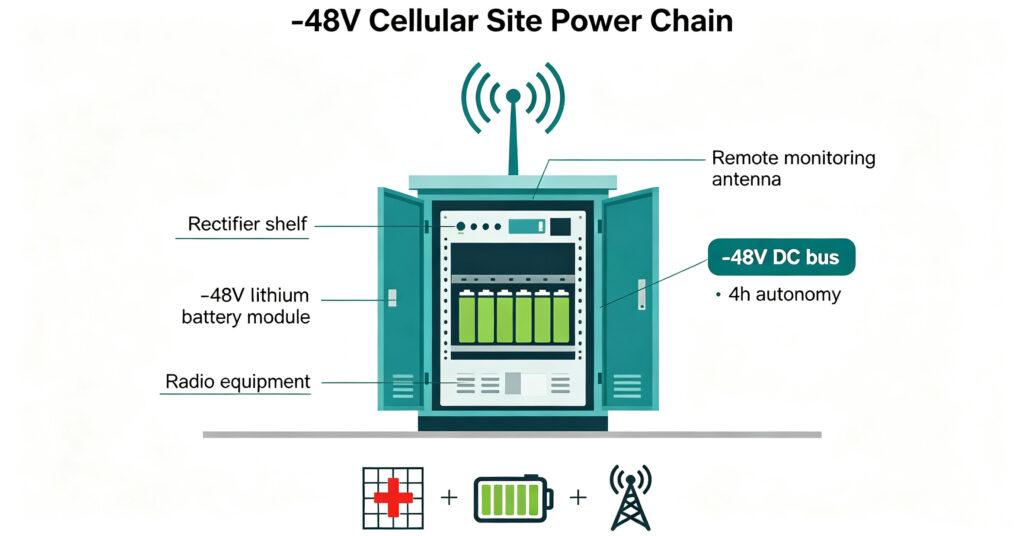
Cellular battery backup is the reserve energy at a mobile network site that keeps radios, baseband units and transport equipment running when mains power fails. Almost every cellular site runs on a -48V DC bus: the rectifier converts mains AC to -48V DC, feeds the load, and floats the battery; when mains drops, the battery carries the load with no switching and no interruption. Sizing a cellular battery backup comes down to one arithmetic step — the site’s DC load in amps multiplied by the required autonomy in hours, divided by the usable depth of discharge — and two judgement calls: how many hours the network operator’s availability target actually requires, and which chemistry survives the site’s temperature profile for the service life being paid for.
Why cellular sites run on -48V DC
The -48V standard comes from the telephone network, which adopted it for two reasons that still apply. A negative polarity at that voltage reduces electrochemical corrosion on buried copper plant, and a voltage around 48V stays within safety extra-low voltage limits while still being high enough to carry useful power over the cable runs inside a site.
The practical consequence for a battery buyer is that a cellular battery backup is not a 48V inverter system. There is no inverter in the standby chain: the load is natively DC, the battery is DC, and the rectifier sits between the mains and the bus. This makes the specification simpler than an AC backup system and removes an entire conversion stage from the efficiency calculation, but it also means the battery module must sit inside the rectifier’s voltage window and behave the way the rectifier controller expects.
The rectifier is the part that decides what “behaves correctly” means. It manages float voltage, boost charging after a discharge, low-voltage disconnect, and often a temperature-compensated charge profile. A battery that cannot tolerate the rectifier’s default profile — or that reports its state of charge in a protocol the controller does not read — will work electrically and still fail the site acceptance test.
Site types and what each one demands
A network is not one thing. Four site categories account for most deployments, and their backup requirements differ by an order of magnitude.
| Site type | Typical DC load | Typical autonomy | Backup requirement driver |
|---|---|---|---|
| Macro tower (ground-based) | 30–120 A at -48V | 3–8 hours | Availability SLA and grid quality at the location |
| Rooftop / urban macro | 40–150 A at -48V | 2–4 hours | Space and weight limits; often generator-backed |
| Small cell / street pole | 5–20 A at -48V | 1–4 hours | Enclosure size; often no generator, no site visit budget |
| Rural / off-grid relay | 10–40 A at -48V | 8–24 hours or solar-hybrid | Long grid outages; solar plus battery instead of genset |
Two patterns matter for procurement. Urban sites tend to have better grid and shorter autonomy requirements, which means a smaller battery that cycles rarely. Rural sites have worse grid, longer outages and no generator in many cases, which pushes the design toward either a much larger battery bank or a solar-hybrid configuration. The off-grid configuration logic is set out in #131 off-grid battery backup, and the solar-hybrid architecture is covered in #99 hybrid vs off-grid vs grid-tied inverter.
The runtime calculation
The sizing arithmetic has three steps, and the third is where most specifications go wrong.
- Step 1 — Establish the DC load. Take the measured site load at the rectifier output, in amps at -48V. Use the measured value, not the equipment nameplate sum; radio equipment rarely draws its rated maximum continuously.
- Step 2 — Multiply by autonomy. Required amp-hours = load (A) × autonomy (h). A site drawing 40 A with a 4-hour requirement needs 160 Ah of deliverable capacity.
- Step 3 — Divide by usable depth of discharge and derate for age and temperature. A 160 Ah requirement at 80% usable DoD needs 200 Ah of nameplate capacity before any derating; adding margin for end-of-life capacity fade and low-temperature performance typically moves the specification to the next available module size up.
The third step is where VRLA and lithium diverge most sharply. A lead-acid bank sized at 50% DoD for the same 4-hour requirement needs twice the nameplate capacity of an LFP bank sized at 80–90% DoD, which is why lithium often wins on total installed cost at a site even before the cycle-life difference is counted. The chemistry comparison is laid out in #33 LiFePO4 vs lithium-ion NMC, and the deeper capacity-versus-price arithmetic is in #46 cycle life vs price.
Chemistry and enclosure: what the site decides
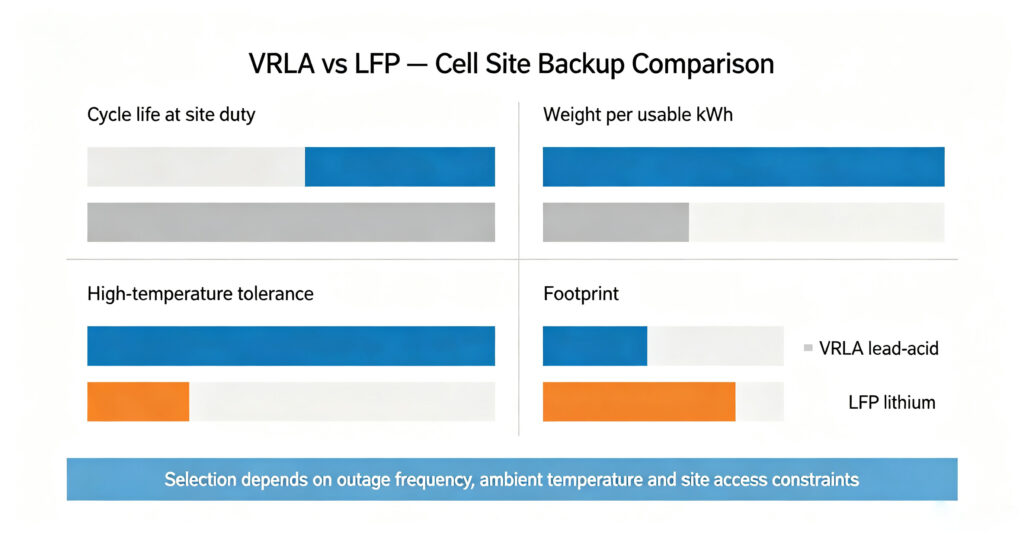
Valve-regulated lead-acid has been the default for decades and is still what most legacy sites have installed. It is cheap up front, tolerant of rough charging, and well understood by field crews. Its weaknesses at a cell site are the ones that matter most: short cycle life when the grid is unreliable, poor high-temperature life, and a large footprint and weight that complicates rooftop and pole installations.
LFP lithium changes the economics at sites with frequent outages or high ambient temperatures. The battery cycles deeply without the rapid capacity loss lead-acid suffers, tolerates a higher ambient temperature before derating, and is roughly a third of the weight for the same deliverable capacity — which matters when the installation is a rooftop with a lift access constraint. The trade-off is a higher upfront cost per Ah and a requirement for a BMS that the site controller can read.
Enclosure rating is the third decision and the easiest to get wrong. An outdoor cabinet needs an ingress rating appropriate to the location, ventilation or thermal management sized for the local summer peak, and — for lithium — a BMS with temperature-based charge inhibit. A battery that is correctly sized and wrongly enclosed will fail early, and the failure will look like a battery problem rather than an enclosure problem.
Monitoring: the part that pays for itself
A distributed network of hundreds or thousands of sites cannot be maintained by site visits. Remote monitoring turns battery management from a truck roll into a queue: state of charge, state of health, cell voltage spread, internal temperature and discharge events all become data that a network operations centre can triage. The monitoring architecture and protocol choices are covered in #83 battery monitoring system manufacturers, and the practical alerting setup is in #120 remote battery monitoring.
The maintenance tasks that remain on site are unchanged: visual inspection, terminal torque, ventilation check, and capacity verification. The inspection cadence and record-keeping that make a fleet maintainable are set out in #84 solar battery maintenance.
Buying for a fleet replacement programme
A battery swap across hundreds of sites is a logistics project as much as a product decision. Six checks separate a programme that lands cleanly from one that stalls at pilot.
- Rectifier compatibility: confirmed charge profile, low-voltage disconnect behaviour and protocol support with the actual rectifier models in the network, with test reports.
- Mechanical fit: the replacement module must fit the existing cabinet or rack, including cable bend radius and terminal orientation.
- Thermal envelope: stated operating and charging temperature range, with the charge-inhibit thresholds documented for the field crew.
- Transport and compliance: UN38.3 for shipping, plus the regional safety marks the operator’s insurance and regulators require. The certification landscape is summarised in #107 battery export certification.
- Firmware consistency: every unit shipped at the same firmware version, with an over-the-air update path documented.
- Spare and RMA logistics: field-replaceable BMS, defined RMA turnaround, and spare modules held in region.
Q. How long should a cellular battery backup last?
Autonomy requirements are set by the network operator’s availability target and by local grid quality. Typical values are 3–8 hours for a macro tower, 2–4 hours for an urban rooftop site where a generator or rapid repair is available, and 8 hours or more for rural sites with long outages. The requirement is a network planning parameter, not a battery parameter.
Q. Why is telecom backup -48V and not 48V positive?
The negative polarity is a telephone-network convention adopted to reduce electrolytic corrosion on outside plant. Functionally, -48V and +48V deliver identical power; the convention matters because rectifiers, batteries and radio equipment are all specified and labelled for the negative standard, so mixing polarity conventions in one site creates wiring and protection errors.
Q. Can I replace a VRLA bank with lithium at an existing site?
Usually yes, but not as a drop-in without checks. The rectifier’s charge profile must be set for lithium, the low-voltage disconnect thresholds must be reviewed, the BMS must be readable by the site controller, and the mechanical fit and ventilation must suit the new module. Sites that skip the rectifier profile step typically see premature shutdowns rather than battery damage.
Q. How many cycles does a cell site battery actually use?
It depends entirely on grid quality. A site on a stable urban grid may see a handful of deep discharges per year and will reach end of life on calendar ageing rather than cycles. A site with daily outages can accumulate hundreds of equivalent full cycles per year, which is where lithium’s cycle-life advantage over lead-acid dominates the total cost calculation.
Q. Do small cells need the same backup as macro sites?
No. Small cells draw far less current and are often deployed where a generator is impossible and a site visit is expensive, so the design tends toward a compact lithium module with longer autonomy per amp and remote monitoring rather than a large bank with frequent physical maintenance.
Next step: size the site before you size the battery
Two numbers decide the specification: the measured DC load at the rectifier and the autonomy your availability target requires. Everything else — chemistry, enclosure, monitoring — follows from those two plus the site’s temperature and access profile.
- Compare chemistries in #33 LiFePO4 vs lithium-ion NMC
- Plan the monitoring layer in #83 battery monitoring system manufacturers
- Review the data-centre and IT-room variant in #90 battery storage for data centers
- Ask leekooenergy for a site-class backup specification that states the measured DC load and required autonomy, the recommended nameplate capacity with the derating assumptions shown, the rectifier compatibility list with test reports, the enclosure rating and thermal envelope, and the spare and RMA plan for a multi-site rollout — so the fleet order is placed against measured site data rather than a generic catalogue rating