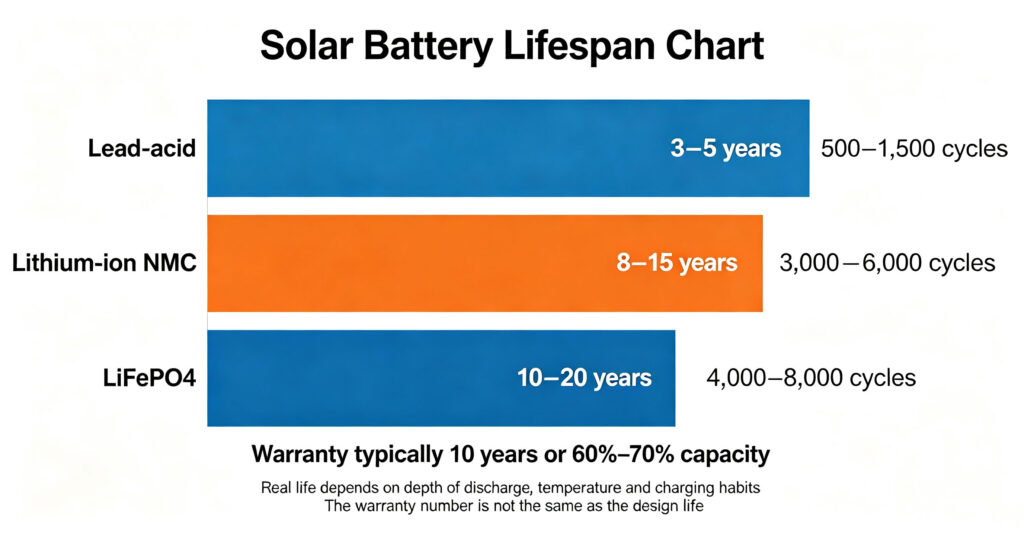
How long do solar panel batteries last? In realistic terms: lead-acid lasts 3–5 years, NMC lithium lasts 8–15 years, and LiFePO4 lasts 10–20 years with 4,000–8,000 cycles before reaching 80% capacity. The chemistry sets the range, but the actual life you get depends on depth of discharge, operating temperature and charging habits — a battery cycled deep in high heat can fail years early, while the same chemistry maintained within its comfort range can outlast its warranty. The warranty number (typically 10 years) is not the design life; it is the contractual guarantee at a defined capacity threshold.
For a homeowner, the question how long do solar panel batteries last is a budget question as much as a technical one: replacement cost enters the financial model at the year the battery fades. This guide gives the realistic ranges and the factors owners actually control. For the cycle life vs price trade-off, see #46 cycle life vs price: 6,000 / 8,000 / 10,000 cycles.
How long do solar panel batteries last: the chemistry sets the range
The first answer to how long do solar panel batteries last is chemistry. The table below gives typical, realistic ranges — not the best-case brochure number.
| Chemistry | Typical lifespan | Cycle life (to 80%) | Typical warranty |
|---|---|---|---|
| Lead-acid | 3–5 years | 500–1,500 | 1–3 years |
| NMC lithium | 8–15 years | 3,000–6,000 | 10 years |
| LiFePO4 | 10–20 years | 4,000–8,000 | 10–15 years |
LiFePO4 dominates new solar installations because its longer life and depth-of-discharge tolerance lower the total cost of ownership. For the general lithium-ion lifespan discussion, see #69 how long does a lithium-ion battery last.
The factors that actually shorten solar battery life
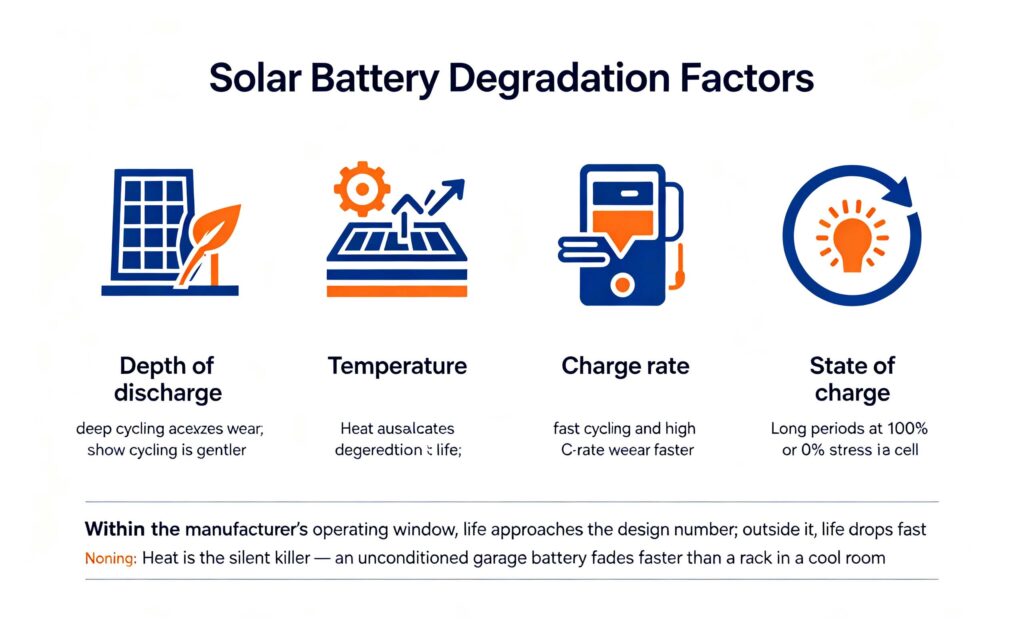
The answer to how long do solar panel batteries last depends on the gap between design life and real life is caused by a small set of controllable factors. Owners who understand them can protect their investment.
Depth of discharge (DoD): cycling a battery to near-empty wears it faster than keeping it between 20% and 80%. LiFePO4 tolerates deeper discharge than lead-acid, but shallow cycling still extends life.
Temperature: heat accelerates every degradation mechanism. A battery in a hot attic or unconditioned garage fades years before a battery in a ventilated, cool room.
Charge and discharge rate: repeated high-current cycling wears faster than gentle use. Sizing the system so it rarely operates at maximum current protects the cells.
State of charge extremes: long storage at 100% or 0% stresses the cell. A battery that sits fully charged for months degrades faster than one cycled normally.
For the daily care practices that protect life, see #84 solar battery maintenance.
What the warranty actually tells you
The warranty number is useful, but it is not the same as the design life. Reading it correctly prevents false expectations.
Warranty term: typically 10 years for residential lithium systems. This is the contractual coverage period, not the expected end of life.
Capacity threshold: most warranties guarantee a remaining capacity (often 60%–70%) at year 10. Below that threshold, the manufacturer replaces or prorates. Above it, the battery continues to work.
Design life: the battery can outlast the warranty at reduced capacity. “Lasting 15 years” means it still functions, not that it delivers rated capacity at year 15.
For how degradation connects to total cost, see #46 cycle life vs price: 6,000 / 8,000 / 10,000 cycles.
What owners can do to extend solar battery life
The good news: the factors that shorten life are mostly controllable. Small operating habits protect a 10–20 year investment.
- Size for shallow cycling: a larger battery that rarely cycles deep outlasts a smaller one cycled hard.
- Keep it cool: install in a ventilated, temperature-stable space; avoid attics and unconditioned garages.
- Avoid prolonged extremes: do not leave the battery at 100% or near-empty for extended periods.
- Follow charging guidance: use the recommended charge current and avoid repeated fast cycling.
- Monitor annually: track capacity trends; a sudden drop signals a BMS or cell issue before it becomes a failure.
For the monitoring practices that catch degradation early, see #120 remote battery monitoring.
Q. How long does a LiFePO4 solar battery last in real use?
A LiFePO4 solar battery typically lasts 10–20 years and 4,000–8,000 cycles before reaching 80% capacity in real use, assuming moderate temperature, reasonable depth of discharge and proper charging. The chemistry sets the range; heat, deep cycling and poor maintenance can shorten it to 7–10 years, while a well-maintained system can approach 15–20 years.
Q. When does a solar battery need replacement?
A solar battery needs replacement when its usable capacity drops below what the system can deliver — commonly when it reaches 60%–70% of rated capacity, which is also the typical warranty threshold. Before that, a steady decline is normal aging; a sudden drop in capacity or voltage usually signals a cell or BMS issue that should be diagnosed, not assumed to be end of life.
Q. Does temperature affect solar battery life?
Yes, significantly. Heat accelerates every degradation mechanism in lithium cells, and a battery installed in a hot attic or unconditioned garage can fade years earlier than the same chemistry in a ventilated, cool room. Cold operation reduces available capacity but is less damaging than heat. Keeping the battery in a temperature-stable space is one of the most effective ways to extend its life.
Q. What does a 10-year battery warranty actually cover?
A 10-year battery warranty typically covers a defined remaining capacity (often 60%–70%) at year 10, not a guarantee that the battery stops working at year 10. If capacity drops below the threshold within the term, the manufacturer replaces or prorates. Above the threshold, the battery continues to operate, possibly at reduced capacity, beyond the warranty period. Always check the specific capacity threshold and exclusions in the warranty document.
Q. How can I make my solar battery last longer?
Size the battery for shallow cycling rather than deep daily use, install it in a cool ventilated space, avoid prolonged storage at 100% or near-empty, follow the recommended charging current, and monitor capacity annually for early warning signs. These habits protect the chemistry’s design life; the battery that is maintained within its operating window can approach the upper end of its lifespan range.
Next step: size and maintain for the long life
How long solar panel batteries last is a controllable outcome: choose LiFePO4 for the longer chemistry range, size for shallow cycling, keep it cool, and monitor annually. The system that is sized and maintained for 15 years delivers a better total cost than the system that is replaced at year 8.
- Balance cycle life vs price in #46
- Follow maintenance in #84
- Set up monitoring in #120
- Ask leekooenergy for a battery system sized for shallow cycling and long life, with the warranty terms and expected capacity retention documented before purchase