The short answer is that how long does a lithium ion battery last depends on two clocks running at the same time: cycle aging, which counts every charge-discharge cycle and is typically rated between a few hundred and several thousand cycles depending on chemistry, and calendar aging, which counts every year the battery exists and continues even when it sits unused. For most well-managed storage batteries, that adds up to a service life measured in years rather than months — commonly around a decade for LFP storage packs under normal use. The one-line version worth quoting: a lithium ion battery ends its useful life when its capacity fades to about 80% of the original rating, and the practical answer to how long that takes is the shorter of two numbers — the cycles you actually use and the years that pass while heat, high state of charge and time quietly degrade the chemistry.
The question sounds simple, but it hides a trap: a sales sheet that says “6,000 cycles” tells you almost nothing unless you also know how many years the battery will be alive while those cycles are used. A solar battery that cycles daily reaches 6,000 cycles in more than sixteen years, yet few batteries are designed to last that long in wall-clock time. This guide separates the two clocks, gives realistic life ranges for each chemistry, lists the habits that shorten life, and finishes with a checklist you can apply to any battery you already own. If your question is really about when a solar battery should be replaced, that decision process is in #51 when to replace a solar battery, and the commercial trade-off between cycle count and price is in #46 cycle life vs price.
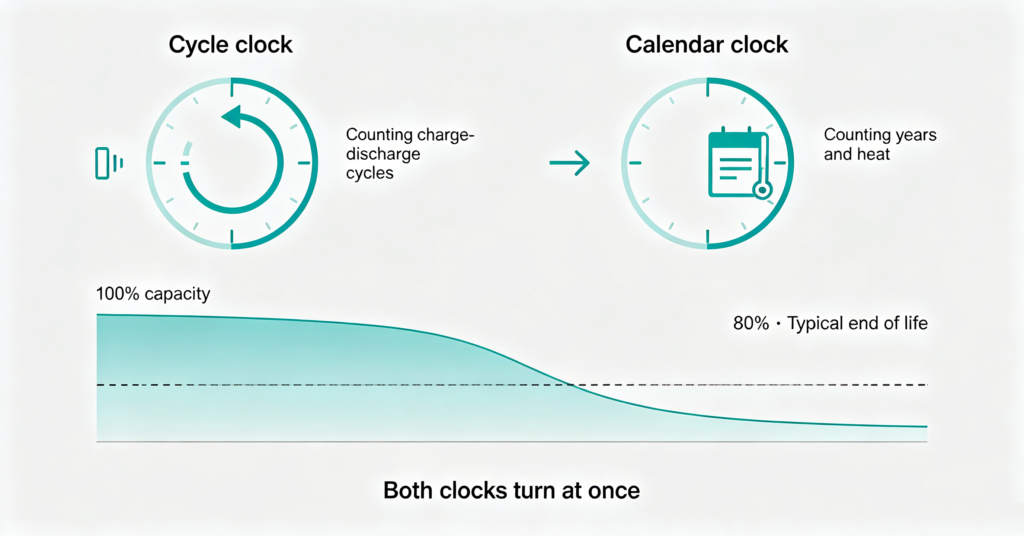
Two clocks: cycle life and calendar aging
Cycle life is the number of full charge-discharge cycles a cell can deliver before its capacity fades below the warranty threshold. One cycle means discharging the rated energy once — two half cycles also count as roughly one full equivalent cycle, which is why the definition matters when you compare warranties. Calendar aging is the degradation that happens with no cycling at all: the chemistry slowly loses active lithium and builds internal resistance over time, faster when the battery is hot or stored at high state of charge. Both clocks damage the same thing — capacity — which is why an idle battery in a hot warehouse ages, and why a cycled battery kept cool and gently used lives far longer than its cycle rating alone suggests. The practical question of how long does a lithium ion battery last is therefore always answered by both clocks together, never by the cycle number on its own. The electrochemistry behind this fading, including the reactions that consume lithium on the electrodes, is described in #63 what is inside a lithium ion battery.
How long different lithium ion chemistries last
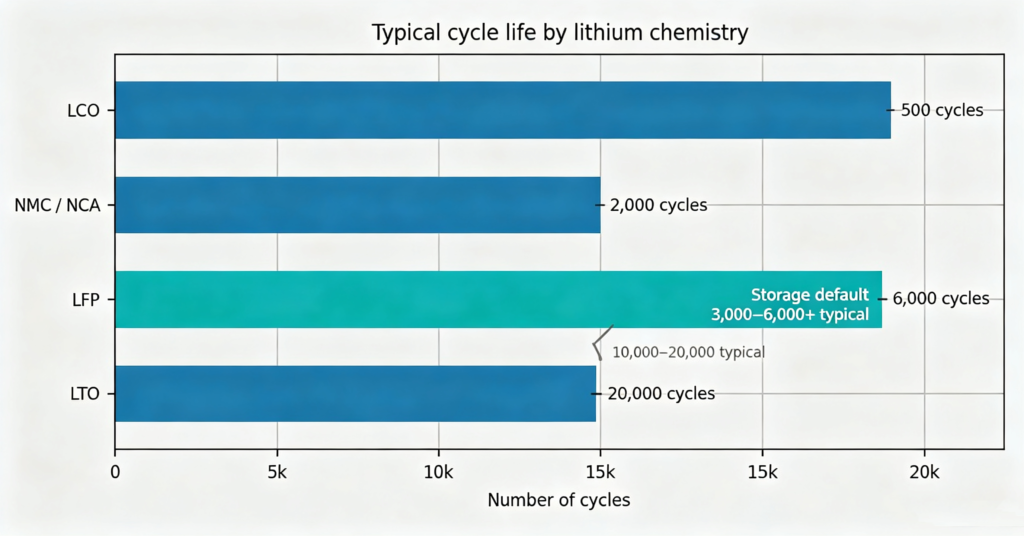
The type of lithium ion battery sets the ceiling for both clocks. Asking how long does a lithium ion battery last in years rather than cycles is really asking which chemistry family the cells belong to. The table gives the industry-typical ranges a buyer should expect from a healthy, well-managed cell.
| Chemistry | Typical cycle life | Typical calendar life | Main ageing weakness |
|---|---|---|---|
| LCO | 300–500 cycles | 2–3 years | Heat and overvoltage sensitivity |
| NMC / NCA | 1,000–2,000 cycles | 5–8 years | High state of charge and heat |
| LFP | 3,000–6,000+ cycles | 8–15 years | Flat voltage makes balancing harder |
| LTO | 10,000–20,000 cycles | 10–20 years | High cost, low energy density |
Read the ranges as design expectations, not guarantees: the same LFP cell can die early in a hot attic at constant 100% state of charge, or outlive the warranty in a cool cabinet cycled between 20% and 80%. That is why chemistry alone is a poor predictor of lifespan — management matters as much. For the specific comparison between the two chemistries most relevant to storage, LFP and NMC, the lifecycle trade-off is examined in #33 LFP vs NMC.
What drains life faster than expected
Four habits account for most premature ageing, and all of them are avoidable. Heat is the largest accelerator: every sustained temperature rise speeds the parasitic reactions that consume lithium, which is why battery rooms need cooling and why a battery next to a hot inverter ages faster. High state of charge: a cell stored at 100% sits at maximum electrochemical stress; keeping a storage battery around 80–90% for daily use and nearer 50–60% for long idle periods measurably reduces calendar ageing. Deep full cycles: regularly draining to 0% and charging to 100% stresses the electrodes more than partial cycling, which is why usable-capacity windows exist in the BMS. Fast charging in the cold: charging a cold cell quickly can plate lithium metal on the anode, permanently consuming capacity. Each of these failure paths is what the BMS protection functions are designed to interrupt, as explained in #49 BMS protection: overcharge, over-discharge and thermal.
Signs a lithium ion battery is nearing end of life
Before the battery stops working, it gives four warnings, and for most owners these warnings are where the true answer to how long does a lithium ion battery last shows up first. The first is capacity fade: the run time or usable kilowatt-hours visibly shrinks, which the BMS log will confirm as falling usable capacity. The second is voltage sag under load: a healthy cell holds voltage until near-empty, while an aged cell dips early because internal resistance has risen. The third is longer charge time and higher heat during charging, both symptoms of the same rising resistance. The fourth is balance drift: the BMS reports increasing differences between cell groups, because degraded cells lose capacity unevenly. When usable capacity falls to roughly 80% of the original rating, the industry convention is that the battery has reached end of life — not because it stops working, but because the remaining capacity declines faster from there. The practical decision process for solar batteries at this stage is in #51 when to replace a solar battery.
How to make a lithium ion battery last longer
The same battery can live twice as long under good management, so the checklist is worth more than most buyers realise. Keep the battery cool: install it away from direct sun, hot walls and heat sources, and keep the room ventilated. Respect the state-of-charge window: charge to 100% only when you will use the energy soon, and let the BMS or EMS hold daily operation inside a milder band. Avoid deep discharges: set the cut-off above empty for daily cycles. Store unused batteries partially charged and cool, around 50–60%, and check them periodically. Use a quality BMS with working balancing and protection, and keep firmware updated, because manufacturers tighten charge limits and balancing logic over time. Finally, size the system so it does not strain: a battery cycled gently within its C-rate rating stays cooler and lasts longer than one pushed to its limits every day. For buyers, the same logic belongs in the specification: compare usable-capacity windows and warranty conditions, not just headline cycles, and the comparison method in #46 cycle life vs price shows how to price that honesty. Keep these habits and the honest answer to how long does a lithium ion battery last moves toward the top of the range; ignore them and it slides toward the bottom.
Q.How many years does a lithium ion battery last?
Most well-managed lithium ion batteries last 5 to 15 years depending on chemistry and use. LCO consumer cells typically last 2–3 years, NMC about 5–8 years, and LFP storage packs commonly around 8–15 years when kept cool and cycled within their design window.
Q.Does fast charging shorten battery life?
Generally yes. Fast charging raises cell temperature and stresses the electrodes, and charging fast in the cold can plate lithium metal on the anode. Occasional fast charging has a small effect; daily fast charging to 100% noticeably shortens both cycle and calendar life.
Q.Is it bad to leave a lithium battery at 100%?
For long-term storage, yes. A cell held at 100% ages faster through calendar aging because the electrodes sit at maximum electrochemical stress. For daily use it is fine to charge to 100% shortly before the energy is needed, but storing a battery at 100% for months measurably shortens its life.
Q.How do I know my lithium battery is degrading?
Watch for shrinking run time or usable capacity in the BMS log, voltage sagging early under load, longer charge times, more heat during charging and growing imbalance between cell groups. A drop to about 80% of rated capacity is the industry end-of-life marker.
Q.Do LFP batteries last longer than NMC?
In cycle life, yes — LFP is typically rated for several times more cycles than NMC — and in calendar life the difference is smaller but still in LFP’s favour under similar conditions. That is why stationary storage, which cycles daily, has largely standardised on LFP.
Next step: buy on life, not on cycles
The honest lifespan number combines the cycle rating with the calendar clock and your actual usage pattern. Ask for both before you compare quotes.
- See how cycle count changes the buying decision in #46 cycle life vs price
- Know when replacement is the right call in #51 when to replace a solar battery
- Compare LFP and NMC ageing directly in #33 LFP vs NMC
- Ask leekooenergy for cycle data at your depth of discharge plus the calendar-life assumptions behind the warranty — so the years and the cycles in the quotation both add up