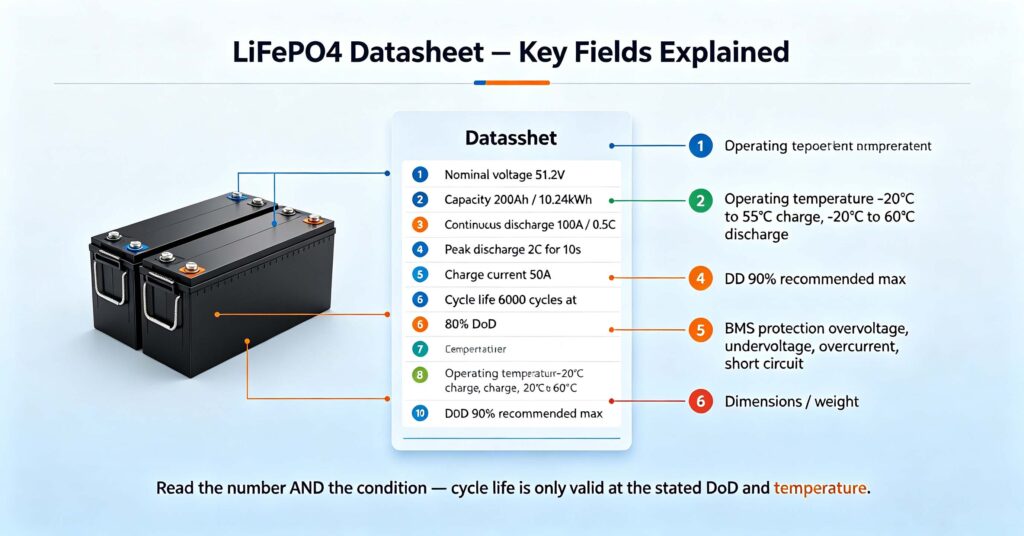
How to read LiFePO4 battery specs comes down to ten numbers: nominal voltage, capacity (Ah and kWh), continuous and peak discharge current, charge current, cycle life, depth of discharge (DoD), operating temperature, BMS protection, and physical dimensions/weight. Every one of these only means something under the stated condition — cycle life is quoted at a specific DoD and temperature, capacity at a specific discharge rate, and current ratings at a specific ambient temperature. The most common buying mistake is reading a headline number and missing the condition attached to it, so a “6000-cycle” battery can legitimately wear out far sooner if the datasheet’s DoD or temperature assumptions do not match the installation. This guide walks through each spec in plain terms, explains what the number means, what condition it is valid under, and what to verify with the supplier before purchase.
Buyers evaluating LiFePO4 batteries are usually comparing datasheets side by side, and the differences that matter are rarely in the headline. This guide explains how to read LiFePO4 battery specs so you can compare like for like and avoid the mismatches that show up after installation. For the chemistry fundamentals, see #1 lithium iron phosphate batteries guide.
How to read LiFePO4 battery specs: the 10 numbers that matter
How to read LiFePO4 battery specs starts with the datasheet: it packs a lot of information, but ten numbers carry almost all the decision weight. The table below lists them, what they mean, and the condition under which each is valid.
| Spec | Example (51.2V 200Ah) | What it means | Valid under |
|---|---|---|---|
| Nominal voltage | 51.2V | Rated voltage of the pack (16S LiFePO4 = 16 × 3.2V) | Defined by cell chemistry and series count |
| Capacity | 200Ah / 10.24kWh | Usable energy at nominal voltage | 0.5C discharge, 25°C, fresh cell |
| Continuous discharge | 100A (0.5C) | Maximum current the pack can sustain | Ambient temperature range stated on sheet |
| Peak discharge | 200A (1C, 10s) | Short surge capability (startup loads) | Time-limited, usually 5-15s |
| Charge current | 50A (0.25C) | Recommended charging rate | Temperature window for charging |
| Cycle life | 6,000 @ 80% DoD | Cycles to 80% remaining capacity | Stated DoD, temperature, and rate |
| Depth of discharge | 90% max recommended | How much capacity you can safely use per cycle | Design limit + BMS settings |
| Operating temperature | -20 to 55°C charge | Safe ambient range | Charge vs discharge ranges differ |
| BMS protection | OV/UV/OC/SC | What the battery protects against | BMS thresholds and settings |
| Dimensions / weight | 520×700×200mm / 48kg | Physical fit and mounting requirements | Measured, verify against site |
Voltage specs: nominal vs full charge vs cut-off
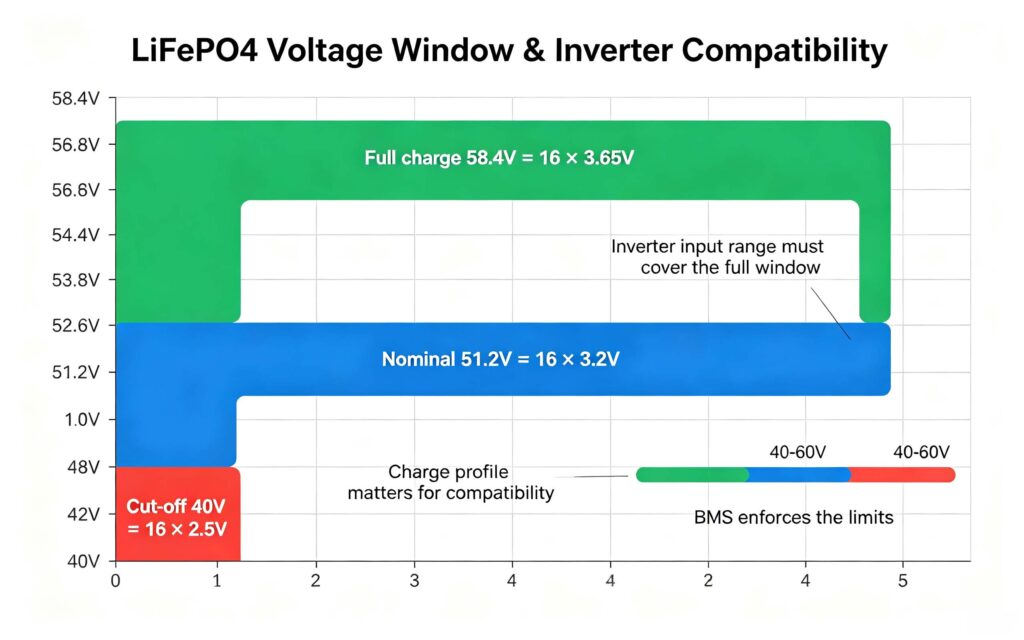
How to read LiFePO4 battery specs correctly starts with the voltage fields, which appear in several places on a datasheet, and buyers often confuse them. The three that matter are nominal voltage, full charge voltage, and cut-off voltage.
Nominal voltage is the rated voltage of the pack, derived from cell chemistry and series count. A 16-cell LiFePO4 pack has a nominal of 51.2V (16 × 3.2V); a 4-cell pack is 12.8V. This is the number used to name the battery and to calculate kWh.
Full charge voltage is the voltage when fully charged — for LiFePO4, 3.65V per cell, so 58.4V for a 16S pack. Cut-off voltage is the lowest safe voltage — typically 2.5V per cell (40V for 16S). Between these, the battery operates. The inverter must be configured within this window, and the BMS enforces the limits. On paper, two batteries with the same nominal voltage can have different charge profiles, which matters for inverter compatibility. For the system-level voltage decision, see #35 48V lithium batteries explained.
Capacity and the conditions attached to it
Capacity is the second core of how to read LiFePO4 battery specs, quoted in amp-hours (Ah) and, for a pack, in kilowatt-hours (kWh = Ah × nominal voltage ÷ 1000). A 200Ah 51.2V battery is 10.24kWh nominal. But the number is only true under the datasheet’s test conditions.
Capacity is typically measured at a 0.5C (or 1C) discharge rate at 25°C on a fresh cell — another reason how to read LiFePO4 battery specs means checking the test rate. Discharge at a higher rate yields less usable capacity (Peukert-style losses, smaller for LiFePO4 than lead-acid), and low temperature reduces capacity significantly — below 0°C, available capacity can drop 20-30% depending on rate. A datasheet that quotes capacity without a condition should be treated with caution; ask the supplier for the test rate and temperature. In practice, this matters most for cold-climate and high-rate applications, and it is where problems often start when a system underperforms in winter.
Usable capacity is different from nominal capacity. It equals nominal capacity × the depth of discharge you actually use, minus any BMS reserve. If a datasheet says 90% DoD is allowed, the usable energy of a 10.24kWh pack is about 9.2kWh — and this is the number that should drive sizing, not the headline kWh. For sizing guidance in a home context, see #09 how to size a home battery.
C-rate, discharge current and what “1C” really means
C-rate is the discharge or charge current expressed relative to capacity. 1C means the current that discharges the full capacity in one hour; for a 200Ah battery, 1C = 200A, 0.5C = 100A, 0.2C = 40A. The C-rate system lets you compare batteries of different capacities on the same scale.
The two current numbers that matter are the continuous discharge current (what the battery can sustain indefinitely within temperature limits) and the peak discharge current (short surges for motor starts or inverter surges, usually specified with a duration like “1C for 10 seconds”). A common mistake is to size the inverter to the peak discharge and expect the battery to deliver it continuously. The specification alone does not tell the whole story — confirm the duty cycle with the supplier, especially for loads that surge repeatedly.
Charge current is usually lower than discharge current for LiFePO4 (often 0.25-0.5C). Charging at the maximum allowed rate in cold temperatures is a common cause of premature aging; the BMS and charger must coordinate. These are the kinds of details that matter more once the system is installed.
Cycle life: the number buyers misread most
Cycle life is the number of charge-discharge cycles until the battery reaches a stated remaining capacity (usually 80% of initial capacity, sometimes 60%), and it is the part of how to read LiFePO4 battery specs that buyers misread most. The most important thing to understand is that the number is only valid under the exact conditions stated: depth of discharge, temperature, and charge/discharge rate.
As a rule of thumb for LiFePO4: cycling at 80% DoD yields roughly 6,000 cycles, at 50% DoD roughly 8,000-10,000, and at 100% DoD fewer. Temperature also matters — sustained high temperature accelerates aging. When comparing two batteries, compare cycle life at the same DoD, not just the headline number. A “10,000-cycle” battery cycled at 40% DoD is not automatically better than a “6,000-cycle” battery rated at 80% DoD for a deep-cycling application. For the deeper treatment of cycle life ratings, see #69 how long does a lithium ion battery last.
Temperature, BMS and the specs that protect the pack
When you learn how to read LiFePO4 battery specs, note that operating temperature is quoted separately for charge and discharge — LiFePO4 can discharge over a wider range (often -20°C to 60°C) than it can charge (often 0°C to 55°C, or -20°C with reduced rates). Charging below the stated limit damages the pack, so the BMS should block charging in cold conditions.
BMS protection is the battery’s safety layer: overvoltage, undervoltage, overcurrent, short circuit, and often temperature cut-offs. The datasheet lists the protections, but the thresholds and whether they are adjustable matter. For an off-grid or critical system, also check whether the BMS supports communication (CAN/RS485) with your inverter — a battery that is electrically compatible but cannot talk to the inverter may be limited to default settings. This integration constraint is where many projects stall. For the protection layer in detail, see #49 BMS protection: overcharge, overdischarge and thermal.
Final checklist before you buy
Use this checklist to compare LiFePO4 battery specs on equal footing.
- Confirm the test conditions: capacity at which C-rate and temperature? Cycle life at which DoD?
- Check the voltage window matches your inverter: nominal, full charge and cut-off all within the inverter input range.
- Size from usable kWh, not nominal: use nominal × allowed DoD.
- Verify continuous vs peak discharge: does the peak rating match your load surge pattern?
- Confirm charge current and cold charging: does the BMS block charging below the minimum temperature?
- Check BMS communication: CAN/RS485 and brand protocol support for your inverter.
- Verify dimensions and weight against the site: mounting, clearance and floor load.
Q. What does 1C mean on a LiFePO4 battery spec?
1C is the current that discharges the full capacity in one hour. For a 200Ah battery, 1C equals 200A, 0.5C equals 100A, and 0.2C equals 40A. The C-rate makes current ratings comparable across batteries of different capacities. Continuous discharge, peak discharge and charge current are all expressed this way, and each is valid only under the stated conditions.
Q. What is the difference between nominal voltage and full charge voltage?
Nominal voltage is the rated voltage derived from cell chemistry and series count — 3.2V per cell, so 51.2V for a 16S LiFePO4 pack. Full charge voltage is the voltage when fully charged, 3.65V per cell or 58.4V for 16S. The battery operates between these limits, and your inverter input range must cover the full window.
Q. Why is cycle life quoted at a specific DoD?
Because depth of discharge directly affects how many cycles the battery can deliver before reaching 80% of initial capacity. LiFePO4 cycled at 80% DoD typically delivers around 6,000 cycles; at shallower DoD the count rises. Comparing cycle life without checking the DoD assumption is meaningless.
Q. What specs do I need to check for cold climates?
Check the operating temperature range for charge and discharge separately, the capacity at low temperature, and whether the BMS blocks charging below the minimum charge temperature. In cold climates, usable capacity can drop 20-30% below 0°C, and charging a cold pack damages it.
Q. How do I compare two LiFePO4 batteries fairly?
Compare each spec under the same conditions: capacity at the same C-rate and temperature, cycle life at the same DoD, and current ratings at the same ambient temperature. Also compare usable energy (nominal × allowed DoD), BMS protection and communication, and physical fit. The headline numbers are only comparable when the conditions match.
Next step: compare specs with the right conditions in mind
Reading a LiFePO4 datasheet correctly means reading every number together with its condition: capacity at a stated rate, cycle life at a stated DoD, current at a stated temperature. Before you buy, build a comparison sheet using the ten specs in this guide and verify each one with the supplier.
- Start with the LiFePO4 chemistry guide in #1
- Size from usable energy with #09
- Understand the 48V system layer in #35
- Ask leekooenergy for a LiFePO4 battery specification sheet that states every number with its test condition: capacity at the rated C-rate and temperature, cycle life at your actual DoD, continuous and peak current at the site ambient temperature, BMS protection thresholds, and communication protocol support — so you compare batteries on equal footing, not on headline numbers