The shortest answer to how to store solar energy in lithium batteries: install a right-sized LiFePO4 bank matched to your evening load, keep its state-of-charge between roughly 20% and 90% for daily cycling, charge it from PV via a hybrid inverter with a low-voltage or high-voltage BMS handshake, and never let it sit at 100% in a hot garage. That recipe covers 90% of the residential cases, and the other 10% (off-grid cabins, all-in-one retrofits, expansion banks) follow the same logic with one or two extra knobs turned. The five things to decide are: chemistry, form factor, capacity, charge profile, and safety envelope — in that order.
Home solar only generates power when the sun shines, and the sun does not shine when the kettle, the lights and the Wi-Fi router all want power at once. Every “storage” solution exists to bridge that gap. For a homeowner today, the practical choices are a lithium battery bank on the DC side of a hybrid inverter, or exporting surplus and pulling it back from the grid via net metering. The five-method sweep — batteries, thermal, pumped hydro, hydrogen, grid — is mapped in detail in #19 on five storage methods. This guide zooms in on the lithium option, because that is the method you can actually buy, install and live with on a single residential meter.
Method 1 — Pick the chemistry first: LiFePO4 is the residential default
For stationary residential storage, lithium iron phosphate (LiFePO4, also written LFP) has displaced both NMC lithium-ion and lead-acid as the default choice. The reason is the trade-off between cycle life, thermal stability and usable depth-of-discharge. LiFePO4 cells typically deliver 4,000–6,000 full cycles to 80% of nameplate capacity before noticeable degradation, tolerate daily discharges to 80–90% depth-of-discharge, and resist thermal runaway far better than NMC chemistries — a meaningful margin when the pack lives indoors. NMC packs win on volumetric energy density (around 30–40% smaller for the same kWh), which matters in EVs and tight wall spaces; for a wall-mounted or rack-mounted residential bank where size is not the constraint, the chemistry decision usually comes down to cycle life and safety, where LFP leads. The detailed chemistry trade-off is worked through in #33 LiFePO4 vs lithium-ion (NMC).
Lead-acid still appears in budget installations where the up-front dollar per kWh is the only metric that matters. A flooded or AGM lead-acid bank returns roughly half the usable energy per purchased kWh compared with LFP, needs equalising charges every few weeks, vents hydrogen in enclosed spaces, and lasts 500–1,200 cycles at 50% depth-of-discharge. For a daily-cycled residential solar system it is rarely the right answer in 2026; it survives in backup-only roles where the battery sits idle most of the time.
Method 2 — Choose the form factor: wall-mount, rack or stack
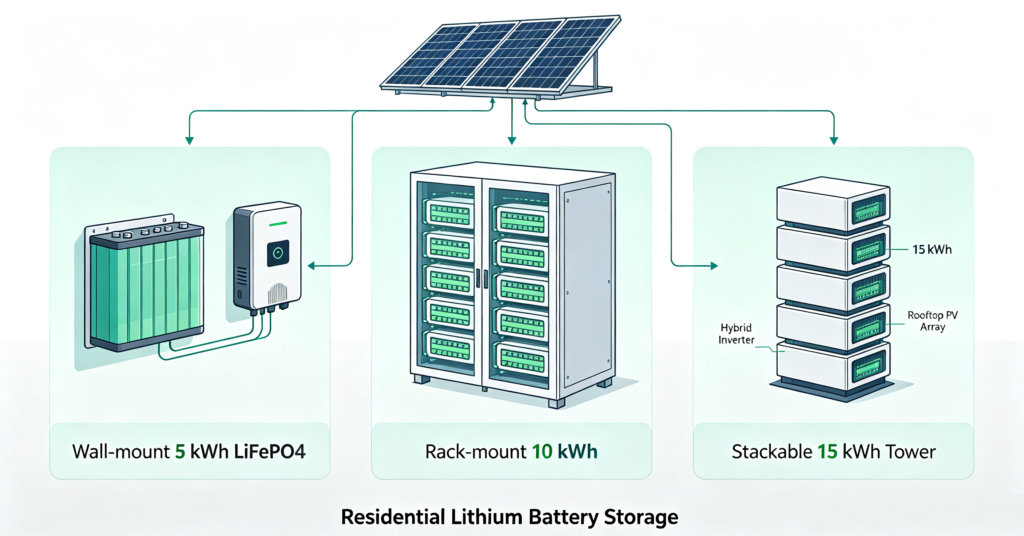
Residential lithium storage comes in three physical formats, and the right one is set by where it lives and how it will expand. Wall-mount units (typically 5–10 kWh) hug a garage or utility-room wall, look like a furnace, and are the easiest retrofits to existing PV systems. Rack-mount banks (10–30 kWh in a 19-inch or 23-inch cabinet) sit on a floor or shelf and scale by adding 2.5–5 kWh modules; they are the format installers prefer for whole-home backup. Stackable towers (5–25 kWh in 5 kWh blocks) trade a slightly larger footprint for the simplest capacity expansion — a homeowner can add another 5 kWh module without an electrician. All three form factors run on the same LiFePO4 cell technology; the difference is mechanical, electrical (some stackables have internal busbars, rack banks rely on external cabling) and the BMS topology that ties the modules together. The installation trade-offs are walked through in #13 home battery installation.
Method 3 — Size the capacity to the evening load, not the panel array
The most common sizing mistake is to match battery capacity to the solar array — a 10 kW PV system does not need a 10 kWh battery, it needs whatever covers the evening. The right calculation starts with the appliances that run between sunset and sunrise: fridge (≈1 kWh/day), lighting (≈0.5 kWh), Wi-Fi/router/CCTV (≈0.2 kWh), one round of cooking (≈1 kWh), and any medical or work-from-home loads you cannot skip. Add them up, double the answer for cloudy days, and that is the bank to install. For a frugal 2-bedroom household 5–10 kWh is plenty; a 4-bedroom all-electric home with EV charging typically wants 15–25 kWh. The math, with a worked example, is in #9 home battery sizing.
Voltage matters as much as capacity. Most residential hybrid inverters accept either a low-voltage (48 V / 51.2 V nominal) battery bank or a high-voltage (100–400 V) battery bank, and the two are not interchangeable. Low-voltage banks are simpler, cheaper per kWh and easier to expand one module at a time; high-voltage banks are more efficient at high power (less cabling loss, smaller cable gauge) and are the format large residential and small commercial systems trend toward. The voltage choice is locked in once the inverter is chosen — see #12 on 48V vs 51.2V for the low-voltage decision tree.
Method 4 — Set the charge profile: not too full, not too empty, not too hot
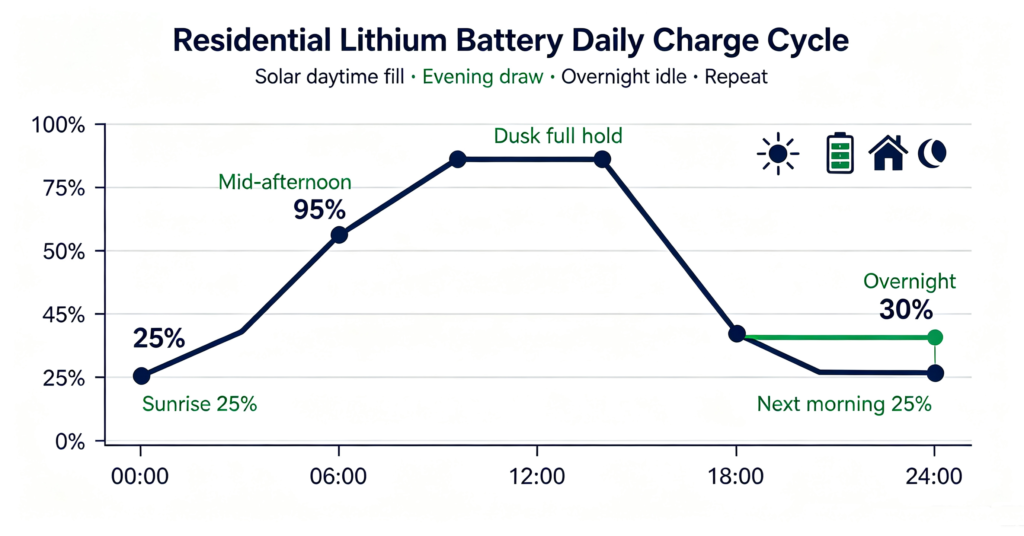
LiFePO4 cells last longest when they spend most of their life between roughly 20% and 90% state-of-charge, not at the absolute extremes. The two practical consequences: configure the inverter’s charge limit to 90–95% (not 100%) and the discharge cutoff to 20% (not 0%) for daily cycling; and expect the BMS to enforce those limits automatically when you set the chemistry to “LFP” in the inverter menu. The other lever is temperature. LiFePO4 charges happily between 0 °C and 45 °C, but charging below freezing — pushing current into a sub-zero cell — causes irreversible lithium plating that permanently reduces capacity. A bank in an unheated garage in a cold climate needs either a self-heating BMS or a location that stays above freezing; an outdoor-rated enclosure solves it.
The charging source matters too. PV-direct charging via MPPT is efficient and predictable; grid-charging from a hybrid inverter is fine for backup-style use but adds wear proportional to the depth of every cycle. A good rule: cycle on the sun during the day, use the grid only as a backup for cloudy stretches, and avoid daily grid-cycling the bank just to arbitrage cheap night rates — the cycle cost usually exceeds the price spread on a residential tariff.
Method 5 — Respect the safety envelope
Lithium residential storage is safe when the installation respects its envelope, and unsafe when it does not. Four rules cover the field: install the bank indoors or in a weather-rated enclosure, never in a living-space closet with no ventilation; keep the BMS firmware current and replace any module that throws persistent faults; use the cable gauge and over-current protection the manufacturer specifies, not smaller; and do not parallel mismatched banks — different age, different cell maker, different internal resistance — without a BMS that can balance them. The full safety checklist, including UL 1973 / IEC 62619 / UN38.3 certifications buyers should ask for, is in #11 types of energy storage systems.
For off-grid cabins, farms and remote sites the safety checklist adds two more lines: a smoke/heat detector in the battery room, and a manual DC disconnect visible from the door. The off-grid sizing logic — including generator backup and load-shedding — is in #23 off-grid solar system batteries.
The five methods at a glance
| Decision | Default for residential | When to deviate | Pair with |
|---|---|---|---|
| Chemistry | LiFePO4 (LFP) | NMC only where volume is critical | BMS rated for the chemistry |
| Form factor | Wall-mount (≤10 kWh) / rack (≥10 kWh) | Stackable when expansion will be DIY | Mounting hardware + clearances |
| Capacity | 5–15 kWh for most homes | 20 kWh+ for EV charging / all-electric | Hybrid inverter sized to peak load |
| Charge profile | 20–90% SoC, 0–45 °C | Self-heating BMS in cold climates | Time-of-use tariff if available |
| Safety | Indoor or IP-rated enclosure | Off-grid: add detector + DC disconnect | UL 1973 / IEC 62619 / UN38.3 certs |
Where lithium batteries are not the answer
Batteries are the right call when the energy you need to move is hours-scale — overnight, a cloudy day, a short outage. They are the wrong call when the gap is seasonal (summer sun for winter heat), when the geography is utility-scale with elevation to spare (pumped hydro), or when a tariff pays you generously to export rather than store (net metering alone). For a homeowner, those alternatives are not really alternatives at all — they are options for utilities and researchers. The decision tree for off-grid vs grid-tied vs hybrid homes, with the lithium option on the right branch, is in #17 on choosing a hybrid inverter.
For the buyers this site serves — installers and the businesses behind them — the operational conclusion is simple. Lithium storage has become a stock item: a LiFePO4 pack at 48 V or 51.2 V, in a wall-mount or rack format, paired with a hybrid inverter that speaks its protocol. The remaining decisions are capacity sizing and install quality, not which chemistry to trust. For leekooenergy, that is the reason the residential line ships in three formats and four capacities: every home is a slightly different evening load, and the storage should fit that load, not the other way around.
Q. How long do lithium batteries hold a solar charge?
Months, with low self-discharge — typically 2–3% per month when idle. The constraint that matters in practice is cycle life, not calendar shelf life: a daily-cycled LiFePO4 bank is usually rated for 4,000–6,000 cycles, or roughly 10–15 years of one cycle per day before it drops to 80% of nameplate capacity.
Q. Can lithium batteries store solar energy without a grid?
Yes. An off-grid LiFePO4 bank paired with a hybrid inverter and a PV array runs the home on stored solar alone, with a generator as backup for cloudy stretches. The sizing logic and load-shedding rules are in #23 off-grid solar system batteries.
Q. What is the best way to store solar energy at home?
A right-sized LiFePO4 battery bank at 48 V or 51.2 V, paired with a hybrid inverter, charged between 20% and 90% state-of-charge, kept above freezing. For grid-tied homes this is paired with whatever net-metering credit the local tariff still pays.
Q. Is it worth storing solar energy in a battery in 2026?
For homes with evening loads larger than what net metering credits, or for any home in an outage-prone region, yes. The payback math depends on the tariff, the depth of daily cycling and the cost of a cycle-rated battery; a worked payback example is in #07 solar battery cost.
Q. How do I store solar energy for later use, not just overnight?
A lithium battery covers overnight and a day or two of cloud; longer horizons need either seasonal storage (hydrogen, still expensive) or a grid connection that lets you net-meter over a longer billing cycle. For most homeowners the practical answer is “overnight and one cloudy day” — anything beyond that, the economics shift.
Next step: pick the format, then size the kWh
The five methods above collapse to two operational questions for a homeowner: wall-mount or rack, and 5 kWh or 15 kWh. Answer those from your evening load list and your expansion plans, and the rest of the system falls into place.
- Compare chemistries and cycle life in #33 LiFePO4 vs NMC
- Work the capacity math with #09 home battery sizing
- Confirm the install envelope in #13 home battery installation
- Browse leekooenergy wall-mount and rack LiFePO4 packs for residential sola