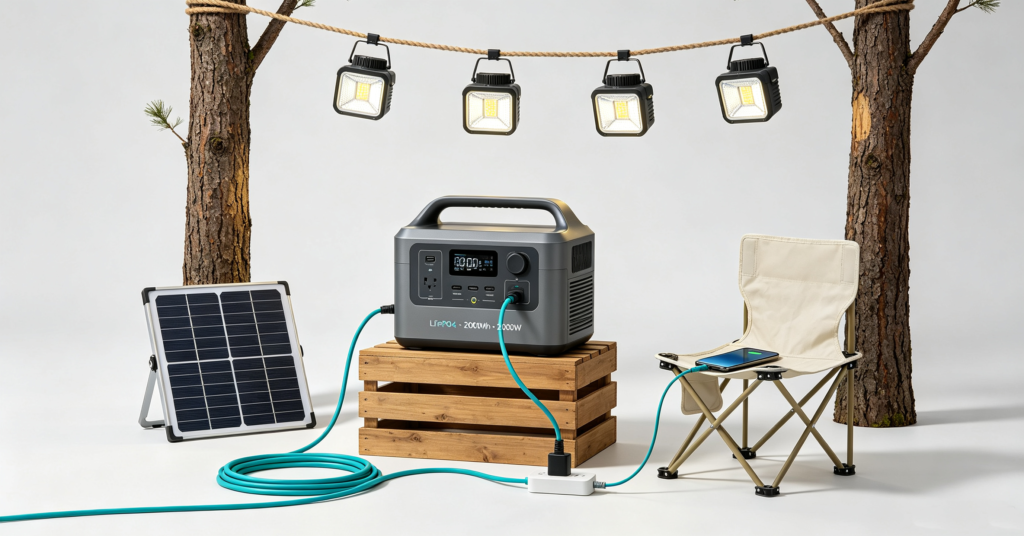
A lifepo4 portable power station is a self-contained, box-shaped lithium power unit built around a LiFePO4 battery, an inverter, a charge controller and a handful of AC / DC / USB outlets — designed to be carried by one or two people, dropped on a job site, and run without gasoline. The “LiFePO4” qualifier matters because most cheaper portable power stations use NMC (nickel manganese cobalt) cells that are lighter but less thermally stable and shorter-lived; for B2B duty — events, telecom field work, construction, rental fleets — LiFePO4 wins on cycle life, safety certifications and total cost per cycle. For a homeowner it is a weekend accessory; for an event producer, a telecom crew or a rental fleet it is a depreciable asset that has to earn its keep.
This guide is for the buyer specifying the unit as part of a fleet, a job-site plan or a rental programme. It covers the four decisions that decide whether a portable power station delivers on the field: LiFePO4 vs NMC chemistry, capacity (Wh) and power (W) ratings, multi-source recharging, and the OEM / rental checks that matter at scale. The chemistry comparison is in #33 LiFePO4 vs lithium ion NMC; this article stays on the LiFePO4 portable unit and the B2B field context.
What a LiFePO4 portable power station actually is
Inside the box are four subsystems working together. A LiFePO4 battery pack stores the energy — typically 500 Wh to 4 kWh in a portable form factor. A BMS protects against over- and under-voltage, over-current, over-temperature and short circuits, and reports state of charge. A pure sine wave inverter converts DC to 110 V / 230 V AC for mains appliances. A charge controller (MPPT solar input + AC charger + car-cigarette input) refills the pack from solar panels, mains or a 12 V vehicle outlet.
What separates a portable power station from a residential solar battery is form factor and grid interaction. A residential battery is permanently installed and wired into a hybrid inverter and the home grid; a portable power station is free-standing and carried. Portable units do not feed power back to the grid — which is why they avoid the grid-interactive certification burden (UL 1741, IEEE 1547) that a residential battery carries.
LiFePO4 vs NMC vs gasoline generator
Three power technologies compete for the same B2B field use case. Each has a different set of trade-offs.
| Property | LiFePO4 portable power station | NMC portable power station | Gasoline inverter generator |
|---|---|---|---|
| Energy density (Wh / kg) | ≈90–130 | ≈150–220 | ≈800–1,200 (fuel not weight) |
| Cycle life to 80% capacity | ≈3,000–6,000 | ≈500–1,500 | n/a (engine hours, not cycles) |
| Thermal runaway risk | low (LiFePO4 chemistry) | medium (NMC chemistry) | n/a (combustion) |
| Operating noise | silent (fan only under load) | silent (fan only under load) | 55–75 dB at 7 m |
| Exhaust / emissions | none | none | CO, NOx, particulates |
| Indoor / enclosed use | yes | yes | no (CO hazard) |
| Refuelling | solar / AC / car | solar / AC / car | petrol, on-site |
| Suitable for events / film / telecom | yes (silent, indoor, no fumes) | yes (lighter, fewer cycles) | outdoor only, with permits |
| Cost per delivered kWh over life | low (LiFePO4 cycle life) | medium-high (early replacement) | medium (fuel + service) |
Two rows deserve attention. Indoor / enclosed use is the deciding factor for many event venues and telecom shelters: a gasoline generator must run outdoors with permits, while a LiFePO4 portable power station can sit next to the camera, audio rack or base-station cabinet. The cycle life row is what rental-fleet economics depend on: an NMC unit that needs a cell replacement after 1,000 cycles costs several times more per delivered kWh than a LiFePO4 unit that lasts 4,000 cycles on the same duty.
Capacity and power: what Wh and W actually mean
Two numbers define a portable power station and they answer different questions. Capacity in Wh is how much energy the unit stores; runtime at a given load is roughly Wh / load W × inverter efficiency. A 1,000 Wh unit running a 100 W LED work-light string delivers about 9 hours; running a 1,000 W hair dryer delivers about 50 minutes (and the inverter fans work hard). Power in W is the maximum instantaneous load the inverter can deliver; the unit shuts down if a load exceeds this rating, even with plenty of capacity left.
Three rules of thumb B2B buyers use to size correctly:
- Peak vs continuous: most inverters deliver continuous power at the stated wattage and surge power for a few seconds (e.g. 2,000 W continuous / 4,000 W surge for motor startup). Confirm both numbers.
- Capacity margin: target 50–70% depth of discharge in normal use, not 100%. Running a pack flat every cycle halves its cycle life.
- Real-world Wh rating: some manufacturers rate at cell nominal voltage, others at BMS-usable capacity. Ask for the BMS-rated usable Wh, not the marketing headline.
For B2B sizing the deeper inverter-to-load reasoning is in #79 hybrid inverter sizing vs battery capacity; the broader battery sizing methodology is in #09 how to size a home battery.
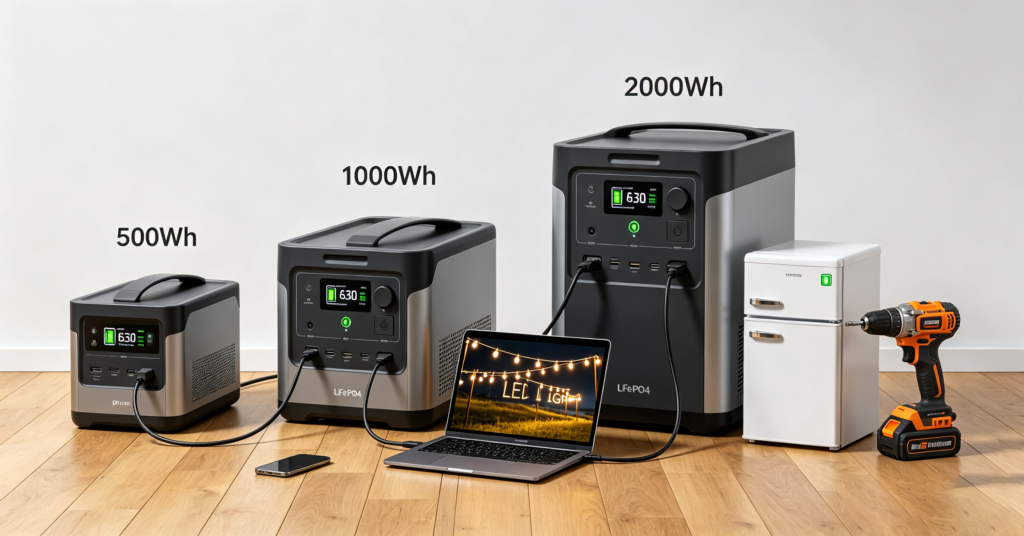
Recharging: solar, AC and the 12V car
A portable power station earns its keep on a job site if it can refill between uses. Three charging paths matter:
- AC mains: fastest; typically 1–2 hours to refill a 1 kWh pack from empty. The default at the depot.
- Solar (MPPT input): slowest but the only option on a remote site. A 200W panel refills a 1 kWh pack in 6–8 sun-hours; a 400W suitcase cuts that to 3–4 hours. Confirm the MPPT input voltage window matches the panel’s Vmp.
- 12 V car (cigarette socket): top-up while driving between sites; typically 100 W input — slow but always available.
The “AC + solar simultaneous” feature some units offer lets the station refill while powering loads — useful for an event that runs all day with a panel on a vendor booth’s roof. The matching solar panel sizing for a portable kit is in #74 PV panel kits; the charger angle for a permanently mounted panel is in #80 solar battery charger for 12V battery.
Where LiFePO4 portable power stations earn their keep
Five B2B use cases dominate the volume. Outdoor events and festivals — silent power for sound, lighting, ticketing and vendor booths; no permit, no exhaust, no fuel spill risk. Telecom field operations — temporary base stations, fibre-splicing crews, tower maintenance; the unit rides in the van and powers equipment where a generator cannot run. Film and broadcast production — silent power on set; the unit sits next to the camera and the audio mixer. Construction and fit-out — temporary site power before the grid is connected; no fuel logistics. Rental fleets — a hire company buys dozens at OEM pricing and rents them by the day or week to event producers, film crews and contractors.
The common thread is duty cycle: the unit runs hard during the rental period, sits at 50–80% state of charge between rentals, and gets a top-up before each new dispatch. That duty pattern rewards LiFePO4 chemistry, which tolerates being held at partial state of charge for long stretches without the calendar-life penalty NMC chemistry incurs.
Buying for OEM, dealer or rental fleet
When the order is dozens or hundreds of units, the questions shift from “does it work” to “does it work the same way every time and can I get spares”.
- Firmware consistency: rental fleets need every unit to behave identically; mismatched firmware can cause different SOC readings, different charge profiles, different alarm thresholds.
- Cell sourcing: ask for cell brand and grade. LFP cells from tier-one suppliers behave predictably; unbranded cells can have wider capacity spread within a batch.
- Certifications: UN38.3 for transport; IEC 62133 for cell safety; CE-EMC / FCC for the unit; UL 2743 for the North American portable power station standard that insurance carriers increasingly read.
- White-label / OEM programme: can the unit ship with the buyer’s brand on the enclosure, firmware defaults pre-loaded, and the buyer’s serial number scheme?
- Service and spares: confirmed RMA process, spare BMS modules, replaceable handles, and a service manual that lets the rental company swap a damaged inverter board in the field rather than shipping the unit back.
- Cost per delivered kWh over life: compare on Wh × cycle count. A 1,000 Wh unit rated 4,000 cycles delivers 4 MWh; the same Wh at 1,000 cycles delivers 1 MWh and is worse even at half the price.
The cell-level sourcing and OEM/ODM assembly pathway that backs a portable power station programme is in #48 lithium cell wholesale; the broader OEM/ODM angle that custom packaging and firmware serve is in #20 custom battery pack OEM/ODM.
Q. Is a LiFePO4 portable power station the same as a power bank?
Not quite. A power bank is a small DC-only device (typically USB output, under 100 Wh) designed to charge phones and laptops. A portable power station is a much larger unit (typically 500 Wh to 4 kWh) that includes a built-in inverter to deliver mains AC as well as DC, designed to power appliances and tools for hours rather than minutes.
Q. Can a portable power station run a refrigerator?
Yes, within capacity limits. A small 100 W fridge draws about 20–25 kWh per day; a 2 kWh LiFePO4 portable power station will run it for about 16–20 hours, depending on compressor duty cycle and ambient temperature. For continuous refrigeration, a larger home battery or a generator backup is more appropriate.
Q. Can a LiFePO4 portable power station be used indoors?
Yes. LiFePO4 chemistry is thermally stable and the unit has no combustion exhaust. The main indoor caveats are ventilation around the inverter heat sink, keeping the unit away from direct heat sources, and not blocking the cooling fan. Compared to a gasoline generator — which produces carbon monoxide and must never run indoors — a LiFePO4 portable power station is the obvious safe choice for enclosed-space use.
Q. How long does a LiFePO4 portable power station last?
A quality LiFePO4 portable power station rated for 3,000–4,000 cycles at 80% depth of discharge will typically deliver 8–12 years of service in a rental fleet or weekly-use scenario. Calendar life also matters: even without cycling, LiFePO4 cells lose a few percent of capacity per year, so an infrequently used unit will still age out at the 10–15 year mark.
Q. Can I take a portable power station on a plane?
Generally no for commercial flights. Most airlines cap lithium battery carry-on at 100 Wh, and checked baggage lithium is mostly prohibited. A 500 Wh+ portable power station exceeds this limit by a wide margin. For ground shipping, UN38.3 certification and proper hazmat labelling are required; the carrier-specific rules vary by country and transport mode.
Next step: match the chemistry, the capacity and the rental economics
The right LiFePO4 portable power station is the one that fits the chemistry (LiFePO4, not NMC), the capacity tier (Wh to match the load profile), and the duty pattern (rental fleet, telecom van, event booth) — and that carries the certifications the insurer reads.
- Confirm the chemistry trade-off in #33 LiFePO4 vs lithium ion NMC
- Match the kit with the panel in #74 PV panel kits
- Size the inverter side in #79 hybrid inverter sizing vs battery capacity
- Plan the OEM/ODM route in #20 custom battery pack OEM/ODM
- Source cells and modules in #48 lithium cell wholesale
- Ask leekooenergy for a LiFePO4 portable power station specification that states cell brand and grade, BMS firmware version, capacity tier (500/1000/2000 Wh), inverter continuous and surge power, AC + solar + car charge inputs, UL 2743 / UN38.3 / IEC 62133 marks, and OEM white-label terms — a unit that fits event producers, telecom crews and rental fleets from a single product line