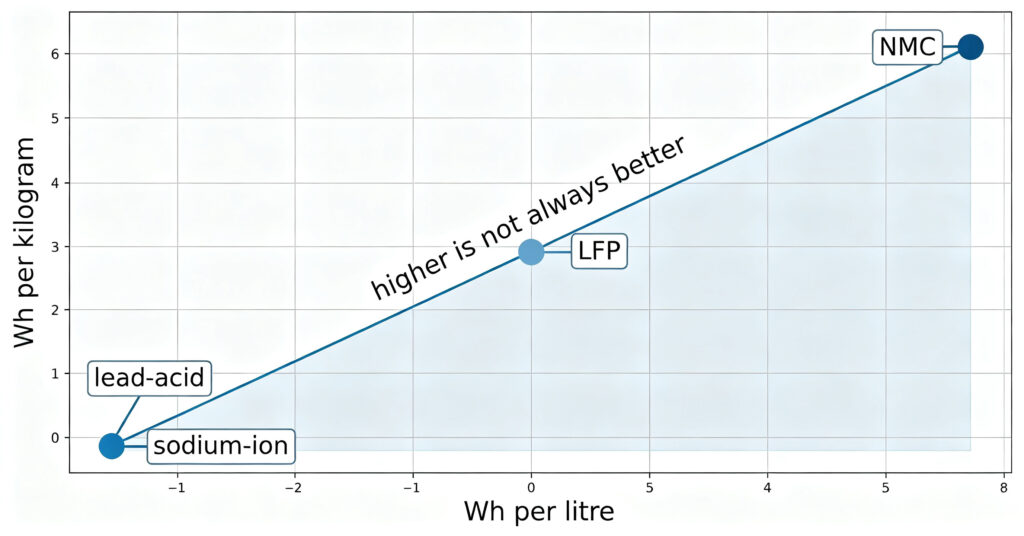
Density for lithium means how much energy a lithium cell carries per unit of mass or per unit of volume — gravimetric density in watt-hours per kilogram, and volumetric density in watt-hours per litre. The two are not interchangeable, and which one matters is decided by the application: a vehicle cares about kilograms, a wall-mounted cabinet cares about litres, and a fixed installation on a concrete slab often cares about neither. The number quoted in a datasheet is measured at cell level, which is not the number an installation sees, because the enclosure, the management system, the thermal hardware and the spacing all subtract from it. The one-line version worth quoting: energy density is the most quoted battery parameter and the least useful one on its own — what you buy is usable energy in a footprint, over a life, at a cost.
This guide is for engineers and buyers comparing chemistries and trying to work out whether a higher number is worth paying for. It covers the two measures, the four ways the figure gets inflated, how much is lost between cell and system, and the trade-offs that come with chasing density. Chemistry-level selection is in #33 LiFePO4 vs NMC; cell-level parameters are in #163 what are battery cells.
Two densities, two questions
Gravimetric density answers “how heavy will this be”, and volumetric density answers “how big will this be”. A chemistry can rank well on one and poorly on the other, and the mismatch is why a spec sheet that only quotes one of them is not enough to design with.
| Chemistry | Gravimetric, cell level | Volumetric, cell level | Where the strength shows |
|---|---|---|---|
| Lead-acid | Low, tens of Wh/kg | Low | Cost and recycling maturity |
| LFP (LiFePO4) | Moderate, roughly 140–160 Wh/kg | Moderate | Cycle life, thermal stability, cost per cycle |
| NMC lithium-ion | High, roughly 150–250 Wh/kg | High | Range in vehicles, compact portable energy |
| Sodium-ion | Lower than LFP at present | Lower than LFP at present | Cold behaviour, material cost, supply breadth |
These figures are cell-level and move as products improve, so treat them as ranges to compare within, not as constants to design against. A supplier quoting a single number without saying cell, module or pack is quoting the most flattering level available.
Four ways the number gets inflated
Almost every density claim that looks too good is using one of these four moves.
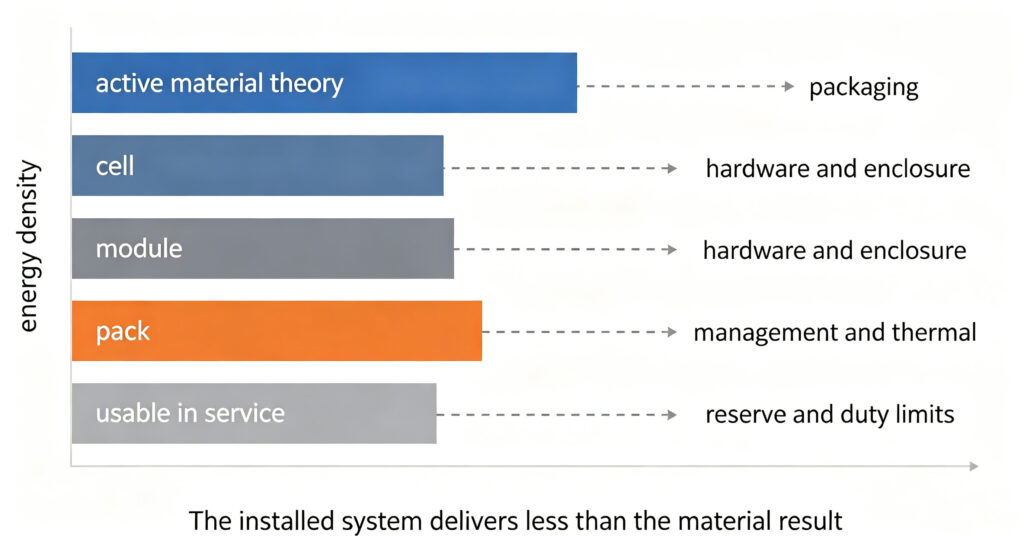
- Active material instead of cell. The theoretical figure counts only the electrode materials and ignores current collectors, separator, electrolyte and packaging. It is a materials-science number, not a product number.
- Cell instead of pack. A pack adds busbars, a management board, an enclosure, thermal hardware and clearance. The gap between cell and pack is substantial and is the reason a cabinet is always bigger than the cells inside it suggest.
- Nameplate instead of usable. A cell’s rated capacity is not the capacity a system may use; the management system leaves margin at both ends, and the duty cycle determines how much is drawn. Usable energy is what the installation delivers.
- Energy density quoted where power density matters. Energy density is capacity; power density is how fast that capacity can be delivered. A cell optimised for energy will not necessarily deliver a high surge, and a load with a motor startup cares about the second property.
The fourth one is worth dwelling on because it is the most expensive confusion in practice. A high energy density cell used in an application that needs a short, heavy burst will sag and heat, and the symptom looks like a capacity problem when it is a power problem.
Why the highest density is often the wrong choice
Chasing the density for lithium costs something, and in fixed storage the costs usually outweigh the benefit. Four trade-offs show up.
- Cycle life. Chemistries tuned for maximum energy per kilogram tend to give up cycle life to get it. A stationary asset bought for a fifteen-year life is valued on cycles delivered, not on kilograms saved.
- Thermal behaviour. Higher energy density generally means less thermal margin, which means more engineering in the thermal management and more careful operating limits. The failure modes and the engineering response are described in #87 thermal runaway and suppression.
- Cost per delivered kilowatt-hour. The metric that matters to an operator is the cost of energy actually delivered over the asset’s life, and on that measure a cheaper, denser-for-its-cost chemistry with a long cycle life regularly beats the highest density option.
- Space is usually not the binding constraint. In a plant room, a container or a warehouse, floor area is cheaper than cycle life. Density becomes the binding constraint only when the battery has to move — in a vehicle, a portable unit, or a cabinet with a fixed envelope.
That last point is the practical decision rule. If the battery is carried, or the envelope is fixed by something other than the building, density is a first-order requirement. If the battery sits on a slab, it usually is not. The longer-horizon view of which chemistries are moving is in #129 solid-state vs lithium-ion, and the very-high-theory end of the range is in #151 lithium-air battery.

How to compare two offers properly
Four corrections turn a headline density for lithium number into a comparison that means something.
- Ask for the level. Cell, module or pack — and if it is a cell figure, ask for the pack figure too.
- Ask for usable energy in the enclosure footprint. Kilowatt-hours usable per square metre of installed footprint is the number a site owner actually experiences.
- Ask for cycle life at the depth of discharge and rate you will use, then divide cost by usable energy times cycles.
- Ask what the thermal management costs. A denser pack that needs active cooling has an energy penalty and a maintenance item that a lower-density pack does not.
Applied consistently, these four corrections also shorten supplier conversations: the questions become specific, and a vendor who cannot answer them has told you something useful about how much of the number is real. The reading exercise for the specification sheet that carries all of this is in #115 how to read LiFePO4 battery specs, and the choice between cell formats is in #136 LFP battery cells.
Q. What is the density for lithium batteries?
Lithium cell energy density is quoted two ways: gravimetric, in watt-hours per kilogram, and volumetric, in watt-hours per litre. Practical lithium cells fall in a broad band from roughly 140 Wh/kg for lithium iron phosphate up to around 250 Wh/kg for some high-nickel cells, measured at cell level rather than at pack level.
Q. Why is LiFePO4 energy density lower than NMC?
Because the iron phosphate cathode operates at a lower voltage and stores less lithium per unit mass than a nickel-rich cathode. In exchange, LFP offers a longer cycle life, better thermal stability and a lower cost per delivered kilowatt-hour, which is why it dominates stationary storage despite the lower density.
Q. Does higher energy density mean longer runtime?
Only if the comparison is made at the same level and the same usable window. A higher cell-level density that is eroded by heavy thermal hardware, a large enclosure or a conservative depth of discharge can deliver less usable runtime in the same footprint than a modest cell in a well-integrated pack.
Q. What is the difference between cell-level and pack-level density?
Cell-level density counts only the cell. Pack-level density counts the enclosure, the management system, busbars, thermal hardware, safety clearances and fixings. Pack-level is always lower, and it is the number that determines how much energy fits in the space you have.
Q. Is energy density the same as power density?
No. Energy density is how much energy is stored per kilogram or litre; power density is how quickly that energy can be delivered. A cell optimised for one is not automatically good at the other, and a load with high surge current needs the power figure checked separately.
Next step: compare usable kWh per footprint, not Wh/kg
Density for lithium is a useful parameter once the level is stated. Before that it is a marketing number. Ask for pack-level usable energy and cost per delivered kilowatt-hour.
- Compare chemistries in #33 LiFePO4 vs NMC
- Read the specification in #115 how to read LiFePO4 specs
- Check the thermal cost in #88 liquid-cooled BESS thermal design
- Ask leekooenergy for a pack-level comparison that states usable energy per installed footprint, the cycle life at your depth of discharge and rate, the thermal management requirement, and the cost per delivered kilowatt-hour over the asset life