What are battery cells? A cell is the smallest complete electrochemical unit that stores and releases electricity: one positive electrode, one negative electrode, a separator and an electrolyte, sealed in one container with two terminals. A single lithium cell delivers a voltage set by its chemistry — around 3.2 V for lithium iron phosphate, around 3.6–3.7 V for most other lithium chemistries — and a capacity measured in amp-hours. Everything sold as a battery, from a 12 V jump starter to a grid-scale container, is an assembly of cells. The one-line version worth quoting: a cell is a component; a battery is an assembly; confusing the two is how procurement orders arrive as boxes of loose cells when the site needed wired modules.
This guide is for someone new to the vocabulary — a buyer reading a cell datasheet for the first time, a DIY builder deciding whether to buy cells or modules, or an engineer explaining the layer model to a colleague. It covers what a cell is, the three package formats it ships in, how cells become modules and packs, and the four numbers on a datasheet that actually matter. Cell selection by chemistry and capacity is in #136 LFP battery cells, and the voltage behaviour of a single cell is in #138 li-ion cell voltage.
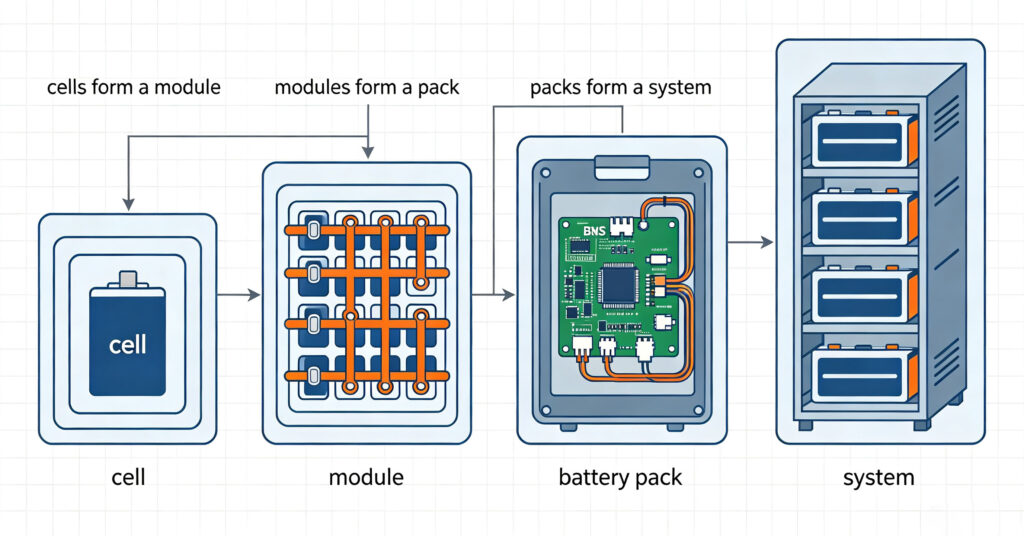
The layer model: cell, module, pack, system
Four levels of assembly sit between a single cell and the thing installed on a wall, and each level adds something.
- Cell: the sealed electrochemical unit. Two terminals, a nameplate capacity in Ah, a voltage set by chemistry.
- Module: several cells connected in series, parallel, or both, held in a frame with busbars and usually a temperature sensor or two. Series raises voltage, parallel raises capacity.
- Pack: one or more modules in an enclosure, with a battery management system, a contactor or protection circuit, a connector set, and a nameplate rating for the whole assembly.
- System: packs plus the inverter, protection, thermal management and controls that make the storage usable by a site.
The layer at which a buyer orders what are battery cells, or modules, or finished packs, depends entirely on what the buyer can do in-house. A pack factory buys cells; an integrator buys modules; an installer buys packs; a site owner buys a system. Buying below your capability means taking on welding, balancing and safety testing; buying above it means paying for someone else’s margin. The assembly-side cautions for the lower layers are collected in #113 DIY battery safety.
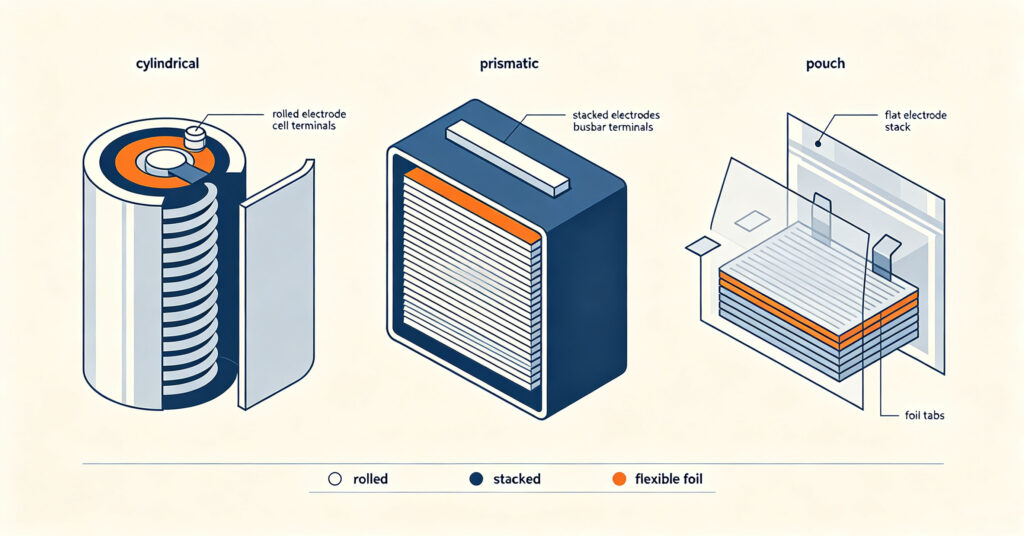
Three package formats
| Format | Construction | Strengths | Watch for | Commonly found in |
|---|---|---|---|---|
| Cylindrical | Rolled electrodes in a steel can | Cheap, mechanically strong, mature automation | Many cells per pack, lower packing density, spot-weld assembly | Power tools, some EV packs, portable units |
| Prismatic | Stacked or rolled electrodes in a rectangular aluminium or steel can | High capacity per cell, simple busbar connection, good space use | Heavier per unit, fewer standard sizes, needs compression in some designs | Stationary storage, LFP home and C&I banks |
| Pouch | Stacked electrodes sealed in flexible laminated foil | Lightest, shape-flexible, good thermal path | Needs mechanical compression and a rigid housing; swells if abused | EV traction packs, thin consumer devices |
For stationary storage, prismatic LFP cells dominate, and the reason is practical rather than chemical: a high-capacity prismatic cell means fewer parallel connections in a module, fewer busbars to torque, and fewer cell-level connections to go wrong over a fifteen-year life. The capacity classes in current use are compared in #25 LFP cells 280Ah vs 314Ah, and the wholesale view of buying at cell level is in #48 lithium cell wholesale.
Four numbers that actually matter
A cell datasheet runs to several pages; four lines decide whether the cell fits the job.
- Nominal voltage: set by chemistry, around 3.2 V for LFP and around 3.6–3.7 V for most other lithium types. Stack enough in series and you reach the system voltage the inverter expects.
- Capacity in Ah: the charge the cell can deliver from full to the cut-off voltage at the stated discharge rate. A 280 Ah LFP cell at 3.2 V nominal holds roughly 0.9 kWh of nameplate energy.
- Energy in Wh: nominal voltage times capacity. This is the number that scales linearly when you add cells, and the only honest way to compare cells of different chemistries.
- Cycle life at a stated depth of discharge, rate and temperature: without those three qualifiers the number is not comparable between suppliers.
Internal resistance is the fifth number worth asking for even when it is not printed: it drives how much the cell heats under load and how much voltage it sags, and cells in a module should be matched on it as well as on capacity. Matching and balancing are explained in #106 active vs passive cell balancing.
Three things people get wrong
The same three misconceptions come up in almost every first conversation about cells.
- “A cell is a battery.” A cell is a component. A battery is an assembly with protection and a management system. A bare cell has no protection at all — it will be destroyed by over-discharge and can be driven into an unsafe condition by overcharge.
- “More Ah means more power.” Capacity in Ah is energy, not power. The power a cell can deliver is governed by its discharge rate limit and internal resistance; a high-capacity cell designed for slow discharge can be the wrong choice for a high-power application.
- “Cells in parallel fix everything.” Paralleling raises capacity but makes cell matching more important, not less. Mismatched cells in parallel circulate current between each other and age faster than either would alone. The safe way to scale is set out in #93 parallel battery packs.
How many cells are in the battery you are buying
Working it out is simple arithmetic and it is worth doing once, because it tells you what you are actually paying for. Take the system voltage, divide by the cell nominal voltage to get the series count, then divide the pack energy by the energy of one cell to get the total cell count. A 48 V LFP bank is sixteen cells in series; a 10 kWh pack built from 280 Ah cells needs roughly eleven of those series strings in parallel, or about 176 cells — and every one of those cells is a potential imbalance, a potential warranty claim, and a potential reason the pack’s stated cycle life is not the one you get. The pack-level specification reading is in #115 how to read LiFePO4 battery specs, and the chemistry context is in #59 what is a lithium-ion battery.
Buying cells: what to ask a supplier
At cell level the questions are different from the questions at pack level. Five are worth asking every time.
- Cell grade and origin: grade A cells from a named manufacturer, with a traceable batch.
- Matching data: capacity and internal resistance spread within the delivered batch, not just typical values.
- Test report: capacity test and cycle test with the method stated, at a depth of discharge and rate that resembles your duty.
- Transport documentation: UN38.3 test summary and the classification for shipping. The documentation set is described in #107 battery export certification.
- Minimum order, lead time and payment terms: the commercial layer that decides whether the price is real. That negotiation is covered in #124 MOQ, lead time and payment terms.
Q. What are battery cells?
Battery cells are the smallest complete electrochemical units that store and release electricity. Each cell contains a positive electrode, a negative electrode, a separator and an electrolyte sealed in one container with two terminals. A cell’s voltage is fixed by its chemistry and its capacity is measured in amp-hours; batteries and packs are assemblies of cells.
Q. What is the difference between a cell and a battery?
A cell is one electrochemical unit; a battery is an assembly of cells with the protection, management and enclosure needed to use them safely. Two or more cells connected together form a battery in the strict sense, and the word is used loosely in trade for anything from a single cell to a rack system.
Q. What are the three types of battery cells?
By package format: cylindrical cells with rolled electrodes in a steel can, prismatic cells with stacked or rolled electrodes in a rectangular can, and pouch cells with a flat electrode stack sealed in flexible laminated foil. The chemistry inside can be the same in all three; the format changes the mechanical, thermal and assembly behaviour.
Q. How many cells are in a 48V lithium battery?
Sixteen in series for a lithium iron phosphate pack, because sixteen cells at roughly 3.2 V nominal give about 51 V. Other lithium chemistries at around 3.6–3.7 V nominal use thirteen or fourteen in series. The total cell count is then multiplied by however many parallel strings the pack’s capacity requires.
Q. Can I use bare cells without a BMS?
No. A bare lithium cell has no protection of any kind; over-discharge destroys it, overcharge can drive it into thermal runaway, and cells in a series string drift apart without balancing. Any assembly of more than one cell in series needs a battery management system, and that is the layer that turns cells into a usable battery.
Next step: decide which layer you should be buying
What are battery cells is the easy question. The expensive question is whether your operation should be buying cells, modules or finished packs.
- Compare formats and capacities in #136 LFP battery cells
- Check the wholesale route in #48 lithium cell wholesale
- Read pack specifications in #115 how to read LiFePO4 specs
- Tell leekooenergy your target pack voltage and usable energy and ask for a cell-to-pack breakdown that states the series and parallel count, the cell capacity and grade, the batch matching data, and whether the same energy is better supplied as modules or as finished packs