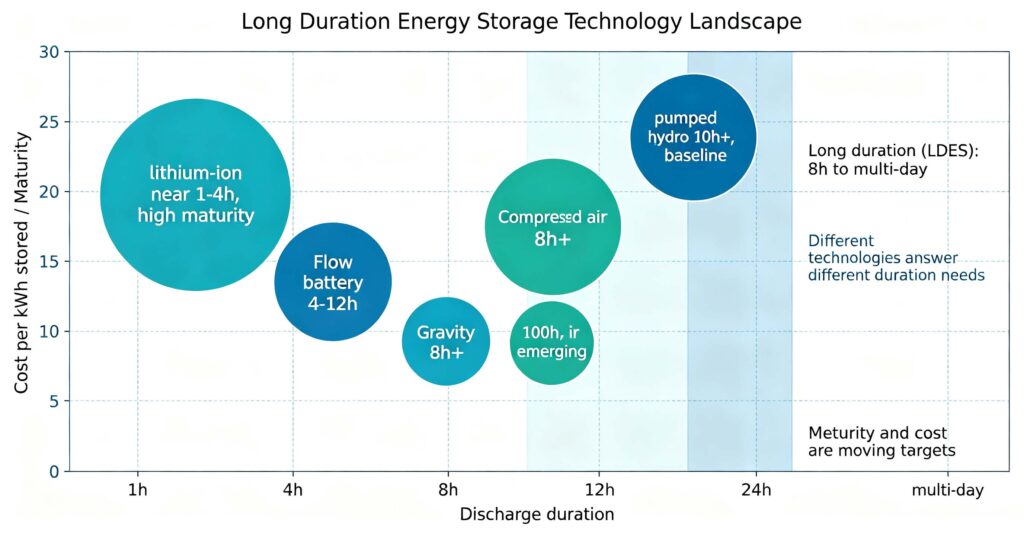
Long duration energy storage (LDES) is storage that discharges continuously for roughly 8 hours up to days or seasons, designed to shift renewable energy across the gaps that short-duration batteries cannot cover — night, multi-day weather events, and seasonal shortfalls. Its role is different from a 2–4 hour battery: short-duration storage manages the daily peaks; long duration storage carries the system through sustained low-generation periods, which is why it becomes more valuable as renewable penetration rises. The main technology routes are: flow batteries (vanadium and iron-based, 4–12+ hours, decoupled power and energy), compressed air (underground or above-ground storage, 8h+), gravity storage (lifting and lowering masses, 8h+), iron-air batteries (100+ hours, early stage), and lithium-plus configurations (stacking more lithium for longer durations where economics allow). The choice for a project depends on four things: the duration actually needed (a grid looking for 8-hour coverage has different needs than one wanting seasonal shifting), site conditions (geology for compressed air or pumped hydro, footprint for gravity), capital and operating cost at scale, and commercial maturity — how many operating plants exist and what warranties look like. A common mistake is choosing a technology for its novelty or headline cost per kWh without modelling the actual duty cycle, round-trip efficiency at that duty, and degradation over the asset life.
As solar and wind penetration grows, the grid needs storage that lasts longer than an evening peak. This guide explains long duration energy storage: why it matters, the technology routes, and how to evaluate them for a project. For the utility-scale storage baseline, see #22 utility-scale battery storage explained.
Why long duration energy storage matters now
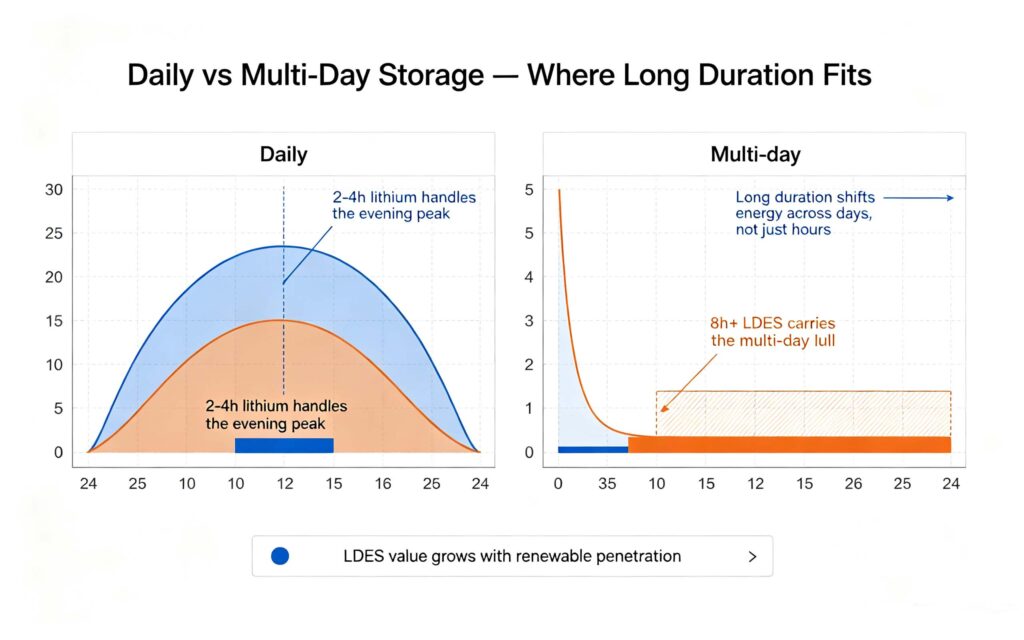
The need for LDES comes from the shape of renewable generation, not from technology fashion. Solar generates mostly at midday; wind varies over days. As renewables grow, systems face multi-day lulls and seasonal gaps that a 4-hour battery cannot bridge at reasonable cost.
Short-duration storage handles the daily shape — morning ramp, evening peak. Long duration storage handles what remains: carrying load through several cloudy days, shifting weekend surplus to weekday, and in some regions moving summer energy to winter. The value of LDES therefore rises with renewable share; grids at high penetration are where the economics first cross. For the daily-peak side that lithium batteries already serve, see #103 peak shaving and energy arbitrage.
The main technology routes compared
Each LDES route trades off duration, cost, efficiency, site constraints and maturity. The table below maps them at a high level.
| Technology | Typical duration | Efficiency | Site needs | Maturity |
|---|---|---|---|---|
| Flow battery | 4–12+ hours | Moderate (65-80%) | Large footprint, electrolyte tanks | Commercial |
| Compressed air | 8h+ | Moderate (40-70%) | Caves / high-pressure vessels | Early commercial |
| Gravity | 8h+ | Moderate | Vertical shaft / terrain | Pilot / early |
| Iron-air | 100h+ | Low-moderate | Moderate | Demonstration |
| Pumped hydro | 10h+ | High (70-85%) | Two reservoirs, terrain | Mature |
| Lithium-plus | 4–8h+ | High (85-92%) | Standard BESS site | Mature |
The table is a map, not a verdict: efficiency numbers vary by design and operating point, and costs are moving quickly. The durable differences are site needs and maturity — those change slowly, while price and efficiency change yearly.
How to choose for a project
Selecting a long duration energy storage technology is a modelling exercise, not a headline comparison. The steps that work:
- Define the duration need: model the resource mix and the gap — is it 8 hours, 24 hours, or seasonal? Different gaps need different routes.
- Match the site: geology for compressed air or pumped hydro, footprint for flow or gravity, permitting and grid connection constraints.
- Model the duty cycle: cycles per year, depth per cycle, and efficiency at that operating point — the annual energy through the system decides the economics.
- Compare full-life cost: capital, efficiency losses, degradation, O&M, and warranty structure over the asset life, not first-cost per kWh.
- Check maturity: operating references, the supplier’s track record, and the warranty and service package.
For projects where 4–8 hours is the real need, a mature lithium-plus configuration may beat an emerging LDES route on risk-adjusted cost — the technology choice follows the need, not the other way around. For the lithium baseline, see #68 lithium ion battery storage.
Where the market stands and what buyers should watch
LDES is a fast-moving space with real demonstrations and some commercial plants, but the market is younger than the lithium storage market buyers are used to. What to watch: verified efficiency and degradation data from operating plants (not pilot claims), the supplier’s balance sheet and warranty execution history, and the total installed-cost trajectory — cost per kWh of discharge is the number that matters, not cost per kWh of nameplate capacity.
Buyers should also watch how the LDES project is financed: the revenue model (capacity payment, energy arbitrage, renewable integration) changes which technology wins. For the grid-connection and dispatch side that every storage technology must satisfy, see #111 BESS commissioning and grid connection.
Q. What is long duration energy storage?
It is storage that discharges continuously for roughly 8 hours up to days or seasons, shifting renewable energy across gaps that short-duration batteries cannot cover — night, multi-day weather events and seasonal shortfalls. Its value rises with renewable penetration, because that is when multi-day and seasonal gaps become economically significant.
Q. What are the main long duration energy storage technologies?
Flow batteries (4-12+ hours, decoupled power and energy), compressed air (8h+, cave or vessel storage), gravity storage (lifting and lowering masses), iron-air batteries (100h+, early stage), pumped hydro (10h+, mature) and lithium-plus configurations (4-8h+, mature). They differ in duration, efficiency, site needs and maturity.
Q. How long is “long duration” in energy storage?
There is no universal boundary, but the common industry definition is roughly 8 hours of continuous discharge and above, with some definitions extending to days or seasons. The practical definition is project-specific: the duration that lets storage carry the system through a sustained low-generation period, not just a daily peak.
Q. Is long duration storage more expensive than lithium batteries?
It depends on the metric. On cost per kWh of capacity, some LDES routes claim advantages at very long durations, but the fair comparison is full-life cost per kWh discharged, including efficiency, degradation, O&M and warranty. For many 4-8 hour applications, mature lithium-plus still wins on risk-adjusted cost; longer durations favour other routes.
Q. When is long duration energy storage worth it?
When renewable penetration is high enough that multi-day lulls and seasonal gaps become real economic problems, and when the revenue model pays for long-duration capability. Model the resource mix, the duration gap, the duty cycle and the full-life cost before choosing — the technology follows the need, not the other way around.
Next step: model the gap, then compare routes on full-life cost
Long duration energy storage is the answer to a specific problem — sustained low-generation periods that short-duration batteries cannot bridge. Define the duration need from your resource mix, match the site, and compare technologies on full-life cost per kWh discharged, not headline price.
- Start with the utility-scale overview in #22
- Compare against lithium in #68
- Plan grid connection with #111
- Ask leekooenergy for a storage technology assessment that starts from your resource mix and duration gap, models the duty cycle and full-life cost, and matches the route to the site — so the long duration energy storage you evaluate is the one your project actually needs