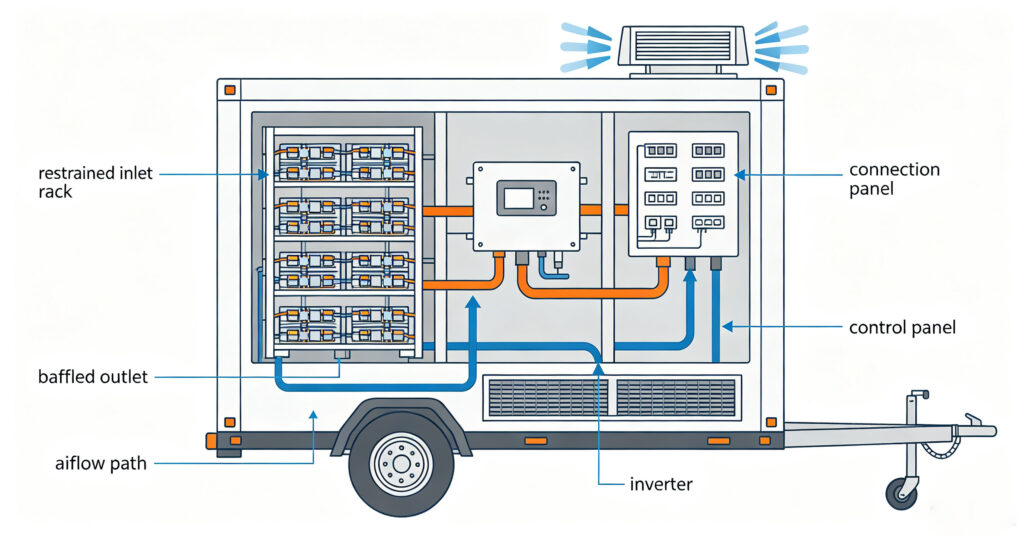
A mobile battery energy storage system is a battery, inverter and control package built into a trailer, a skid or a truck bed so that it can be towed or driven to a site, connected within minutes, and taken away again when the job ends — typically in the tens to low hundreds of kilowatt-hour class, far larger than a portable power station and far smaller than a fixed container. It replaces the diesel generator in the applications where the generator’s real costs are not fuel but noise, exhaust, fuel logistics, permitting and the crew required to babysit it. The one-line version worth quoting: a mobile unit competes with a generator on a rental invoice and wins on everything the invoice does not show.
This guide is for the person specifying temporary power: an event or construction contractor, a disaster-response planner, a rental fleet manager, or a facilities team planning a bridge-power contingency. It covers the deployment cases, the five technical constraints that decide the design, how to size a unit, and the transport and compliance questions that arrive with anything on wheels. The fixed container alternative is in #121 containerized BESS; the commercial models for renting rather than buying are in #58 battery storage rental.
Four deployment cases
| Case | Typical load | Duration | What the unit must do |
|---|---|---|---|
| Events, film and broadcast | Lighting, sound, catering, vendor booths | Hours to days | Run silently, start instantly, accept a top-up while working |
| Construction and fit-out | Tools, welfare units, temporary site power | Weeks to months | Take mains or generator input, survive dust and weather |
| Emergency and disaster response | Medical, communications, lighting, water pumping | Days, unpredictable | Deploy without infrastructure, recharge from any source available |
| Planned outage and bridge power | Critical loads during maintenance or upgrade | Hours, scheduled | Transfer seamlessly, run in parallel with the grid where required |
A mobile battery energy storage system in the fourth case is the one with the most technical content, because a unit that must support a critical load through a planned transfer has to behave correctly at the moment of switching. That means an automatic or manual transfer arrangement, correct synchronisation when running alongside the grid, and a clear statement of which loads are on the protected bus.
Five technical constraints
Mobile duty imposes five requirements that a fixed installation does not have.
- Mechanical ruggedness. Everything inside is subject to road vibration and shock for the whole journey. Cells need proper compression and restraint, busbars need support against flexing, and every connector needs a positive lock. A pack that is fine on a slab can work loose on a highway.
- Weather sealing with ventilation. The enclosure has to keep out rain and dust while still moving heat, which usually means filtered and baffled ventilation rather than an open grille, and a drainage path for condensation.
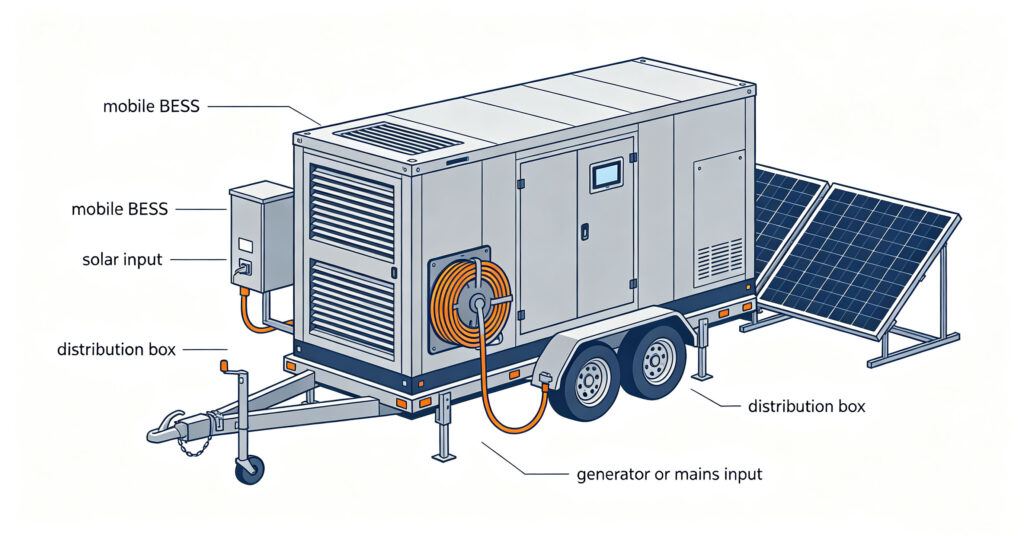
- Charging from anything. A mobile unit should accept mains, a generator, or a solar array, because the next site’s available source is unknowable in advance. The wider input window the better, and the changeover should not require tools.
- Transport compliance. A lithium battery above a certain size being moved on public roads is dangerous goods, and the classification, documentation and sometimes the driver qualification follow from the energy content. This is the constraint most often discovered late.
- Simple, labelled operation. The person connecting it on a Friday evening is not the engineer who specified it. Connector types, a clear start procedure and visible state-of-charge indication matter more on a mobile unit than on anything installed once by specialists.
Sizing a unit
Three numbers, in this order, and they are not interchangeable.
- Energy in kWh: average load in kilowatts multiplied by the hours it must run. This sets the battery.
- Power in kW: the largest simultaneous load, including surge. This sets the inverter, and it is independent of the energy — a unit with plenty of energy can still be unable to start a motor.
- Recharge power and time: how fast the unit can be brought back between uses. An event that runs all day and recharges overnight needs a very different charger from one that runs for four hours and recharges over two days.
A useful sanity check is to divide the required energy by the shift length: if the result is close to the unit’s continuous power rating, the unit will be running flat out for the whole shift and there is no headroom for a surge. Slightly oversizing the inverter for surge is usually cheaper than dealing with a nuisance trip in front of an audience. The chemistry and cycle-life reasoning behind the choice of LFP for this duty is in #33 LiFePO4 vs NMC, and the thermal design question that follows from continuous high-rate duty is in #88 liquid-cooled BESS thermal design.
Against the diesel generator
The comparison is usually made on rental day-rate and should be made on five lines.
- Fuel and logistics: the generator needs deliveries, storage and spill management; the battery needs a charging source.
- Noise and emissions: the deciding factor indoors, at night, and at any event with a noise clause.
- Crew time: a generator is often rented with an attendant; a battery unit is not.
- Load behaviour: a generator runs inefficiently at low load and must be sized for peaks, while a battery handles a variable load without penalty.
- Refuelling versus recharging: where the grid is available on site, recharging is free; where it is not, a generator plus a battery hybrid often beats either alone.
The full comparison for a fixed installation is in #47 home battery vs generator, and the plant-level backup perspective is in #149 industrial plant backup power.
What to check before buying or renting
Six questions, and the fifth is the one that surprises people.
- On-grid and off-grid modes: can the unit run standalone, pass through mains, and charge while supplying load?
- Transfer arrangement: is there a transfer switch, and who specifies it at the site?
- Connection standard: which sockets or single-pole connectors, and do they match the site’s distribution?
- Environmental limits: operating temperature range, ingress rating, and whether the unit can run in the rain.
- Transport classification and documentation: dangerous-goods class, the documentation supplied, and whether a qualified driver is required. The certification landscape is described in #107 battery export certification.
- Service and spares: who fixes it, where, and how fast — the rental question that decides repeat business.
Fleet buyers should also ask about remote monitoring, because a rented unit that reports its own state of charge and location is materially cheaper to operate than one that has to be visited to be checked. The monitoring layer is described in #83 battery monitoring system manufacturers.
Q. What is a mobile battery energy storage system?
A mobile battery energy storage system is a battery, inverter and control package built into a trailer, skid or truck bed so it can be transported to a site, connected quickly and removed afterwards. It typically sits in the tens to low hundreds of kilowatt-hour range and is used for temporary power at events, construction sites, emergency response and planned outages.
Q. How is it different from a portable power station?
Scale and mobility method. A portable power station is carried by one or two people and stores up to a few kilowatt-hours. A mobile battery energy storage system requires a tow vehicle or truck, stores far more, and usually provides three-phase or higher single-phase power with a proper connection panel.
Q. Can it replace a diesel generator?
Often yes, where noise, exhaust, fuel logistics or indoor use are the problem. The comparison should include fuel and delivery cost, crew time, load behaviour and recharging availability, not just the day-rate. Where no charging source exists on site, a generator paired with a battery is frequently the best combination.
Q. How long does a mobile unit run?
Depends on the load. Divide the usable energy by the average load in kilowatts to get hours, then check that the peak load including surge is within the inverter’s rating. A unit with enough energy can still trip if its power rating is too small for the starting surge of a motor.
Q. Are there transport restrictions?
Yes. Lithium batteries above a certain energy content are classified as dangerous goods for road transport, which brings documentation, packaging, marking and sometimes driver qualification requirements. Ask the supplier for the classification and the documentation set before scheduling a move.
Next step: size on energy and power separately
A mobile battery energy storage system fails on the surge far more often than on the energy. Check both numbers before comparing rental rates.
- Compare rental models in #58 battery storage rental
- Check the container alternative in #121 containerized BESS
- Review generator comparison in #47 home battery vs generator
- Tell leekooenergy your load in kilowatts, the largest surge, the shift length in hours and whether mains is available at the site — and ask for a configuration that states usable energy, continuous and surge power, recharge time from each source, the transport classification and the connection standard