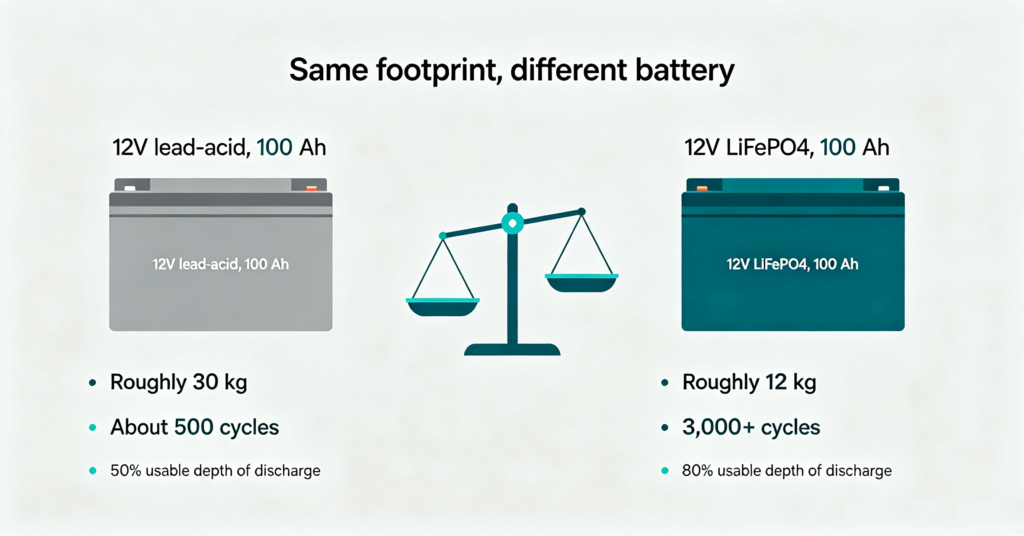
A 12v lifepo4 battery is a lithium iron phosphate battery with a nominal voltage of 12.8 V, built from four 3.2 V cells in series, and designed to drop into the spaces where 12V lead-acid batteries have worked for decades. It stores the same usable energy in roughly a third of the weight, delivers several times more cycles, and can be discharged deeper without damage — which is why it has become the default replacement for deep-cycle lead-acid in off-grid solar, mobile and backup systems. The one-line version worth quoting: when you replace a 12V lead-acid battery with a 12v lifepo4 battery of the same amp-hour rating, you are not just buying a lighter battery — you are buying three to five times the cycle life and a larger usable window, provided the charger and the system are set up for lithium voltages and the cells are protected by a proper BMS.
Twelve-volt systems are everywhere — small solar arrays, boats, caravans, gate openers, telecom shelters and starter-less backup loads — and most of them were designed around lead-acid habits. Those habits, especially float charging and discharging to empty, are exactly what shortens a lithium battery’s life. This guide covers what the numbers on a 12V LiFePO4 label actually mean, how the battery compares with the lead-acid unit you are replacing, how to wire it in series and parallel safely, how to charge it correctly, and what to check when you buy in volume. If your application is a full home or larger solar system rather than a single 12V circuit, the right product is usually a 48V system, and the comparison is covered in #35 48V lithium batteries explained.
Why a 12V LiFePO4 battery is not a 12V battery
Lead-acid “12V” batteries actually sit near 12.6–12.8 V when full and are charged to around 14.4–14.8 V. A four-cell LiFePO4 pack has a nominal 12.8 V, rests near 13.2–13.4 V when full, and charges to about 14.2–14.6 V. The numbers are close enough that many loads work unchanged, but different enough that chargers and charge controllers need a lithium profile. The bigger difference is behaviour: a lead-acid battery is normally limited to roughly 50% depth of discharge if you want a reasonable life, while an LFP pack is designed to cycle to 80% or more of its rated capacity every day. That single difference is why the same amp-hour rating delivers more usable energy from the lithium battery, and why switching is popular even where the load never changes. The full cost and benefit analysis of leaving lead-acid behind is in #24 lithium vs lead-acid deep cycle.
Reading the numbers: amp hours, kilowatt-hours and C-rate
The label on a 12v lifepo4 battery gives you four numbers that decide whether it fits. Voltage: nominal 12.8 V for four series cells. Amp hours (Ah): the charge capacity; multiply by 12.8 V to get kilowatt-hours. Continuous C-rate: how many amps the battery can sustain, where 1C for a 100 Ah battery means 100 A. Peak C-rate: the short surge the BMS allows, which matters for inverter or motor starts. The table converts the common sizes so the energy number is easy to compare.
| Size | Energy at 12.8 V | Usable at 80% DoD | Typical role |
|---|---|---|---|
| 12V 50 Ah | 0.64 kWh | ≈0.5 kWh | Small loads, electronics, gate systems |
| 12V 100 Ah | 1.28 kWh | ≈1.0 kWh | Small solar cabins, trolling applications |
| 12V 200 Ah | 2.56 kWh | ≈2.0 kWh | Off-grid cabins, larger mobile loads |
| 12V 300 Ah | 3.84 kWh | ≈3.1 kWh | High-draw systems, backup clusters |
Two warnings follow from the table. First, “usable at 80%” assumes the BMS and inverter are set so the battery is not drained past that point; the same pack can die early if a lead-acid inverter keeps pulling it to empty. Second, amp hours are not directly comparable across voltages — a 12V 200 Ah battery holds 2.56 kWh, while a 48V 100 Ah battery holds 5.12 kWh, and the product families are not interchangeable. For sizing a solar system on this basis rather than guessing, the load-based method in #23 off-grid solar system batteries walks through the calculation.
Series, parallel and balancing: building 24V and 48V from 12V
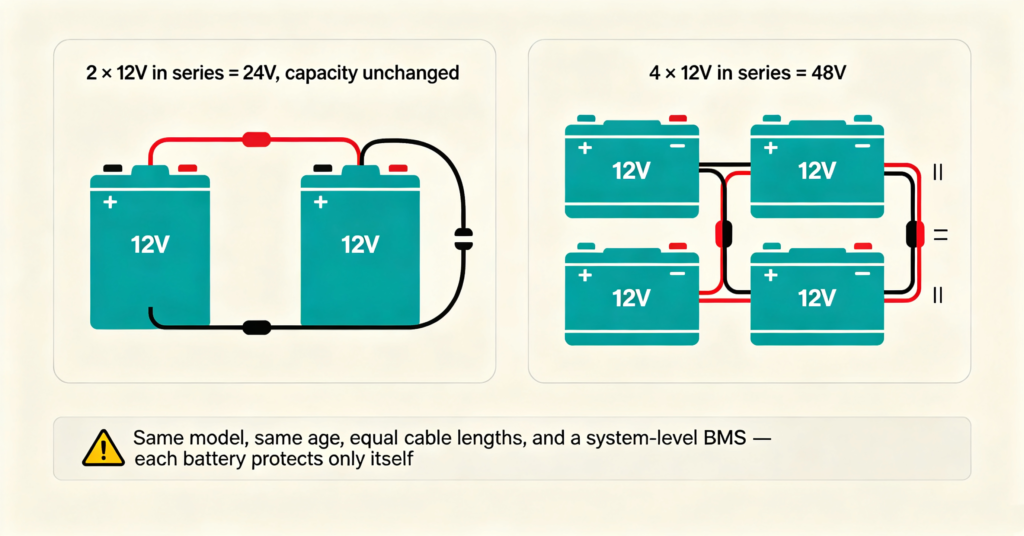
Wire batteries in series to raise voltage: two 12V packs make a 24V string and four make a 48V string, with amp hours unchanged. Wire them in parallel to raise capacity at the same voltage: two 12V 100 Ah packs in parallel give 12V 200 Ah. The rules that keep this safe are strict. Use batteries of the same model, same age and same state of charge; connecting an old and a new pack lets the weaker one drag the string. Keep series and parallel cable lengths equal so current shares evenly. And understand that the BMS inside a battery protects its own cells, not the string — series strings above 12V need a system-level check, because if one pack trips while others push, the voltage can swing dangerously. For solar and home storage, a native 48V battery built from 16 cells is usually a better engineering choice than four 12V packs in series, and the reasoning is in #12 48V vs 51.2V solar battery.
Charging a 12v lifepo4 battery correctly
Three charger settings decide whether a 12v lifepo4 battery lives its rated life or fails early. Charge voltage: bulk and absorption around 14.2–14.6 V for a 12V LFP pack, and never a lead-acid profile that pushes toward 15 V. Float: switch it off — LFP does not need float charging, and holding the cells at full voltage for months accelerates calendar aging. Temperature: charging below about 0 °C damages LFP cells unless the battery has internal heating, so a lithium-specific charger or a BMS with low-temperature cut-off is essential in cold climates. When the charger is a solar charge controller or a vehicle alternator, check that it has a lithium mode or a programmable profile, because a controller set for lead-acid will overcharge an LFP pack. These limits are exactly what the protection electronics enforce, and the details of how the BMS cuts off overcharge, over-discharge and cold charging are in #49 BMS protection: overcharge, over-discharge and thermal.
Where a 12V system is the right answer
A 12V LFP battery wins in three situations. First, retrofit: where a 12V load, wiring and charger already exist, swapping the battery needs no re-wiring, which makes the upgrade cheap. Second, small and mobile systems: single-cabinet loads, lighting, pumps, communication gear and vehicle auxiliary power, where the simplicity of one 12V circuit beats the efficiency of a higher-voltage design. Third, OEM products: equipment built around a 12V bus — trailers, medical carts, cleaning machines, telecom enclosures — where a drop-in lithium pack extends the product’s value without redesign. A 12V system is usually the wrong answer when power grows: moving 3 kW or more over 12V needs thick cable and suffers losses that a 24V or 48V bus avoids, and whole-home storage with solar is far better served by a 48V battery system, as #39 residential LiFePO4 battery options explains.
What to check when buying 12V LiFePO4 in volume
Once the product family is chosen, the buying decision comes down to six checks, and they matter more when you buy dozens of units. Cell grade: ask for the cell brand and grade, because A-grade cells are what make cycle-life claims real. BMS quality: the BMS is the most common failure point in a 12V pack, so name the BMS and its protection list. Continuous and peak ratings: confirm the C-rate matches the inverter or load surge you will connect. Low-temperature charging: if the pack will see cold, require low-temperature cut-off or heating. Certifications: UN38.3, cell and pack test reports, and the safety marks for your market. Cycle-life data: ask for cycles at your depth of discharge with the test method, not a headline number at unrealistically shallow DoD. The same discipline applied at manufacturer level is covered in #21 how to evaluate battery manufacturers, and the economics of buying packs at higher cycle ratings is priced in #46 cycle life vs price.
Q. What is the difference between a 12V LiFePO4 battery and a 12V lead-acid battery?
The lithium battery stores the same usable energy at roughly a third of the weight, delivers several times more cycles, and can be discharged to about 80% instead of 50%. It also needs a lithium charger profile and a BMS, which lead-acid systems do not require.
Q. Can I use a 12v lifepo4 battery to start an engine?
Not as a direct replacement for a starter battery. LFP packs are built for deep-cycle service, and a BMS may trip on the huge surge of an engine start. Use a battery specifically rated for cranking, or keep starting duty on the original starter battery.
Q. How many amp hours do I need?
Work out the daily load in watt-hours, divide by 12.8 V for the amp hours consumed, multiply for the days of autonomy you want, and divide by the usable depth of discharge, typically 80% for LFP. Sizing this way instead of guessing usually lands on 100, 200 or 300 Ah.
Q. Can I connect 12V LiFePO4 batteries in series?
Yes, to make 24V or 48V strings, but only with batteries of the same model, age and state of charge, equal cable lengths, and a system-level protection design — the BMS inside each battery protects only that battery, not the string.
Q. What voltage should charge a 12v lifepo4 battery?
Charge to about 14.2–14.6 V with a lithium or programmable profile, and disable float charging. Charging below about 0 °C damages the cells unless the battery has internal heating or a low-temperature cut-off.
Next step: match the 12V pack to the real load
The right 12V LiFePO4 battery is the one whose amp hours, C-rate and cold-weather behaviour match your actual circuit — not the cheapest amp-hour on the page.
- Check whether the switch from lead-acid pays off in #24 lithium vs lead-acid deep cycle
- Confirm 12V is the right voltage for the job in #35 48V lithium batteries explained
- Verify the supplier behind the cells in #21 how to evaluate battery manufacturers
- Ask leekooenergy for 12V LiFePO4 specifications that state the cell brand, BMS protection list, C-ratings and cycle data at your depth of discharge — a 12-volt battery you can specify with confidence