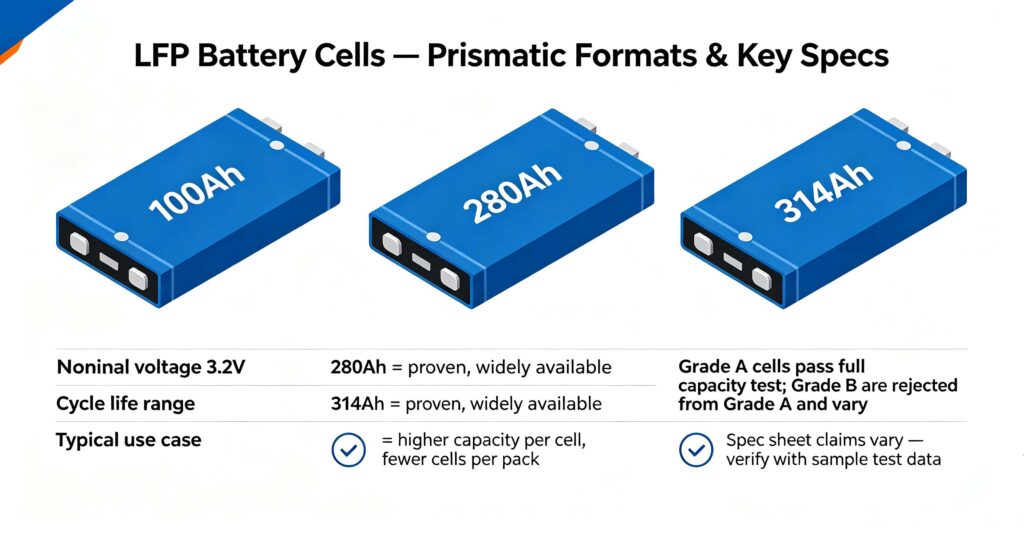
LFP battery cells are the cylindrical or prismatic lithium iron phosphate units that power most modern stationary storage systems, and choosing them comes down to three decisions: format (prismatic dominates stationary storage), capacity (280Ah is proven and widely available; 314Ah gives more capacity per cell), and grade (Grade A passes full capacity and consistency tests; Grade B is rejected stock with variable quality). For a B2B buyer, the practical choice is usually prismatic cells — 280Ah for proven supply chain and proven pack design, 314Ah where fewer cells per pack and higher energy density matter. Always verify the spec sheet with sample test data before volume orders, because claimed specifications vary across suppliers.
For a pack builder or brand, lfp battery cells are the single biggest cost and quality driver in the system. This guide covers the formats, the capacity trade-off and the procurement checks. For the deep 280 vs 314 comparison, see #25 LFP cells: 280Ah vs 314Ah.
The prismatic format that dominates LFP battery cells
While cylindrical and pouch cells exist, prismatic aluminum-can cells are the standard for stationary storage and C&I systems, and they shape the pack design choices that follow.
Prismatic cells: rectangular aluminum can, rigid, easy to stack and bolt, with a wide range of capacities (50Ah to 314Ah and beyond). They dominate rack and cabinet storage because mechanical structure is straightforward.
Cylindrical cells: smaller individual cells, more cells per pack, more connections. Common in smaller systems and some EV-derived packs, but less common in large stationary storage.
Pouch cells: flexible, higher energy density per volume, but require strong mechanical containment and have shorter track record in stationary applications.
For how these cells go into a finished pack, see #48 lithium cell wholesale and pack assembly.
280Ah vs 314Ah: the LFP battery cells choice most buyers make
The two dominant prismatic capacities create a real trade-off in pack design, supply chain and cost. The table below compares the practical implications.
| Dimension | 280Ah cell | 314Ah cell |
|---|---|---|
| Proven track record | Longer production history, widely validated | Newer, but growing quickly |
| Cells per 48V pack | More cells, more connections | Fewer cells, fewer connections |
| Energy per cell | ~896 Wh (3.2V × 280Ah) | ~1,005 Wh (3.2V × 314Ah) |
| Supply chain | Broad, competitive pricing | Still maturing, fewer sources |
| Pack design impact | Proven mechanical layouts | Newer dimensions to accommodate |
The detailed trade-off analysis is in #25 LFP cells: 280Ah vs 314Ah. For reading the spec sheet itself, see #115 how to read LiFePO4 battery specs.
Grade A vs Grade B: the procurement risk in LFP battery cells
Cell grade is where price cuts become quality problems. Understanding it protects the buyer from the most common procurement trap.
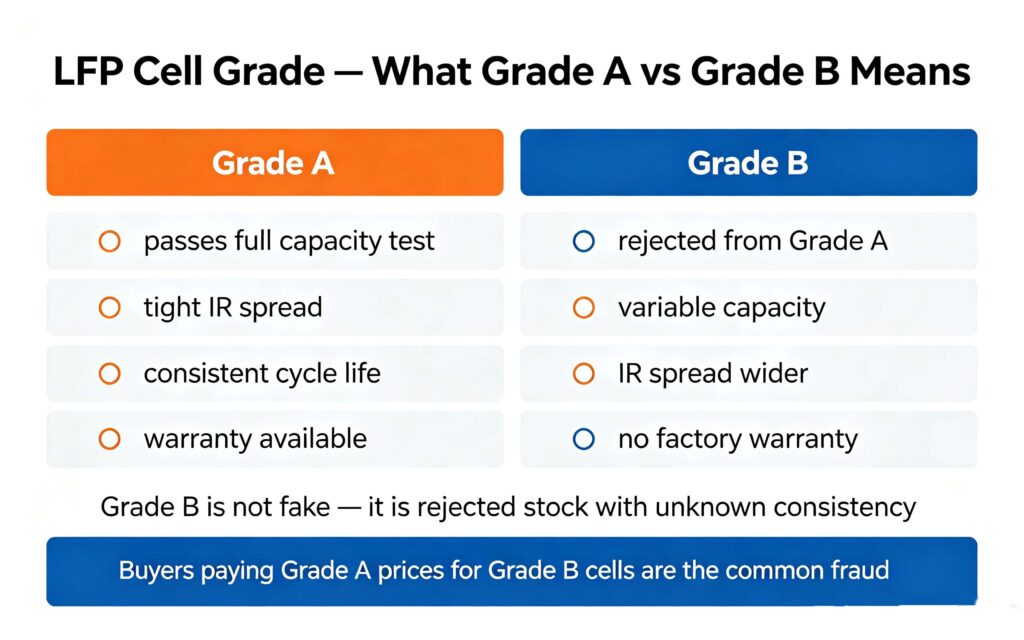
Grade A cells pass the factory’s full capacity, consistency and appearance tests. They come with factory warranty and consistent cycle life. This is what a commercial storage project should specify.
Grade B cells are rejected from Grade A production — they may have lower capacity, wider internal resistance spread or cosmetic defects. They are not fake, but their consistency is unknown, and they carry no factory warranty. A pack built on Grade B cells can still work, but failure rates and warranty risk shift to the buyer.
The common fraud: selling Grade B cells at Grade A prices. The protection is sample testing before volume orders — measure capacity and IR on random samples and compare to the spec sheet.
The spec sheet every buyer should verify
Claimed specifications vary across suppliers. The buyer-side checklist converts a brochure into testable numbers.
- Rated capacity at what current and temperature: the same “280Ah” measured at 0.5C and 25°C vs 1C and 20°C are different numbers.
- Internal resistance spread: Grade A cells have a tight IR range; ask for the actual distribution.
- Cycle life to what capacity retention: “6,000 cycles” means little without the retention threshold (e.g., 80%).
- Dimensions and weight: pack design depends on real dimensions, not nominal ones.
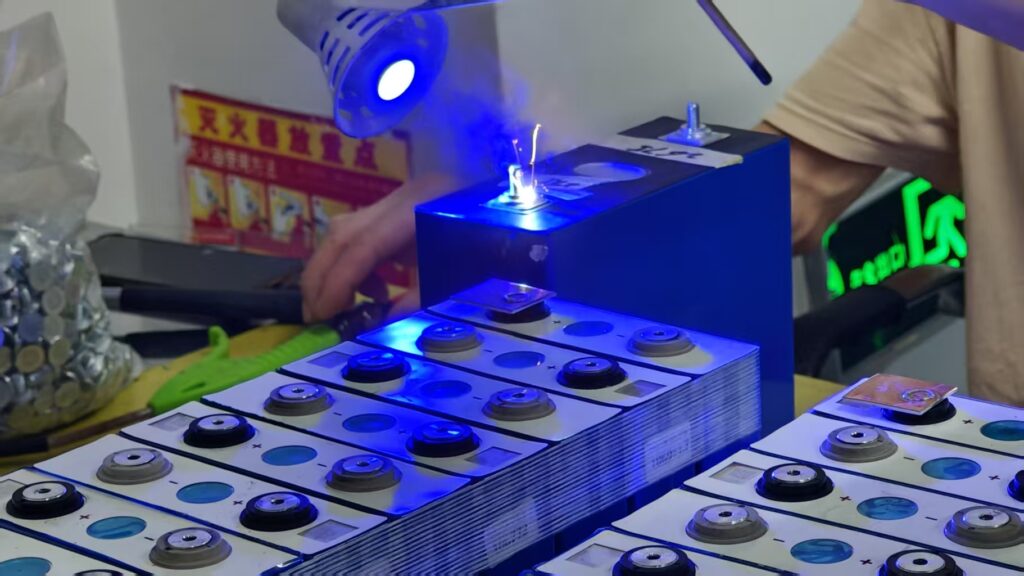
- Sample test data: before volume, order a small batch and test random units yourself.
For the broader cell wholesale context, see #48 lithium cell wholesale and pack assembly.
Q. What are LFP battery cells and why do they dominate storage?
LFP battery cells are lithium iron phosphate units, usually prismatic aluminum-can format, that deliver longer cycle life and better thermal safety than NMC cells. They dominate stationary storage and C&I systems because the chemistry is stable, the cells are available in large capacities like 280Ah and 314Ah, and the total cost per cycle is lower over a 6,000-plus cycle life.
Q. Should I choose 280Ah or 314Ah LFP cells?
Choose 280Ah if you want a proven supply chain, validated pack designs and competitive pricing. Choose 314Ah if fewer cells per pack and higher energy density justify the newer, less mature supply chain. For most commercial projects, 280Ah remains the safer default; 314Ah suits designs where pack count and footprint matter more than supply chain maturity.
Q. What is the difference between Grade A and Grade B LFP cells?
Grade A cells pass the factory’s full capacity, consistency and appearance tests and carry a factory warranty. Grade B cells are rejected from Grade A production — they may have lower capacity, wider internal resistance spread or cosmetic defects, and they carry no factory warranty. They are not fake, but their consistency is unknown. The common fraud is selling Grade B at Grade A prices; sample testing before volume orders is the protection.
Q. How do I verify LFP cell specifications before ordering?
Ask for the rated capacity at a specific current and temperature, the internal resistance spread distribution, cycle life to a defined retention threshold (usually 80%), and actual dimensions. Then order a small sample batch and test random units yourself: measure capacity, voltage and internal resistance, and compare to the spec sheet. Verified samples, not brochure numbers, decide the volume order.
Q. Are prismatic LFP cells better than cylindrical for storage?
For stationary and C&I storage, prismatic cells are the practical standard: larger individual capacity means fewer cells per pack, easier mechanical stacking, and a mature supply chain. Cylindrical cells work in smaller systems but require far more connections. Pouch cells offer higher density but less track record in stationary applications. The format choice is driven by pack architecture, not chemistry alone.
Next step: specify cells with verified samples
LFP battery cells define the pack’s cost, life and risk. Choose the format that fits your pack architecture, specify Grade A on the spec sheet, and verify with sample test data before volume. The supplier that provides real sample data is the supplier you can scale with.
- Deep 280Ah vs 314Ah comparison in #25
- Read the spec sheet in #115
- Understand cell wholesale in #48
- Ask leekooenergy for LFP cell samples and test reports: 280Ah and 314Ah units with capacity, IR and cycle data, plus the Grade A specification they will honor in volume orders