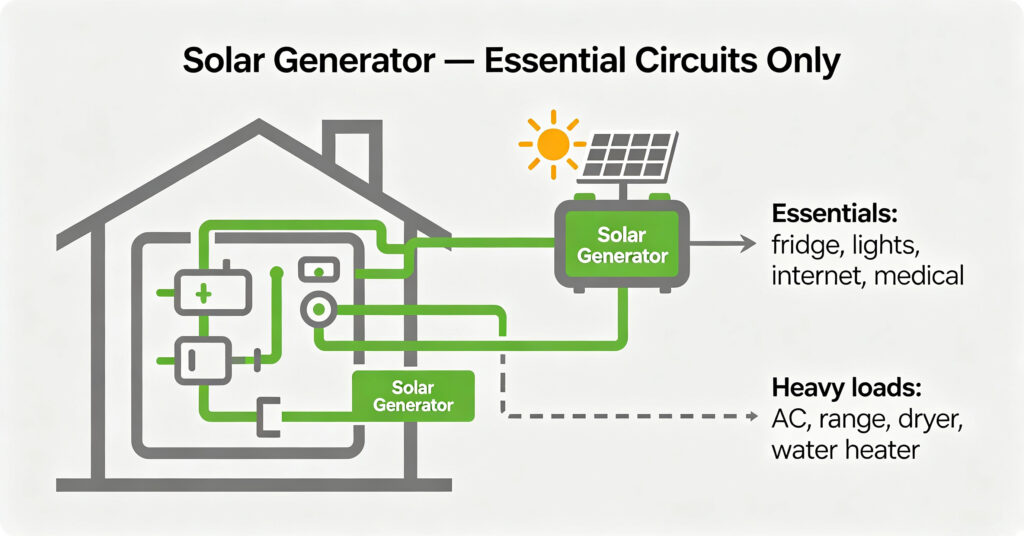
Can a solar generator power a house? Yes — but the honest answer depends entirely on what “power a house” means in your case. A solar generator is a combined battery, inverter and charge controller in one box, and it is limited by two independent numbers: continuous wattage (how much load it can run at once) and capacity in watt-hours (how long it can run that load). A unit with a 2,000W inverter and 2 kWh of capacity will run a refrigerator, lighting, a router and a few small appliances for hours. It will not start a central air conditioner, and it will not run an electric range, a clothes dryer or a resistance water heater at all. The realistic design target for a portable solar generator is essential circuits, not the whole service panel — and whole-house coverage is the point at which a fixed home battery system becomes the right answer.
The two numbers that decide everything
Every solar generator specification carries two ratings, and confusing them is the reason buyers are disappointed.
- Continuous power, in watts. The maximum load the inverter can supply indefinitely. Exceed it and the unit shuts down or trips, regardless of how much energy is left in the battery.
- Capacity, in watt-hours. The stored energy. Runtime at a given load is approximately capacity divided by load, adjusted for inverter efficiency and for the usable depth of discharge the manufacturer permits.
A unit can be generous on one and limiting on the other. A 4 kWh unit with a 1,500W inverter will run for a long time but cannot run many appliances simultaneously; a 1 kWh unit with a 3,000W inverter can start heavy loads but will drain quickly. Reading both together is what makes a specification meaningful, and the wider guidance on reading battery ratings is in #115 how to read LiFePO4 battery specs.
Surge: the reason a fridge is harder than it looks
Motor-driven loads — refrigerator compressors, well pumps, power tools, air conditioners — draw several times their running current for a fraction of a second when they start. The inverter must cover that surge or it will trip even though the steady-state load is well within its rating.
Three practical consequences follow:
- Check surge rating and duration. A unit advertised as “2,000W / 4,000W surge” may only sustain the surge figure for a few seconds, which is usually enough for a compressor start and often not enough for a well pump.
- Stagger starts. Two motor loads starting simultaneously can exceed the surge capability even when each is individually fine.
- Expect a derating in heat. Inverter output falls as the unit heats up, so a unit that just manages a load on a cool morning may trip on the same load in a hot garage.
What typical household loads actually need
The table below gives broad ranges for planning. Real values vary by appliance age, size and efficiency, and the nameplate or the appliance’s own label is always the better source.
| Load | Running power | Start surge | Realistic on a portable unit? |
|---|---|---|---|
| LED lighting, whole house | 50–200W | None | Yes, easily |
| Router, modem, phone charging | 20–80W | None | Yes, easily |
| Refrigerator / freezer | 100–400W running | 2–4× for a second | Yes with surge margin |
| CPAP or medical device | 30–100W | None | Yes |
| Microwave | 600–1,500W | Small | Yes on larger units, briefly |
| Well pump | 700–2,500W | 3–5× for a second | Only on large units |
| Central air conditioner | 2,000–5,000W | High | Usually no |
| Electric range, oven | 2,000–5,000W | None | No |
| Clothes dryer (electric) | 2,000–5,000W | Moderate | No |
| Resistance water heater | 3,000–5,500W | None | No |
The pattern is clear: electronics, lighting, refrigeration and small appliances are comfortably within reach. Anything that makes heat by passing current through a resistance element, and anything with a large compressor, is not.
A three-step load audit
Do this before shopping, and the specification question answers itself.
- List what must stay on. Not what would be nice — what cannot be without. Refrigeration, lighting on the circuits you use, communications, any medical equipment, and possibly a well pump or a sump pump.
- Write down running watts for each, and identify surge loads. Use the appliance label or a plug-in power meter; a measured value over a day is far better than an estimate, because refrigerators and freezers cycle rather than running continuously.
- Add them with a diversity factor, and pick the unit above the total. Not every load runs at once, so a straight sum overstates the requirement — but the surge capability must cover the largest single motor start on top of whatever else is running.
The same method applied to a fixed home battery, including how lighting and refrigeration duty cycles affect the answer, is worked through in #09 how to size a home battery.
Connection: the part people underestimate
Having enough watts is only half the problem. Getting the power into the house safely is the other half, and it is where a portable unit’s limits become obvious.
- Extension cords. The simplest approach and the only one that requires no electrical work: run the essentials directly from the unit’s outlets. It is safe, it is limited to what the cord reaches, and it cannot power hard-wired circuits.
- Transfer switch or interlock. To power circuits through the house panel, a transfer switch or a listed interlock kit is required. Its purpose is to physically prevent the generator from back-feeding the grid, which is a safety and legal requirement, not an optional convenience.
- 120V versus 120/240V. Most portable solar generators output 120V only. Household systems in North America use split-phase 120/240V, and any 240V load — well pumps, many air handlers, electric dryers and ranges — cannot run from a 120V source, regardless of the wattage available. The split-phase question is covered in #150 split-phase inverter guide.
The safe connection requirements, including the isolation rule that protects line workers, belong with the general installation guidance in #128 battery installation safety requirements.
Runtime, and what solar input actually adds
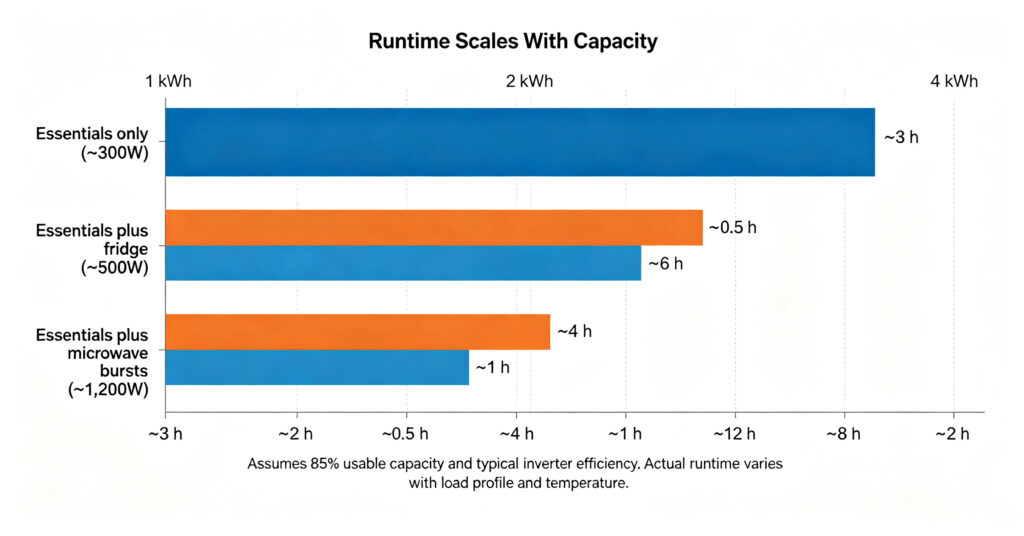
Runtime is capacity divided by load, corrected for usable depth of discharge and inverter efficiency. A 2 kWh unit running a 400W average essential load delivers roughly four to five hours, not the twelve a naive division suggests, because the battery should not be run completely flat and the inverter loses a percentage in conversion.
Solar input changes the picture in a specific way: it extends runtime during daylight but rarely replaces it. A portable panel array recharging a unit while it powers a load will slow the discharge and may hold steady on a sunny day, but the panel wattage is usually well below the load, so the battery still drains — just more slowly. Sizing the panel honestly, including the difference between rated panel watts and real output, is covered in #74 PV panel kits.
When the answer becomes a home battery instead
Three signals say the answer to whether a solar generator can power a house is no for your case and a fixed system is the right one.
- You need 240V loads. Well pumps, air handlers and dryers require a split-phase source that most portable units do not provide.
- You need more than a few hours of autonomy. Capacity sufficient for overnight or multi-day coverage is physically larger and better deployed as a fixed bank with a proper transfer setup.
- You want automatic switchover. A portable unit requires someone to plug things in. A fixed system with automatic transfer keeps the lights on without anyone being home.
The fixed-system alternative, including the case for storage without solar, is set out in #04 home battery backup without solar, and the comparison against a fuel generator is in #47 home battery vs generator. For the outage-planning perspective on which circuits matter, see #26 solar battery backup for outages. The portable unit itself, and the B2B field uses it suits better than whole-house duty, is described in #82 LiFePO4 portable power station.
Q. Can a solar generator power a house?
Realistically, no — not in the sense of powering every circuit. A portable solar generator can cover essential circuits such as refrigeration, lighting, communications and small appliances. Central air conditioning, electric ranges, dryers and resistance water heaters draw far more than a portable inverter can supply, and 240V loads require a split-phase source that most portable units do not provide.
Q. What size solar generator do I need to run a house?
Add the running watts of the loads you must keep on, then choose a unit whose continuous rating exceeds that total with margin and whose surge rating covers your largest motor start. For most households the essential-circuits requirement lands in the region of a few hundred to a couple of thousand watts continuous, with several kilowatt-hours of capacity for overnight coverage.
Q. How long will a solar generator run a refrigerator?
A refrigerator cycles rather than running continuously, so the useful measure is its average draw over a day rather than its compressor wattage. Divide the unit’s usable capacity by that average draw: a typical modern fridge on a 2 kWh unit will run for many hours, often most of a day, while the same unit also carries lighting and communications.
Q. Can I connect a solar generator to my house panel?
Only through a listed transfer switch, an interlock kit or a dedicated critical-loads sub-panel installed by a qualified electrician. Connecting a generator directly to the panel without an approved isolation device can back-feed the grid, which is dangerous to line workers and prohibited by electrical codes.
Q. Will solar panels keep the generator running indefinitely?
Usually not. Portable panel arrays typically deliver less power than the load draws, so they extend runtime during daylight rather than replacing it. Indefinite operation requires a panel array sized to exceed the average load with margin for weather, which is a fixed installation rather than a portable kit.
Next step: audit the loads before you buy the box
Whether a solar generator can power a house in your case comes down to two numbers: the continuous and surge wattage of what must stay on, and the hours of autonomy you need. Those two tell you whether you are shopping for a portable unit or for a fixed home battery.
- See the portable unit’s strengths in #82 LiFePO4 portable power station
- Size a fixed alternative in #09 how to size a home battery
- Check the 240V constraint in #150 split-phase inverter guide
- Ask leekooenergy for a backup load assessment that lists your essential circuits with measured running and surge watts, the recommended continuous and surge inverter rating with margin, the capacity needed for your target autonomy, and whether a portable unit or a fixed split-phase system is the right class of solution — so the purchase is matched to what your house actually needs to keep running