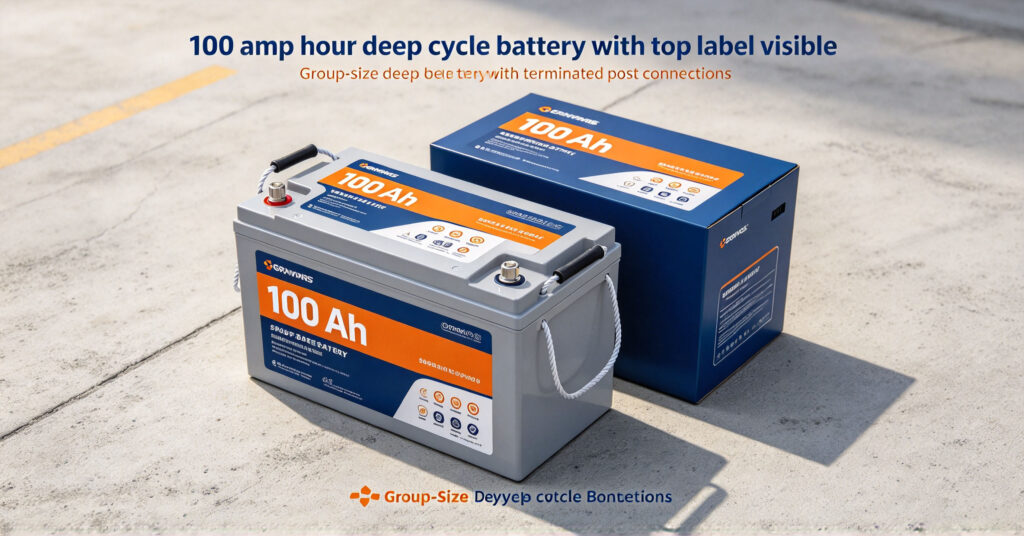
A 100 amp hour deep cycle battery carries a nameplate that flatters it. The 100 Ah figure is measured at a gentle twenty-hour discharge; pull the same energy in two hours and the bank delivers materially less, and do it cold and it delivers less again. That is physics, not a defect, and every deep-cycle battery is quoted the same way. This guide explains the rating conventions, the rate and temperature penalties, how to compare two spec sheets, and what a hundred amp-hours covers in real loads.
Two batteries with the same amp-hour number can behave very differently in the same circuit. The difference lives in the fine print of how the rating was measured.
What the nameplate actually promises
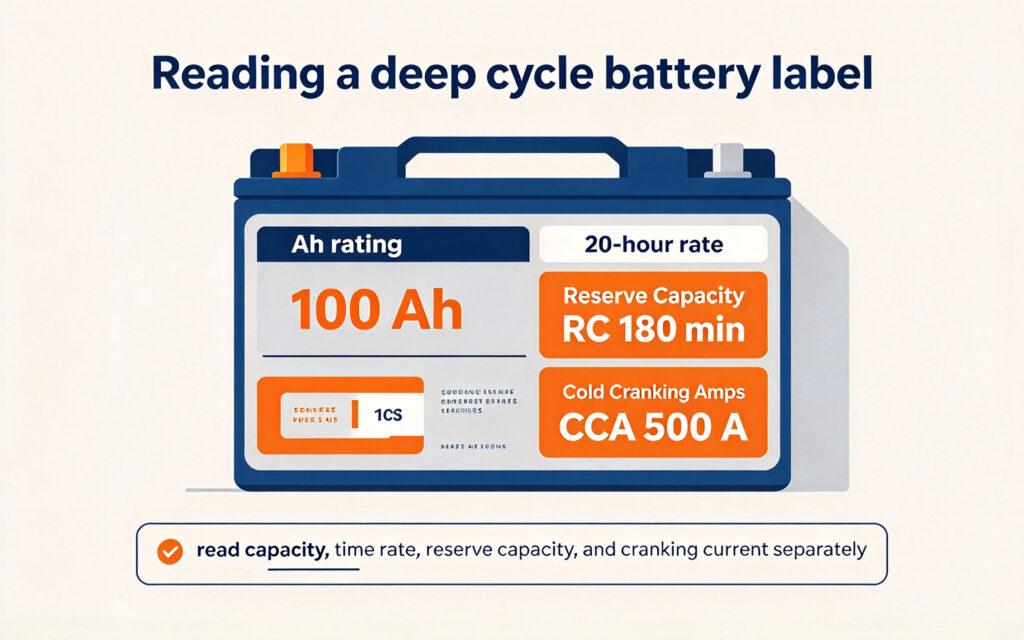
Amp-hours measure charge, not energy, and the industry measures them at a reference discharge rate. The common convention is the 20-hour rate: the battery is discharged over twenty hours down to a defined cutoff voltage, and the amp-hours delivered in that window become the rating. A 100 Ah battery at the 20-hour rate is therefore delivering about five amps for twenty hours — a gentle, almost laboratory duty.
Real loads are rarely gentle. Inverters, motors and heaters pull current in bursts and plateaus that have nothing to do with a five-amp trickle. The faster you draw, the lower the delivered capacity, and the relationship is not linear — doubling the current can cut delivered amp-hours by considerably more than the arithmetic suggests. A 100 amp hour deep cycle battery that shows 100 Ah on a slow test might deliver something meaningfully lower at the rates a household or a vehicle actually imposes.
Discharge rate: the Peukert penalty
The effect that links discharge rate to delivered capacity is described by the Peukert equation, and the practical takeaway does not require the maths. Lead-acid batteries suffer a steep penalty at high discharge rates because the electrochemical reaction cannot keep up with the current being drawn; lithium batteries suffer a much smaller one because their internal resistance is far lower. Two banks with identical 100 Ah labels — one flooded lead-acid, one lithium — will deliver noticeably different amounts under the same heavy load.
| Chemistry | Penalty at high discharge rate | What it means in practice |
|---|---|---|
| Flooded lead-acid | Steep; delivered capacity falls sharply as current rises | Size with a large margin for surge loads |
| AGM | Moderate; better than flooded at high rate | Reasonable middle ground for mixed loads |
| Gel | Moderate, similar to AGM | Watch thermal conditions more closely |
| Lithium (LFP) | Small; internal resistance is far lower | Nameplate capacity holds up under load |
This is why a specification that only lists amp-hours is incomplete. Ask for the capacity at the discharge rate you actually intend to use, or at least for the test rate alongside the number. The deep cycle lead acid battery guide covers the lead-acid side of this in more detail.
Temperature and age
Cold is the second discount on the label. Capacity is quoted at a reference temperature near room conditions; below that, the available charge falls, and at the same time the internal resistance rises, which compounds the discharge-rate penalty. A bank that performs to spec in summer can come up short on the first cold morning of the season — the same morning the load is likely largest. Garage and outbuilding installations feel this most, and it is the reason heated or insulated battery enclosures exist in cold markets at all.
Age works more slowly. Every cycle and every month on the shelf removes a little capacity, and the removal is not uniform: the first year is usually the steepest, after which the decline flattens before accelerating again near end of life. A bank bought new and a bank that has been through three seasons of daily cycling should not be expected to deliver the same amp-hours from the same nameplate. The LiFePO4 battery temperature range guide covers the temperature windows in detail.
Why the chemistry changes the arithmetic
The same 100 amp-hour label hides very different behaviour depending on what is inside the case. A flooded lead-acid bank at this rating is heavy, inexpensive per amp-hour, tolerant of careless charging, and steeply discounted by fast draws and deep cycling. An AGM bank trades some of that price advantage for better high-rate behaviour and no maintenance. A lithium bank at the same nameplate is the lightest by a wide margin, holds its voltage under load, and can be cycled deeply every day — but costs several times more per amp-hour and needs a charging profile that respects its protection limits.
None of that makes one chemistry universally correct. It makes the label a starting point rather than a conclusion: the same 100 amp hour deep cycle battery is one product in a lead-acid system and a very different product in a lithium one, and the duty decides which one the buyer actually needs. Where the duty is daily deep cycling with weight or space constraints, the AGM versus LiFePO4 deep cycle upgrade comparison lays out the upgrade case in full.
Comparing two spec sheets honestly
Faced with two 100 Ah batteries at different prices, the comparison that matters is delivered energy under your duty, adjusted for how deeply the chemistry can be cycled. A lead-acid bank discounted to 50 percent depth of discharge is effectively a smaller battery than a lithium bank usable to 90 percent — and the price difference has to be read against that, not against the nameplate.
Check three things beyond the headline number. First, the test rate behind the rating. Second, the recommended depth of discharge, which decides what fraction of the capacity is yours to use. Third, the warranty terms, particularly whether capacity fade is covered and at what threshold. A warranty that guarantees 80 percent of rated capacity at a stated cycle count is worth more than a longer warranty with a vague fade clause. The AGM versus LiFePO4 deep cycle upgrade comparison works through the upgrade case where these questions usually surface.
What a 100 amp hour deep cycle battery actually covers
Translate the number into loads before deciding it is enough. At a nominal 12 volts, a 100 amp hour deep cycle battery represents roughly 1.2 kWh of nameplate energy; at 24 volts the same cells represent about 2.4 kWh. After depth-of-discharge and inverter losses, the usable energy is a fraction of that. An evening of modest loads — lighting, a television, some charging — fits comfortably. A refrigerator plus a water pump plus a microwave over a long evening starts to press. Anything with a heating element or a compressor that cycles hard will exhaust the bank quickly.
For vehicles and marine use the same arithmetic applies with different loads: trolling motors, winches and anchor windlasses are surge-heavy, which is exactly where lead-acid capacity collapses and where a lithium bank earns its price. The group 27 deep cycle battery and group 24 deep cycle battery guides cover the case-size dimension of the same question.
Buying notes that protect the usable number
Buy to the duty, not the discount. If the load is surge-heavy or the installation is cold for part of the year, budget for a larger bank or a chemistry that holds capacity under stress. If the bank will be cycled daily, depth of discharge matters more than the headline rating. And keep the bank’s operating history — a simple log of cycles, loads and occasional capacity checks turns a nameplate into a managed asset. The li-ion cell voltage guide guide explains how voltage readings can be used to estimate state of charge on either chemistry.
Q. 100 amp hour deep cycle battery?
A 100 amp hour deep cycle battery is a deep-cycle battery rated to deliver 100 amp-hours at its reference discharge rate — a slow, 20-hour test that most real loads exceed, so delivered capacity is usually lower.
Q. How many watt-hours is a 100 Ah battery?
At 12 volts, roughly 1.2 kWh nameplate; at 24 volts, roughly 2.4 kWh. Usable energy is that figure multiplied by the usable depth of discharge and then discounted for inverter losses.
Q. Why does my 100 Ah battery run out faster than expected?
Almost always discharge rate, temperature or depth-of-discharge assumptions. Fast draws reduce delivered capacity, cold compounds the effect, and cycling below the recommended depth shortens both the runtime and the life.
Q. Can I connect two 100 Ah batteries in parallel?
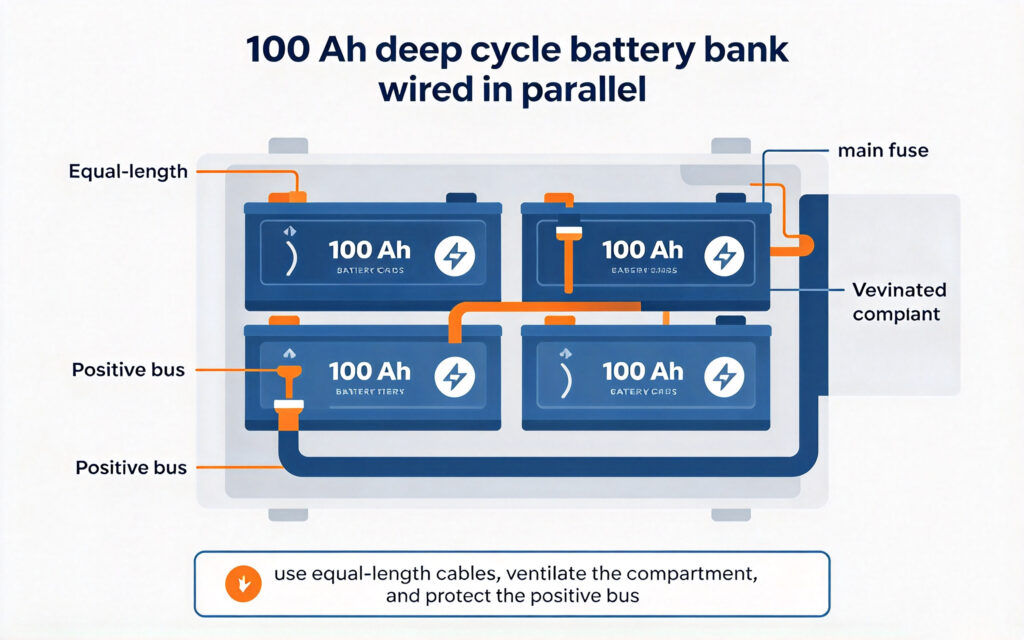
Yes, with care: match age and chemistry, use equal-length cables, and fuse each string. Parallel banks add capacity and surge capability while keeping voltage the same; mismatched banks will fight each other.
Q. How long should a 100 Ah deep cycle battery last?
It depends far more on how deeply it is cycled than on the nameplate. Shallow daily cycling with prompt recharging extends life considerably; habitual deep discharge in heat shortens it.
Q. Is a 100 Ah lithium battery really 100 Ah?
Much closer to it than lead-acid under load, because lithium internal resistance is far lower and the chemistry tolerates deep discharge. Check the specified depth of discharge and test conditions anyway.
Next step: buy to the duty, not the label
The right bank size comes from the real load profile. Send the load list, the surge loads and the operating temperature range.
- Verify health with a deep cycle battery load tester before trusting an existing bank
- Check the LiFePO4 battery temperature range if the site sees cold mornings
- Run the numbers with the how to size a home battery method before ordering
- For chisidal projects, send the load list, the surge loads and the operating temperature range, then ask for the capacity class matched to that duty