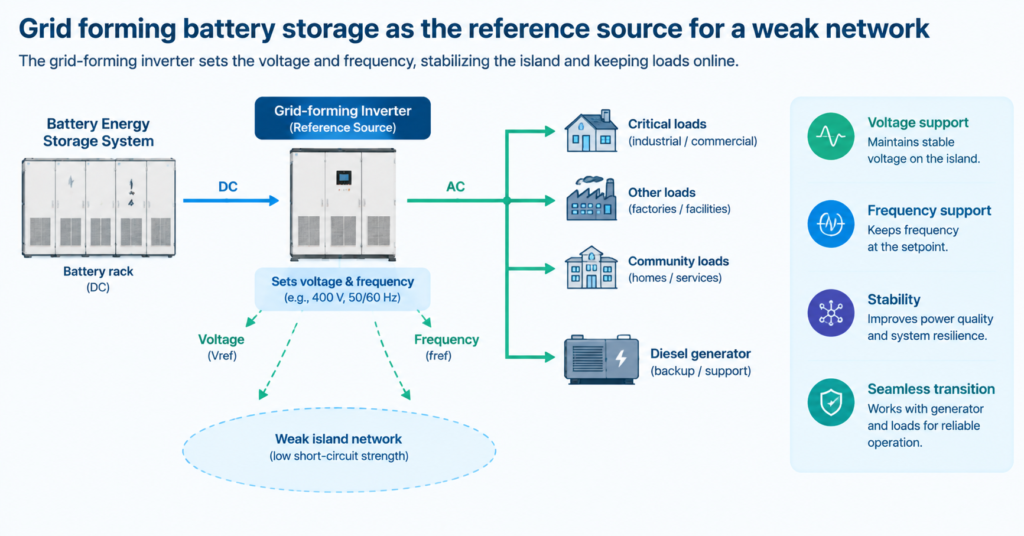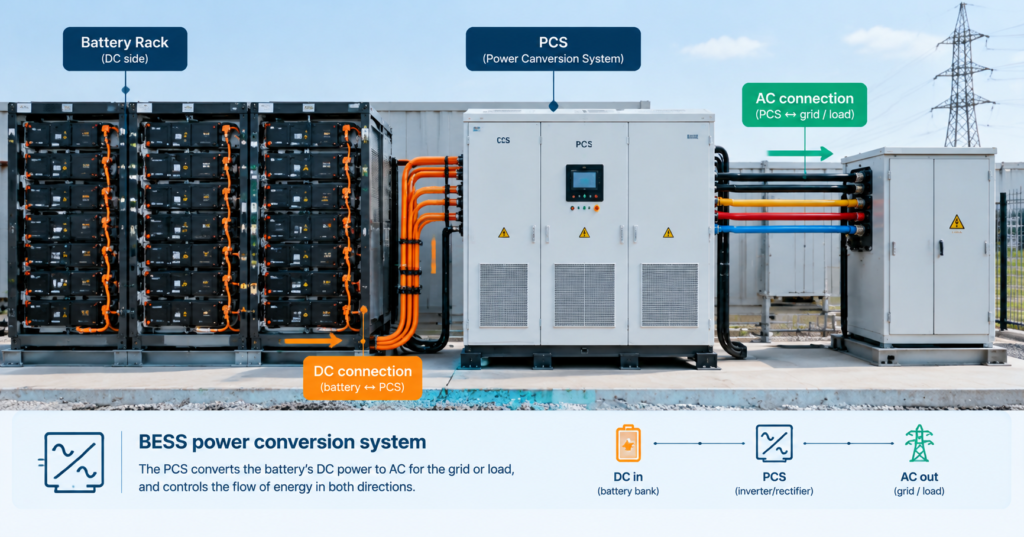
A battery powered inverter takes DC straight from a battery bank and turns it into AC for the loads you plug in. There is no solar input stage, no MPPT tracking and no array to design — just a battery, an inverter and the loads. That simplicity is the point: it is the right tool for vehicles, boats, sheds and backup kits where the energy is already in a battery. This guide covers what defines the category, how it differs from a solar inverter, and how to match one to a bank.
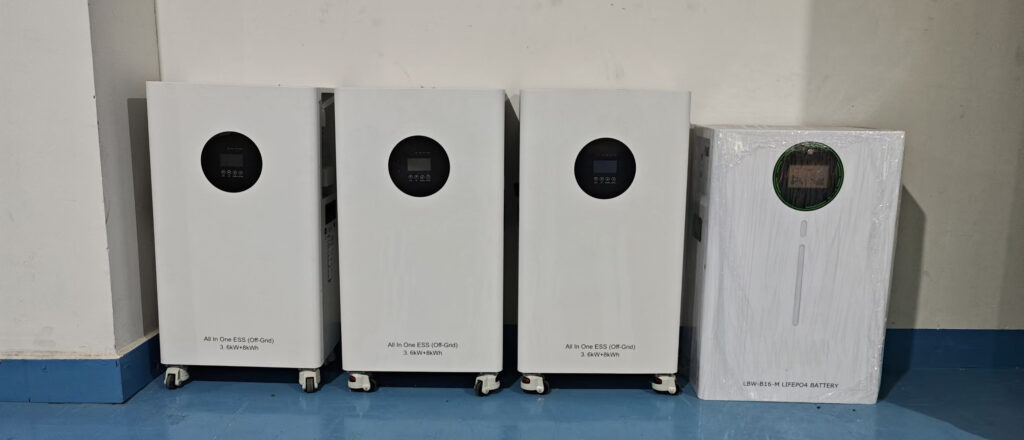
Not every inverter is a solar inverter. When the source is a battery and nothing else, the right unit is a smaller, simpler and cheaper machine.
What makes an inverter “battery powered”
The defining feature is the input. A battery powered inverter expects a DC source within a stated voltage window — commonly a nominal 12 or 24 volts for portable and vehicle units, and 48 volts or higher for stationary installations — and inverts whatever the bank can supply. There is no PV input, because there is nothing to track. Many units add a basic charger so the bank can be refilled from a generator or shore power, but the solar question is simply absent.
That absence simplifies everything. Wiring is two conductors from the bank, correctly fused; mounting is anywhere ventilated; and commissioning is a voltage check and a load test. For a van, a boat, a workshop or a backup box, this is the category that fits — and the 48V inverter guide guide covers the 48 V stationary variant in detail.
The input voltage window
Everything about the specification follows from the input window. A 12 V nominal unit does not see a steady 12 volts: a lead-acid bank swings from around 14.4 volts while charging down toward 10.5 or 11 volts at the low-voltage cutoff, and a lithium bank swings across a wider range still. The inverter must tolerate the top of the charge range and must shut down cleanly before the bank is damaged at the bottom.
Undersize the cable and the unit will trip on its own undervoltage protection under load, because the voltage drop in the cable looks identical to a flat battery. This is the single most common installation fault in the category: a correctly chosen inverter, correctly rated, connected with undersized cable and a mediocre connection. The battery inverter compatibility over RS485 guide covers the communication side where the battery and inverter need to coordinate.
How it differs from a solar MPPT inverter
The comparison is worth making explicitly, because buyers routinely pay for solar features they do not need or skip features they do.
| Aspect | Battery powered inverter | Solar (MPPT or hybrid) inverter |
|---|---|---|
| Energy source | Battery bank only | PV array, battery, or grid |
| PV input stage | None | MPPT tracker with voltage window |
| Charging | Optional basic charger (AC or generator) | Solar charge controller plus AC charger |
| Typical placement | Vehicle, boat, shed, backup box | Wall or garage, permanent install |
| Cost per watt | Lower | Higher, reflecting the added stages |
| Right when | Energy is already in a battery | Energy must come from panels or grid |
Where a site has both a battery and panels, a hybrid unit replaces the pair — the inverter charger combo guide covers that combination, and the MPPT inverter guide explains what the MPPT stage adds.
Standby draw and small-load efficiency
Two efficiency numbers decide whether a small system is pleasant or frustrating. The first is standby draw: the power the inverter consumes simply being on, typically on the order of a few tenths of a watt to a couple of watts depending on size and quality. On a small bank left connected for days, that idle draw can flatten a battery that nothing appeared to be using — which is why quality units have a search or sleep mode, and why permanent installations should switch the inverter off when it is not needed.
The second is efficiency at the load level you actually use. Inverter efficiency curves fall away at both ends: very light loads are dominated by the fixed overheads, and very heavy loads approach the unit’s ceiling where heat losses climb. A unit run at a fraction of its rating on a fridge and a few lights may deliver a smaller fraction of the bank’s energy than its headline efficiency suggests. Match the unit to the real load band, not to the theoretical maximum.
There is a third number worth checking on any datasheet: no-load current, which is the standby draw expressed in amps at the bank voltage. It converts directly into how long a parked vehicle or an idle shed will hold charge with the inverter simply switched on, and it varies by an order of magnitude across the category. A battery powered inverter with a low no-load figure can stay connected for weeks; a careless one can flatten a modest bank over a long weekend. The 48V split phase inverter guide guide shows how the same discipline applies at stationary scale.
Sizing for surge loads
Continuous wattage is the number on the box; surge capability is the number that decides whether the fridge starts. Motors, compressors and pumps demand several times their running current for a moment at start-up, and an inverter that cannot supply the surge will simply trip. A unit with a modest continuous rating but a healthy surge spec will start loads that a larger continuous-rated unit with a weak surge spec will not.
The bank has to agree with the inverter. Surge current at 12 volts is a serious current draw, and a small bank with high internal resistance will sag under it no matter what the inverter can supply. On lead-acid especially, the bank and the inverter are sized as a pair — the 100 amp hour deep cycle battery guide covers the bank side of that pairing.
Where each type belongs
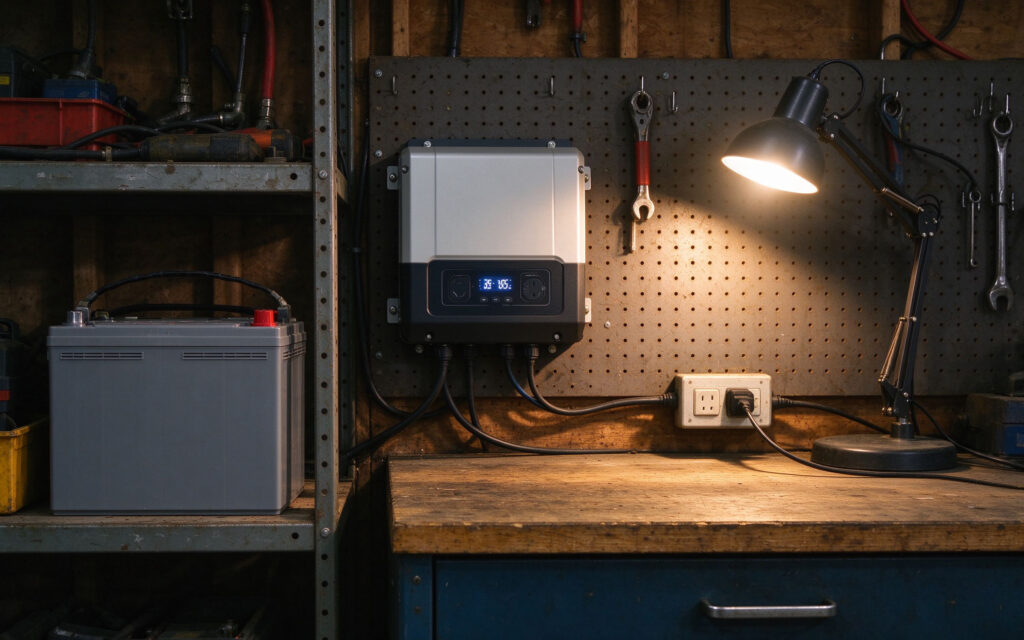
The category lines up cleanly against use cases. Vehicle and marine installations want a compact 12 or 24 V unit with a basic charger for shore or alternator top-up. Sheds and workshops want a similar unit on a bank with solar trickle charging, where a small panel and controller are cheaper than running power out. Emergency backup boxes want a larger stationary unit, often at 48 volts to keep cable sizes sane, paired with a bank that is charged from the grid or a generator until it is needed.
What none of these want is a full solar inverter. Where the site genuinely has panels, the arithmetic changes and the how an inverter works guide is the better starting point — followed by the 10 kilowatt inverter guide for the stationary power class and the solar inverter not working guide when a unit refuses to cooperate.
Q. battery powered inverter?
A battery powered inverter converts DC from a battery bank into AC for appliances, with no solar input stage. It suits vehicles, boats, sheds and backup kits where the energy is already stored in a battery.
Q. Can I run solar panels into a battery powered inverter?
Not directly. A battery powered inverter has no PV input stage; panels need a separate charge controller to charge the bank, which then feeds the inverter.
Q. Why does my inverter alarm when a motor starts?
Almost always surge. Motors and compressors demand several times their running current at start-up, and the inverter trips when the demand exceeds its surge rating or the bank sags under the draw.
Q. How long will a battery last with an inverter on standby?
Standby draw is small but continuous — on the order of a few tenths of a watt to a couple of watts. On a small bank left connected for days it can flatten the battery, so switch the unit off when unused.
Q. Do I need pure sine wave?
For anything with a motor, a transformer-based charger or sensitive electronics, yes. Modified sine wave units are cheaper and fine for simple resistive loads like heaters and incandescent lighting.
Q. What cable size for a battery powered inverter?
Follow the manufacturer’s table for the unit’s rating and the cable run. Undersized cable causes voltage drop that looks like a flat battery, and it is the most common installation fault in the category.
Q. Can I use a battery powered inverter for home backup?
Yes, if it is sized for the load and the bank supports it. Stationary 48 V units are the usual choice at home scale because they keep cable sizes and losses manageable.
Next step: match the unit to the load band
Surge, standby and cable are the whole specification. Send the load list, the bank voltage and the cable run.
- Step up in scale with the 10 kilowatt inverter guide
- Diagnose a misbehaving unit with the solar inverter not working guide
- For chisidal, send your usage and site details, and we will come back with product prices, lead time and warranty information.