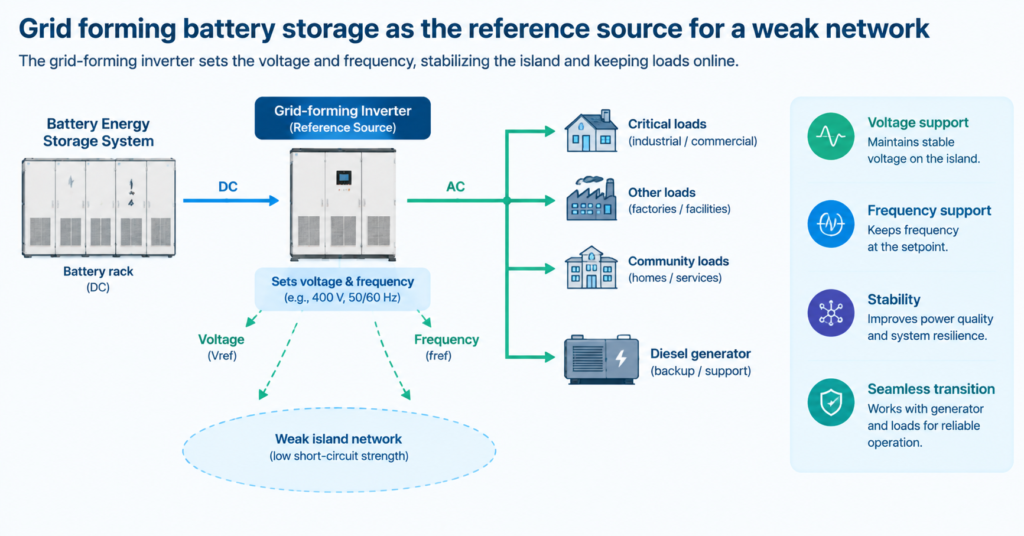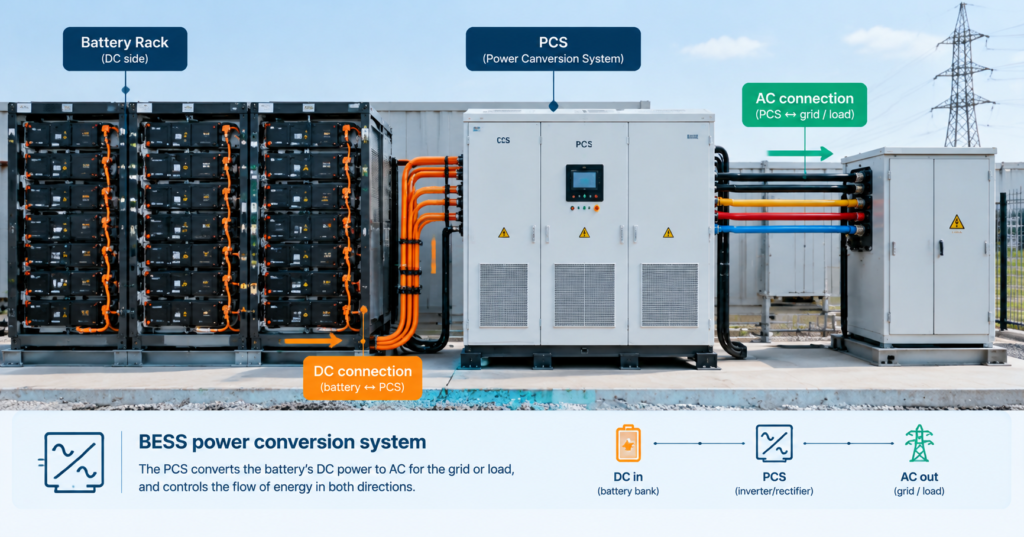
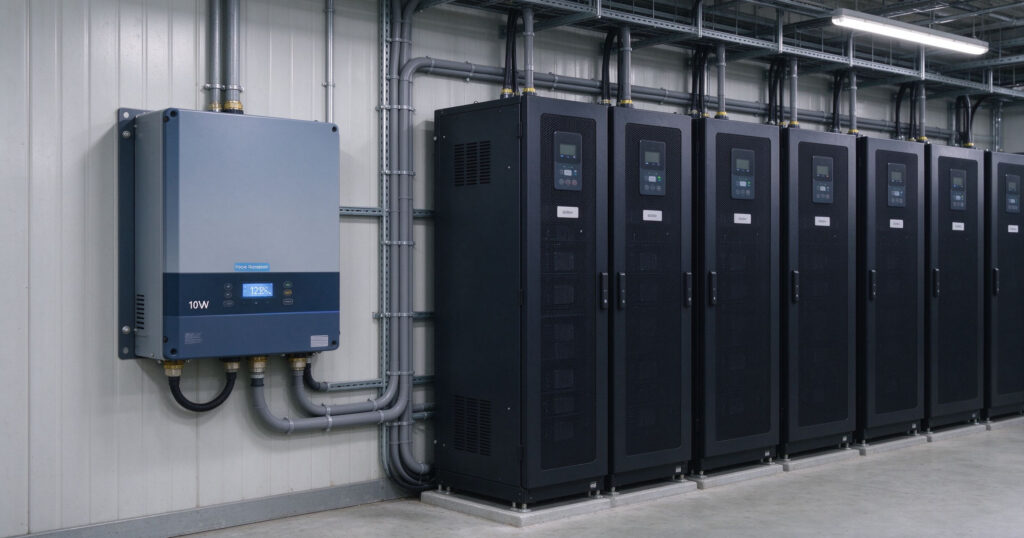
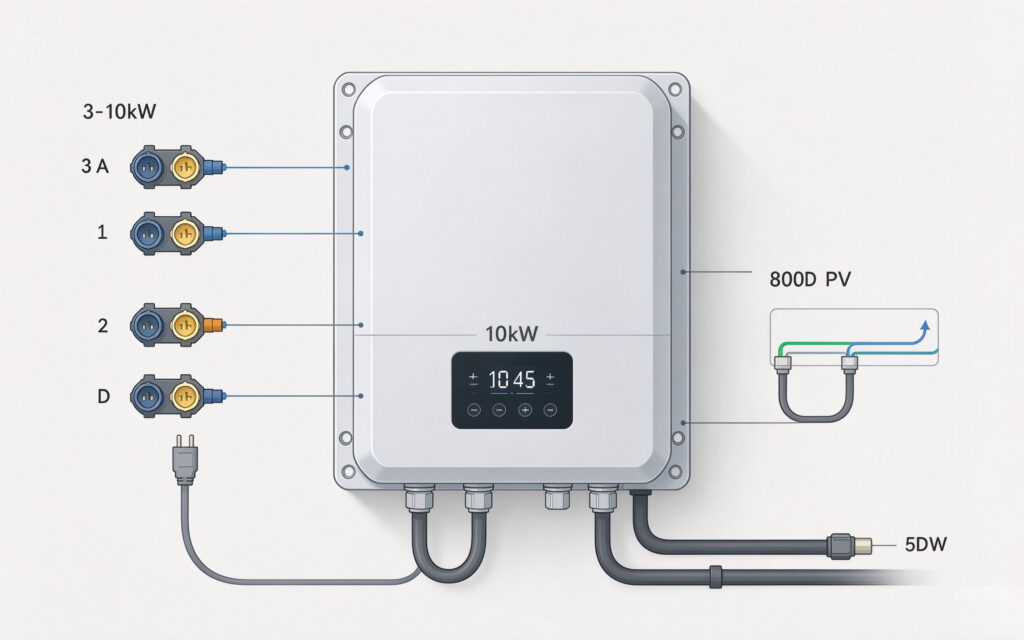
A 10 kilowatt inverter is the power class where a home system starts to look like a small commercial one: enough headroom to run a well pump, an air conditioner and a workshop at once, and enough output to make battery discharge capability the binding constraint. But the nameplate describes an ideal, and three limits decide whether the class suits a site: the simultaneous load, the surge it can supply, and what the battery can deliver at that current. This guide covers what the class covers and where it disappoints.
At this power class, the inverter stops being the limiting component. Everything else in the system has to keep up with it.
What the 10 kW class covers
A 10 kW continuous rating is generous for a typical residence and modest for a small commercial load. It comfortably runs a whole panel of ordinary household circuits — lighting, refrigeration, cooking on one or two elements, a well pump, a workshop tool at a time — with margin. It will not, on its own, run electric resistance heat or multiple air conditioners in a large building, and pretending otherwise is how systems end up undersized.
The class is also the point where three-phase becomes a genuine option. Many markets supply three-phase service to commercial premises and an increasing number of larger homes, and a 10 kilowatt inverter in three-phase form balances the load across phases in a way a single-phase unit of the same rating cannot. The 48V inverter guide guide covers the 48 V battery-side pairing, and the what size solar inverter you need guide covers the load-first sizing method that should precede any choice of power class.
Continuous versus surge: the number that trips
Continuous rating is what the unit can carry indefinitely without overheating. Surge rating is what it can carry for seconds to minutes while a motor starts. The gap between them is where systems fail: a unit with a 10 kW continuous rating and a modest surge spec will not start a well pump or a compressor that a smaller unit with a strong surge spec handles easily.
Surge demand is set by the motor, not by the inverter. A compressor or a pump can demand several times its running current at start-up, and the simultaneous figure — every motor starting at once, which is exactly what happens when power returns after an outage — is the number the inverter has to survive. Where the load list contains several motors, staggered starting or a soft starter is often cheaper than buying a much larger inverter.
| Load group | Continuous draw | Surge behaviour |
|---|---|---|
| Lighting and electronics | Low | Negligible |
| Refrigeration | Moderate | Short, high compressor surge |
| Well pump | Moderate to high | Long, heavy surge at start |
| Air conditioning | High | Very high surge, repeated cycling |
| Resistance heat | Very high | None, but continuous is punishing |
What the battery has to be able to do
At 10 kW the battery becomes the constraint. A 48 V bank supplying 10 kW is delivering on the order of two hundred amps, and the cable, fusing and battery discharge rating all have to accept that current continuously. A bank rated for a hundred amps of discharge cannot feed this inverter at full output no matter what the inverter’s nameplate says — the protection will trip, or the voltage will sag, long before the load is satisfied.
Lead-acid banks feel this most acutely: their voltage sags under heavy current, their capacity collapses at high discharge rates, and the delivered energy at 10 kW is a fraction of the nameplate. Lithium banks hold their voltage and tolerate the current far better, which is why the power class and the chemistry choice are usually made together. The 100 amp hour deep cycle battery guide covers the discharge-rate penalty in detail, and the 10 kilowatt hour battery guide covers the capacity side of the pairing.
Clipping, oversizing and the array question
Where the inverter serves a solar array, a second question appears: how much of the array’s peak the inverter can accept. An array whose peak exceeds the inverter’s rating clips output in the best hours of the day. Mild clipping is usually an economic trade — the clipped hours are few, and a smaller inverter is cheaper and more efficient at part load. Aggressive clipping, on the other hand, throws away the hours that would otherwise offset the most expensive demand charges.
The usual resolution is to size the inverter to the load and let the array be as large as the roof allows, accepting the clipping. Where the tariff rewards afternoon production, the arithmetic shifts the other way. The MPPT inverter guide covers how the tracking stage interacts with array sizing, and the string solar inverters guide covers the string architecture that feeds the DC side.
Clipping is also a climate question in disguise. A site with long clear summer afternoons will clip for more hours of the year than a cloudier site with the same hardware, and a site whose afternoon peak coincides with a demand-charge window will feel the clipped hours more than one whose peak arrives at noon. None of that changes the inverter choice — it changes how much array is worth installing behind it, which is the question a 10 kilowatt inverter should be evaluated against rather than in isolation.

When a smaller unit is the better answer
Not every site needs 10 kW. A small off-grid cabin, a backup circuit covering a refrigerator and a few lights, or a system with a modest battery bank will be better served by a unit in the low kilowatts: cheaper, more efficient at the part loads those sites actually run, and matched to a battery that can supply it. Buying headroom that is never used costs twice — once in the purchase and again in the lower part-load efficiency that follows the system all its life.
The reverse also holds: a site with an air conditioner, a well pump and a workshop should not be economised into a 3 kW unit that trips on the first compressor start. The battery powered inverter guide covers the battery-only end of the range, and the how an inverter works guide is the grounding read for anyone comparing classes for the first time.
Buying notes for the 10 kW class
Specify three numbers, not one: continuous rating, surge rating and duration, and the battery discharge current the unit expects. Confirm the AC configuration — single-phase, split-phase or three-phase — matches the service. Check the part-load efficiency curve, because a unit run at a third of its rating most of the time lives at the low end of that curve. And confirm the DC voltage window suits the chosen bank, including the top of its charge range. The right unit is the one the site actually needs, not the one that looks impressive on a quote.
Q. 10 kilowatt inverter?
A 10 kilowatt inverter is a power conversion unit rated to supply 10 kW continuously. It suits larger homes and small commercial loads where several substantial circuits run at once.
Q. What can a 10 kW inverter run?
A whole household panel of ordinary circuits — lighting, refrigeration, cooking, a well pump, a workshop tool — with margin. It will not run electric resistance heat or several air conditioners in a large building.
Q. How many amps does a 10 kW inverter draw from a 48V battery?
On the order of two hundred amps at nominal voltage, before inefficiency. The battery, cabling and fusing must all be rated for that continuous current, which is what makes the battery the real constraint at this class.
Q. Is 10 kW enough for a whole house?
For most homes without electric heat, yes with margin. Homes with heat pumps plus electric cooking plus a well pump should be checked load by load before committing.
Q. Do I need three-phase at 10 kW?
It depends on the service available and the load balance. Three-phase suits commercial premises and larger homes; single-phase or split-phase covers most residential services.
Q. What happens if my array is bigger than the inverter?
The inverter clips output above its rating during peak sun hours. Mild clipping is an acceptable economic trade; aggressive clipping wastes the hours that matter most for demand-charge offset.
Q. Can a 10 kW inverter run on a small battery?
Only at reduced output. The battery’s discharge rating and voltage sag set the real ceiling — a bank that cannot supply the current will trip protection or collapse under load regardless of the inverter’s rating.
Next step: check the surge list before the nameplate
The motors on site decide whether this class fits. Send the load list with the motor starting requirements.
- Start from the load with the what size solar inverter you need method
- Verify the bank pairing in the 48V inverter guide guide
- For chisidal, send your usage and site details, and we will come back with product prices, lead time and warranty information.