A 5kWh battery is the smallest home storage class that behaves like a real system: enough usable energy for an evening peak and a night of essentials, in a unit one person can wall-mount. It is also the class where buyers most often overestimate what they are getting, because the nameplate assumes deep-discharge lithium behaviour that lead-acid cannot match. This guide places the 5kWh class on the capacity ladder, works the runtime arithmetic, and explains the chemistry, inverter and solar decisions that decide whether the label survives contact with a real household.
Five kilowatt-hours is where home storage stops being a gadget and starts being a system — and where the gap between nameplate and delivered energy first becomes impossible to ignore.
What a 5kWh battery actually covers
Home storage sizes answer different questions, and the 5 kWh class answers the essentials question: keep the refrigerator, the lights, the network gear and the charging going through an evening peak and a night, then recharge. That is a real and useful job — it covers the outages most households actually experience, which are measured in hours rather than days — but it is not whole-house backup, and buyers who expect the latter are disappointed by arithmetic rather than by the product.
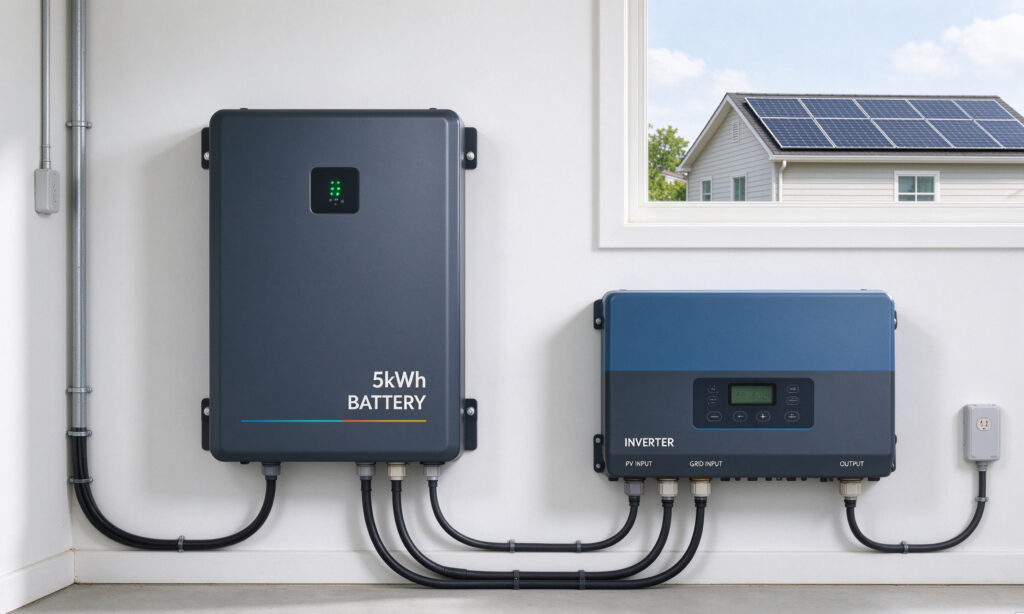
The class is also where the physical form changes. A 5kWh battery is light and compact enough to wall-mount in a garage or utility room, which is why it dominates the entry tier of the home storage market: no floor loading questions, no cabinet, no installation crew. The 10 kilowatt hour battery guide covers the class above, and the how to size a home battery method is the load-first way to decide whether 5 kWh is the right entry point at all.
Usable versus nameplate at this size
A 5 kWh nameplate is a ceiling. On lithium the usual depth-of-discharge specification leaves roughly a tenth in reserve, so the working figure is closer to four and a half kilowatt-hours before anything else takes a share. On lead-acid at the same nameplate, the recommended routine depth of discharge halves it again, and that is before conversion losses through the inverter.
| Chemistry | Nameplate | Typical usable fraction | Working energy |
|---|---|---|---|
| Lithium (LFP), wall-mounted | 5 kWh | Around 90 percent | Close to 4.5 kWh before inverter losses |
| AGM, floor bank | 5 kWh | Around 50 percent routinely | Closer to 2.5 kWh, more with shallow cycling |
| Flooded lead-acid | 5 kWh | Around 50 percent for longevity | Similar to AGM, with ventilation duties attached |
None of this is a defect — it is how the chemistries are specified — but it means the same 5kWh label describes two very different products depending on what is inside the case. The chemistry comparison is covered in its own guide, and the temperature windows further discount both.
Runtime arithmetic for a 5kWh battery
The honest sizing method is bottom-up from loads. A refrigerator cycling through a day draws a few tenths of a kilowatt-hour in practice. An evening of lighting, a television and device charging adds another fraction. Network gear and a freezer push the total higher. A modest household’s overnight list usually lands somewhere between two and four kilowatt-hours, which is why a 5 kWh class system covers it comfortably on lithium and tightly on lead-acid.
The loads that break the class are heating and cooling: an electric oven for an hour, a space heater through an evening, or a well pump cycling overnight each add enough to exhaust the bank on their own. The useful discipline is to separate must-run loads from nice-to-have loads before buying, because the two categories price very differently. The whole house battery backup guide covers the whole-house framing, and the 100 amp hour deep cycle battery guide explains the module-level arithmetic behind the same number.
Chemistry and module formats
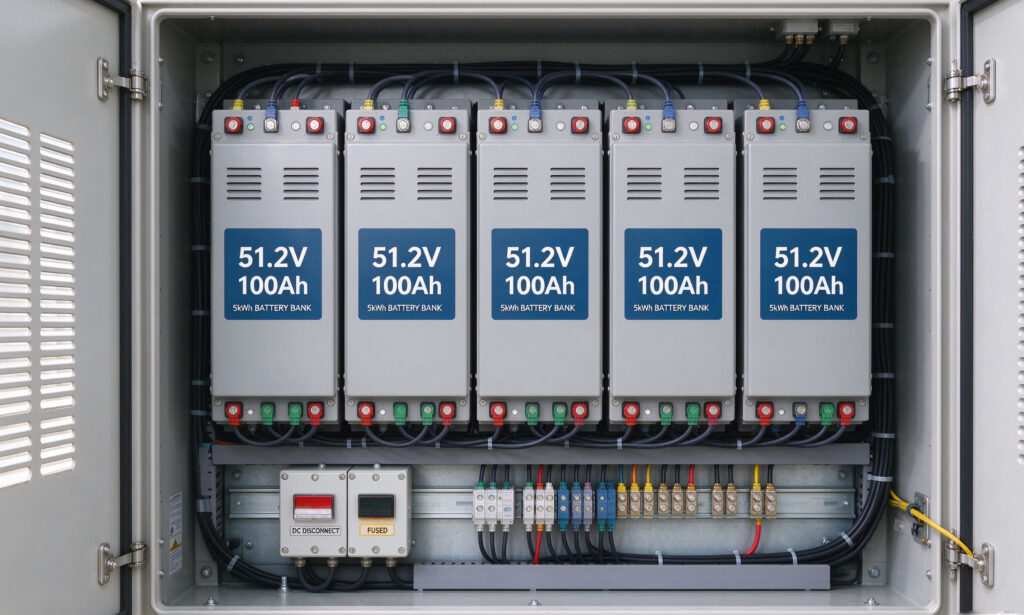
The class is sold in three physical forms, and the format is a bigger daily-life decision than the chemistry label. Wall-mounted lithium units — typically built around a 51.2 V, 100 Ah module, which is where the 5 kWh number comes from — hang on a wall, arrive pre-wired and need nothing but a bracket and a breaker. Floor-standing lead-acid banks of equivalent energy need ventilation, a tray, and a conversation about where the acid gas goes.
The third option is the modular route: start with a smaller lithium bank and add modules as the budget or the load list grows. That flexibility is genuinely valuable at this size, because the jump from 5 kWh to 10 kWh is the most common upgrade path in home storage, and a system designed for expansion avoids buying the whole stack twice. Confirm the expansion path before purchase — it constrains the inverter choice more than the battery choice.
Inverter and solar pairing
A 5 kWh class bank is usually paired with a hybrid inverter in the three-to-five-kilowatt range, which is enough to run the essentials simultaneously while leaving headroom for the occasional well pump or compressor start. Two numbers decide whether the pairing behaves: continuous output, which has to cover the simultaneous load rather than the sum of everything that exists, and surge capability, which covers motor starts.
On the solar side, recharging a 5 kWh class bank on a typical day takes an array on the order of one and a half to two kilowatts in the sunny season, and meaningfully more in winter or at high latitudes. A buyer planning to run essentials on solar alone through a northern winter needs either a much larger array or acceptance that the grid will top up — and that decision belongs before purchase, because it changes the inverter and array sizing rather than just the budget. The how home battery charging works guide covers the charging-side options in full.
Write the decision down — duty, chemistry, expansion plan — before the quote arrives, because that page is what keeps the purchase honest six months later, when the first real outage tests whether the bank was sized for the loads that were listed or the loads that were imagined.
Buying notes for the 5kWh class
Three questions separate a durable 5kWh battery from a regret. First, what depth of discharge does the warranty assume — a warranty quoted at 100 percent of nameplate is marketing, while one quoted at a realistic usable figure is engineering. Second, what does the BMS actually protect against, and does it log: a bank whose state-of-charge and current data can be read is a managed asset, while one that reports nothing is a guess. Third, what is the expansion path, because at this size the system will grow or the buyer will wish it had.
Two operational habits protect the investment. Keep the bank’s operating history — a simple log of cycles and occasional capacity checks turns a nameplate into a trend, and the load-testing discipline is covered in its own guide. And decide the duty profile early: a bank cycled daily and a bank held in reserve justify different chemistries, different warranties and different charging regimes, and the cheapest unit for one duty is often the wrong unit for the other.
5kwh battery?
A 5kWh battery is a home storage bank rated at five kilowatt-hours of nameplate energy — the smallest class that covers an evening peak and a night of essentials, usually as a wall-mounted lithium unit.
Q. How long will a 5kWh battery run my house?
Essentials only, typically a night and into the next morning on lithium; less on lead-acid at the same nameplate. Cooking, climate loads and well pumping exhaust it far faster.
Q. Is a 5kWh battery enough for whole-house backup?
No. It covers the loads most households actually run during a short outage, but not electric heat, air conditioning or extended well pumping. Size to the must-run list.
Q. How many solar panels do I need to charge a 5kWh battery?
An array on the order of one and a half to two kilowatts refills the bank on a good day in the sunny season; winter output and roof orientation decide whether that holds year-round.
Q. Can I expand a 5kWh battery later?
Often yes — modular systems accept additional modules, and many hybrid inverters are rated for more battery capacity than they ship with. Confirm the expansion path before purchase.
Q. Is a 5kWh lithium battery really 5 kWh usable?
Close to it: lithium systems in this class are usually specified around 90 percent usable, so plan on roughly four and a half kilowatt-hours before inverter losses.
Q. Does a 5kWh battery work without solar?
Yes — it charges from the grid and stands ready, which is the resilience case. Whether daily cycling pays for itself depends entirely on the local tariff structure.
Next step: size from the must-run list
A 5 kWh class system pays off when the essentials list is honest. Send the overnight load list and the available wall or floor space.
- Check the cold-weather window with the LiFePO4 battery temperature range guide
- Compare chemistries with the LiFePO4 versus lithium ion NMC guide
- For chisidal, send your usage and site details, and we will come back with product prices, lead time and warranty information.