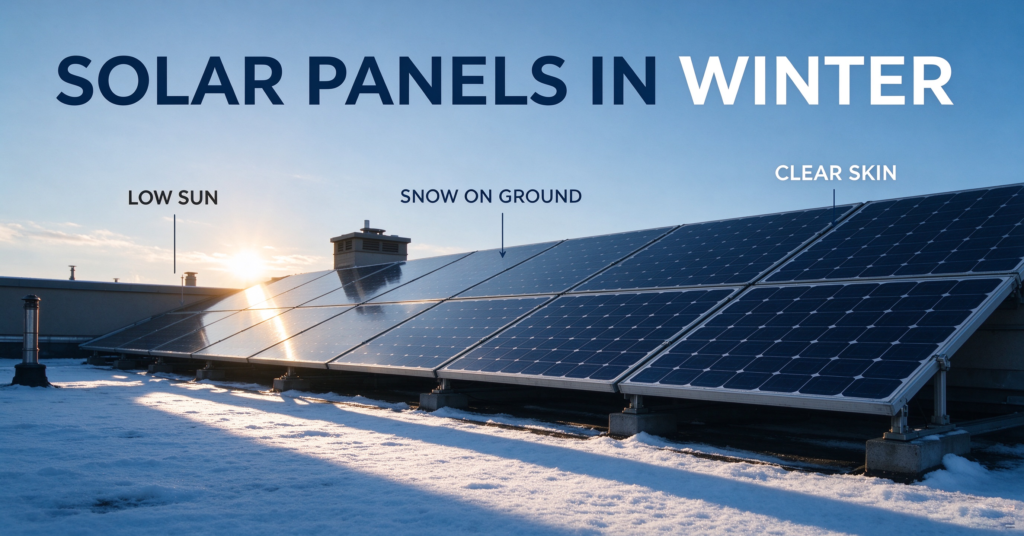
Yes — do solar panels work in winter, and cold cells are actually more efficient per unit of light than warm ones. What winter takes away is not efficiency but hours: shorter days, a lower sun angle and, in snow country, covered glass. A well-sited array still produces through the cold months, just materially less per day than in June. This guide separates the three effects and shows what a winter day really delivers.
The instinct is that cold weather kills solar output. The physics mostly says the opposite — the problem is the calendar and the geometry, not the temperature.
What winter actually changes
Do solar panels work in winter? Yes — but the honest answer needs the season broken into three separate effects, because only one of them has anything to do with the cold.
Three separate things happen between June and December, and only one of them is about the weather being cold. Day length shrinks, so there are fewer hours of light. The sun tracks lower across the sky, so the light that does arrive hits the module at a shallower angle and spreads its energy over more glass. And in snow country, the array can be covered for days at a time. None of these is a temperature effect.
Separating them matters because they have different fixes. Nothing can be done about day length. The low sun angle is partly answerable with tilt — a steeper winter angle aims the array better at a low sun, which is exactly the argument for seasonal adjustment. Snow is an operational problem with its own tools and its own risks, covered in the solar panel snow removal guide. Treating all three as “winter is bad” leads to the wrong design decisions.
The cold-weather bonus: temperature coefficients
Do solar panels work in winter better than owners expect? Often yes, and the reason sits on the datasheet rather than in the sky: the temperature coefficient penalises heat, not cold.
Here is the counter-intuitive part. A solar cell is more efficient when it is cold. Every module carries a temperature coefficient on its datasheet — a small percentage of output lost for every degree above the standard test temperature — and that number is a penalty for heat, not for cold. A hot summer roof can cost a meaningful slice of a module’s rated output even at full sun, while a crisp, clear winter day at freezing point lets the same module run closer to, or above, its rated figure.
That bonus does not rescue the season, because it is a few percent against a loss of more than half the daily hours. But it does explain two things owners notice: a bright cold day can produce surprisingly well, and the worst output often comes not in December but in a warm, humid, overcast stretch. The whether solar panels work on cloudy days guide works through the irradiance side, which is the dominant variable in winter just as it is in summer.
Sun hours and the low sun angle
Output planning runs on peak sun hours — the equivalent number of hours at full test-condition intensity — rather than on daylight hours. Winter peak sun hours at a temperate site can be a third of the summer figure, and that single ratio explains most of the seasonal drop. A site with five to six peak sun hours in June may see one and a half to three in December.
| Season | Peak sun hours (typical) | Sun angle | Array behaviour |
|---|---|---|---|
| Summer | Five to six | High, near overhead | Long production window; heat losses on the roof |
| Shoulder | Three and a half to five | Moderate | Best balance of hours and temperature |
| Winter | One and a half to three | Low | Short window; steep tilt helps; cold cells help |
The low sun angle compounds the hours problem in two ways. Light arriving at a shallow angle loses energy to reflection off the glass, and the array casts longer shadows — onto itself, onto neighbouring rows, and onto chimneys and trees that were irrelevant in June. Shading that is a summer non-event becomes a winter problem, which is why the solar panel tilt angle guide treats seasonal tilt as a winter tool as much as a summer one.
Snow, albedo and the cover problem
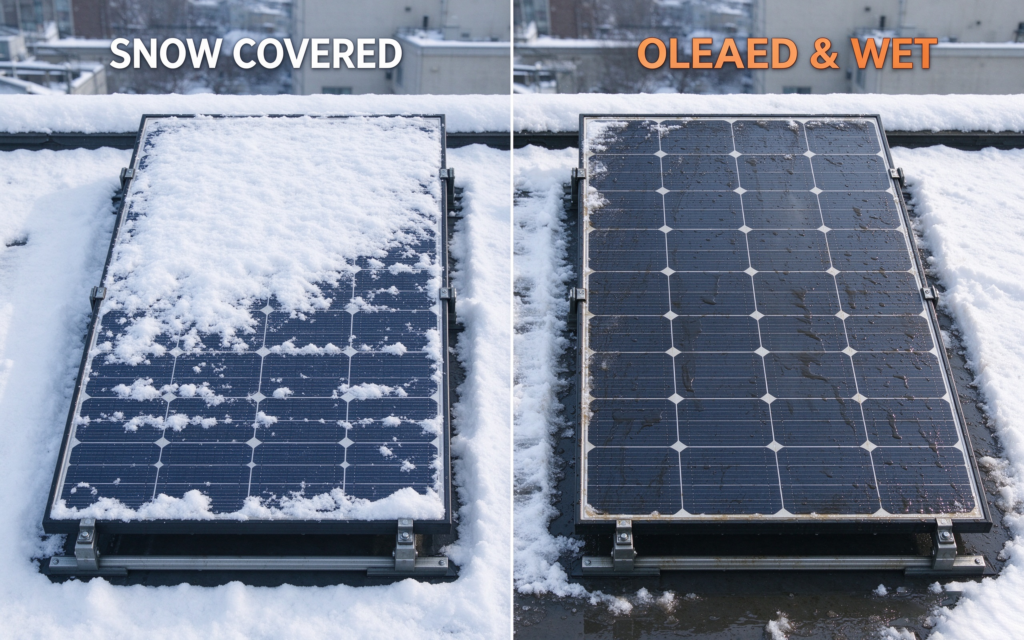
Do solar panels work in winter under snow? A fully covered module produces nothing at all, and in snow country that is the single largest winter loss — larger than the cold and larger than the short days.
Snow does two opposite things. Cover is straightforwardly bad: a covered module produces nothing, and the loss compounds for every day the snow sits. Albedo is the interesting one — clean snow is highly reflective, and light bouncing off a snow-covered ground onto a clear array can raise the irradiance reaching the glass. A bright, cold, snowy day with a clear array can beat a dull autumn day.
The dangerous case is neither of those but the slide: snow melting at the warm module surface releases the whole sheet at once, and a roof-height avalanche takes racking, gutters and anything beneath it with it. And the albedo gain never offsets a full cover, so the planning assumption should always be that snow days are zero-output days rather than partial ones. The solar panel snow removal guide covers clearing tools, guards and the safe way to handle a covered array.
What a winter day actually delivers
The practical answer for a typical temperate site is that a winter day delivers somewhere between a fifth and a half of what the same array delivers in high summer, with the wide range driven by site latitude, tilt, snow and how many clear days the season gives. A system that covers a household’s daytime baseline in June will cover a fraction of it in December — which is the point of designing against the worst month rather than the best.
Two habits make that honest. Budget storage against the winter number, because a battery sized on summer surplus will sit empty through the short days when it is most needed. And read the annual figure, not the daily one: the year is what pays back the system, and a good winter does not need to be a good summer. The how to size a home battery guide is the load-first way to do that arithmetic, and the whether solar panels work at night guide covers the other half of the day.
Planning the year around the worst month
Do solar panels work in winter well enough to carry the loads that matter? That is the only version of the question that changes a design, and it is answered by the worst month rather than the best.
Sizing against December is the discipline that makes winter survivable. If the array is sized so the worst month still covers the loads that genuinely matter, the surplus in the other eleven months is usable rather than wasted — fed to a battery, exported, or spent on loads that were optional. Sizing against June produces a system that disappoints exactly when the weather is worst.
Two adjustments help more than adding panels. A steeper winter tilt recovers a real share of the low-sun loss, and on adjustable ground mounts it costs an afternoon twice a year. And keeping the array clear and clean matters more in winter, because the hours available are too few to waste. The solar panel lifespan guide guide is the right frame for the long view, and the solar panels on a metal roof guide covers the roof-profile case for sites where the winter tilt is fixed by the roof rather than chosen.
Q. do solar panels work in winter?
Yes. Solar panels work in winter and cold cells are more efficient per unit of light, but shorter days, a lower sun angle and possible snow cover mean a winter day delivers materially less than a summer one.
Q. Do solar panels work in cold weather?
Yes, and they work slightly better per unit of light. Module temperature coefficients penalise heat, not cold, so a freezing clear day lets a module run closer to its rated output than a hot one.
Q. How much less do solar panels produce in winter?
A winter day at a temperate site typically delivers somewhere between a fifth and a half of high-summer output, driven mainly by shorter days and a lower sun angle rather than by the cold itself.
Q. Do solar panels work when covered in snow?
A fully covered module produces nothing. Partial cover leaves the clear sections producing, and reflected light off snow can help a clear array, but the snow albedo gain never offsets a full cover.
Q. Should I tilt my panels more in winter?
Yes, where the mount allows it. A steeper winter angle aims the array better at a low sun and sheds snow more readily, which is why seasonal adjustment is worth the twice-yearly effort on adjustable mounts.
Q. Is it worth clearing snow off solar panels?
Sometimes. Clearing recovers the output of covered modules, but the risk of damaging the glass, the roof and the person doing it usually outweighs a day or two of lost production, especially on steep roofs.
Q. Do I need a bigger battery for winter?
Plan storage against the winter figure rather than the summer one. A bank sized on summer surplus will run short through the short days, which is exactly when backup matters most.
Next step: size against the worst month
Winter planning is an arithmetic exercise, not a weather bet. Send the site, the tilt and the load list.
- Read the snow case in the solar panel snow removal guide
- Check the seasonal tilt argument in the solar panel tilt angle guide
- For chisidal, send your usage and site details, and we will come back with product prices, lead time and warranty information.