battery warranty claim process is the part that decides whether a good warranty actually pays: the evidence you can produce, how fault is apportioned, how a faulty unit is physically returned, and what settlement looks like. This guide walks from the reported fault through to closure.
Warranty terms are a promise, and the claim process is the enforcement of it. Most disappointed buyers turned out to have good terms and a weak evidence file, which is where this guide starts, before working through to settlement.
Why a strong warranty is not the same as a paid claim
Two documents get confused. The warranty states what the manufacturer promises, usually as a term in years and a cycle or capacity commitment. The claim process decides whether any particular failure counts as a breach of it, and who has to prove what. A generous warranty with an undefined claim process is worth less than a modest one with a clear one.
The gap shows up in three places: whether the failure is a defect at all, whether the operating conditions stayed inside the envelope, and whether the evidence exists to settle both. Buyers who lose claims usually lose on the third, having run a system for two years without recording anything that would prove the second.
The comparison of warranty structures belongs elsewhere. Which matters more, the cycle count or the term in years, and how capacity retention is defined, is covered in the battery warranty cycles versus years guide. This page takes the terms as given and works through enforcing them.
Trigger conditions in the battery warranty claim process
A claim normally starts from an observable condition rather than a suspicion: delivered capacity falling below the committed floor, a cell or module that has failed outright, a management board that no longer reports or protects correctly, or a safety event. Each of these has a different evidence burden.
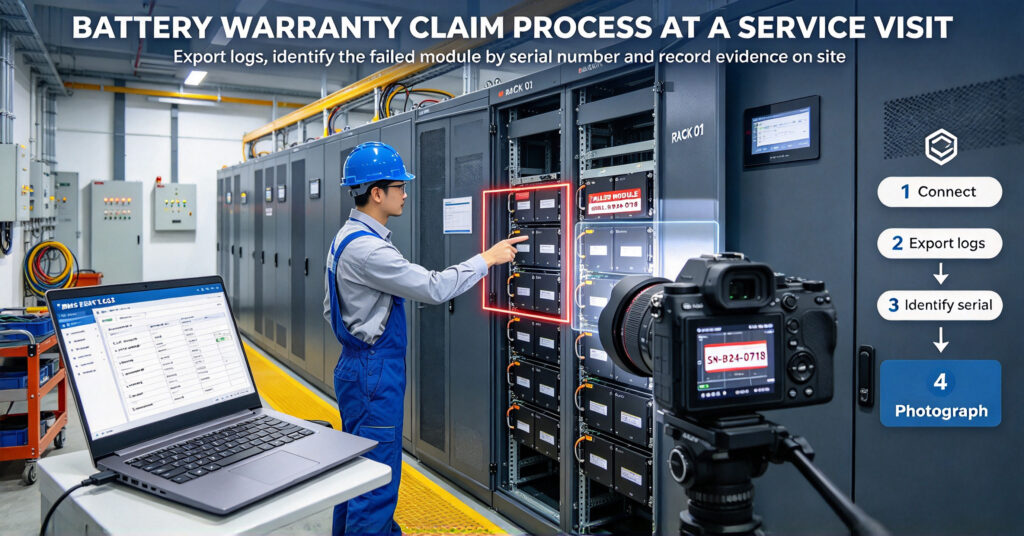
The file that settles most of them is assembled long before anything fails: serial numbers tied to the installation date, commissioning records, the operating profile the system actually ran, ambient conditions at the site, and the logs the management system recorded throughout. Photographs of the installation and of the failed unit in place close the set.
Where the system has been logging from day one, the diagnosis is usually quick. Where it has not, the claim becomes an argument about what probably happened, and arguments about probability are settled slowly and in the manufacturer’s favour, which is why the battery warranty claim process is worth agreeing at the point of purchase rather than at the point of failure.
| Trigger | Evidence that settles it | Where claims stall |
|---|---|---|
| Capacity below floor | Test log at stated rate and temperature | Test conditions not recorded |
| Cell or module failure | Serial, voltage history, photos | No per-unit traceability |
| Management board fault | Event and alarm log export | Logs overwritten or never downloaded |
| Safety event | Incident record, site conditions | Site altered before inspection |
Step one: remote diagnosis and data export
Most claims should be settled without anything moving, and that is the first principle of any battery warranty claim process. The first step is to export the management system’s event and alarm history, the per-cell voltage and temperature record, and the cycle and throughput counters, then compare them against the operating envelope the warranty assumes.
That comparison usually answers the question. If the log shows the pack ran inside limits and still lost capacity, the case is a product one. If it shows repeated excursions beyond the specified temperature or current, the case is about operating conditions, and no amount of arguing about cell quality will change it.
What the board records, and how to read it, is covered in the BMS technology guide; it is worth reading before a fault occurs rather than during one. Where the log is genuinely ambiguous, the next step is a supervised test on site, witnessed and recorded, which is cheaper than a return in either direction.
Return freight is harder than outbound freight
A failed battery is still dangerous goods, and often more awkward than the one that shipped: the cells may be damaged, the state of charge is unknown, and the original packaging is usually gone. Many carriers who happily took the outbound consignment will decline the return, and the ones who accept it will want a fresh declaration and approved packaging. This is the stage of the battery warranty claim process that surprises people most.
That is why returns are the slowest part of most claims and the part most likely to be quietly abandoned. Three alternatives usually beat a full return: local assessment with a partial return of the failed module rather than the whole pack, return of the management board alone where the fault is in the electronics, and documented local disposal where the value of the unit is below the freight.
Who pays for the return should have been settled before the fault, not after it. Freight on a heavy, class-regulated return can exceed the value of the part being replaced, and a claim that is nominally approved can stall indefinitely on that line alone.
Apportioning fault: product, operating conditions or installation
Faults fall into three buckets. A product defect is a cell or component that failed although it was operated within specification. An operating-conditions failure is one caused by running outside the envelope. An installation failure covers undersized conductors, incorrect torque and wrong protection settings.
The second and third are not manufacturing problems, and a warranty will not cover them, however generously it is written. The evidence usually settles which bucket applies: a temperature log showing sustained operation beyond the stated range points at the site, while consistent behaviour across a whole batch points at the product.
Knowing the envelope is what makes that judgement possible. The LiFePO4 battery temperature range guide sets out the temperature window cells are specified for and what running outside it costs, which is the reference most operating-conditions arguments turn on. Where the cause is genuinely shared, the honest answer is an apportioned settlement rather than a clean verdict.
What settlement looks like
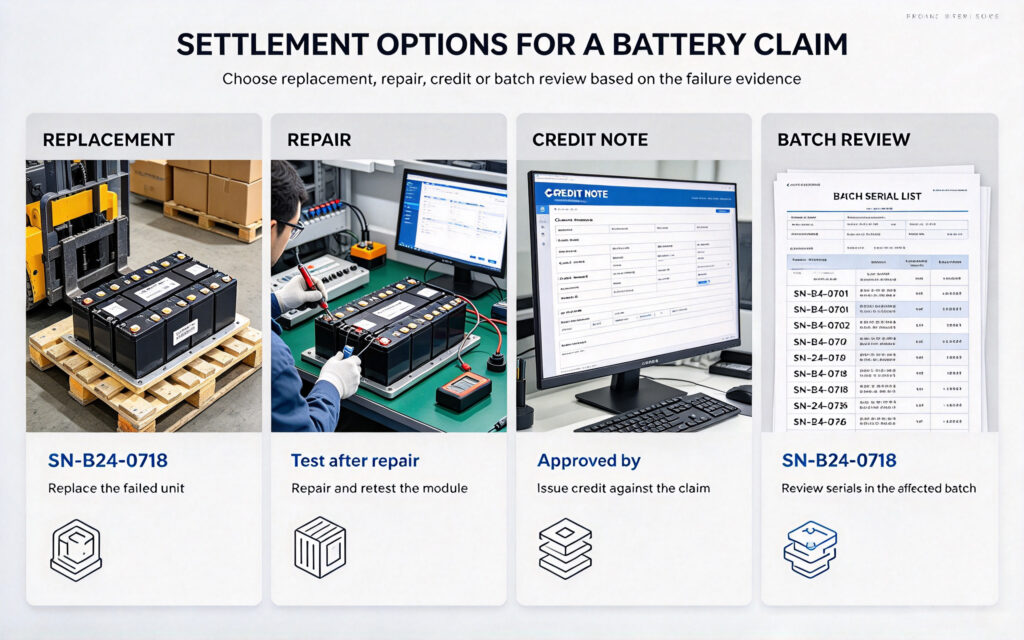
Four forms are common. Replacement of the failed unit is the cleanest and is typical where the fault is isolated and the product is current. Repair, often a module swap or a board replacement, is common where the pack is large and the failed part is identifiable.
A credit against future orders is the pragmatic answer where the failure is real but partial, or where the value is small relative to the logistics. Batch-level handling is the outcome when the same defect appears across a production run: rather than replacing unit by unit, the supplier agrees a programme covering the affected serial range.
Which one you get depends partly on the claim and partly on how complete the evidence file is.
Timelines and the ways claims stall
A claim moves through recognisable stages: report and acknowledgement, evidence request, remote diagnosis, a decision on whether anything needs to be returned, the physical return or local disposal, and settlement. The stages that take the time are rarely the technical ones; they are the waits between them. In most battery warranty claim process failures, that is exactly where the delay sits.
The stall patterns are consistent. Repeated requests for data that has already been supplied. A test method nobody agreed, so two parties measure the same unit differently and get different answers. A return that nobody has arranged freight for. And a decision deferred pending a batch review that has no stated date.
The counter to all four is the same: put dates and methods in writing at the start. Agree the test method, agree who arranges the return, ask for a decision date on each stage, and confirm each exchange in writing. None of this is adversarial; it is what turns an open conversation into a process.
Lowering claim cost at the specification and record-keeping stage
The cheapest claim is the one that never happens, and most of what makes a battery warranty claim process expensive is decided at specification. Buying against a duty cycle the system will actually see, sizing for the temperature the site really reaches, and specifying the logging the warranty will later demand remove most of the disputes before they start.
Record-keeping is the rest of it. Commissioning data, periodic log exports, and a simple register tying serial numbers to locations and dates cost almost nothing to maintain and are what converts a contested claim into a routine one.
Two other pieces belong in the frame. End-of-life value is part of the calculation when a unit is written off rather than replaced, which the battery second life and LiFePO4 recycling guide covers. And the inspection record is what tells you whether a fault arrived with the unit or developed later, which is where the battery pre-shipment inspection report earns its keep a second time.
battery warranty claim process?
Battery warranty claim process is the route from a reported fault to a settlement: evidence gathering, remote diagnosis, apportioning fault between product, operating conditions and installation, arranging any return, and agreeing the form of settlement.
Q. What evidence do I need for a battery warranty claim?
Serial numbers tied to the installation date, commissioning records, the operating profile, site conditions and the management system logs. Photographs of the installation and of the failed unit in place complete the file.
Q. Do I have to ship the battery back?
Not always. Many claims settle on exported logs and a witnessed site test. Where a return is needed it is awkward, because a failed unit is still dangerous goods and carriers often decline it.
Q. Who pays return freight on a warranty claim?
Whoever the contract says. It should be agreed before any fault occurs, because freight on a heavy class-regulated return can exceed the value of the part being replaced.
Q. What if the fault was caused by operating conditions?
Then it is usually not a product defect and the warranty will not cover it. Logs showing sustained operation outside the specified envelope are what settle the question.
Q. What settlement forms are typical?
Replacement of the failed unit, repair such as a module or board swap, a credit against future orders, or a programme covering an affected serial range where the defect appears across a batch.
Q. Why do battery warranty claims take so long?
Usually the waits between stages rather than the technical work: repeated data requests, an unagreed test method, an unarranged return, or a batch review with no stated date.
Next step: get the evidence file in order first
Claims are won on records kept before the fault. Send the operating profile and the serial register.
- Put the remedies in writing with the battery purchase contract guide
- Or start upstream with the how to evaluate battery manufacturers guide
- For chisidal, send your usage and site details, and we will come back with product prices, lead time and warranty information.