battery pre-shipment inspection is the last checkpoint before a container closes: it confirms that the batch being shipped matches what was approved at sample stage. This guide covers what to test, how to think about sampling, who should run it, and why the acceptance criteria belong in the contract rather than in the report.
A battery order passes three gates, and only the middle one is cheap to fail. This guide is about the one that runs before the container closes, and about why its acceptance criteria belong in the contract rather than in the report.
Where the inspection sits in a battery order
Three gates stand between an enquiry and a working system. The sample gate proves the design can be built to the specification. The pre-shipment gate proves that this particular batch was built to it. The arrival gate is where you discover what both of the earlier ones missed.
The economics are uneven. Failing at the sample gate costs weeks and is expected. Failing at the arrival gate costs the freight, the reinstallation and the relationship. Failing at the pre-shipment gate costs a delay while the batch is still on the factory floor, which is why battery pre-shipment inspection is worth doing properly.
What happens at the sample stage belongs to the battery sample order guide. This page starts once a sample has been approved and a production batch exists to check against it.
What battery pre-shipment inspection actually covers
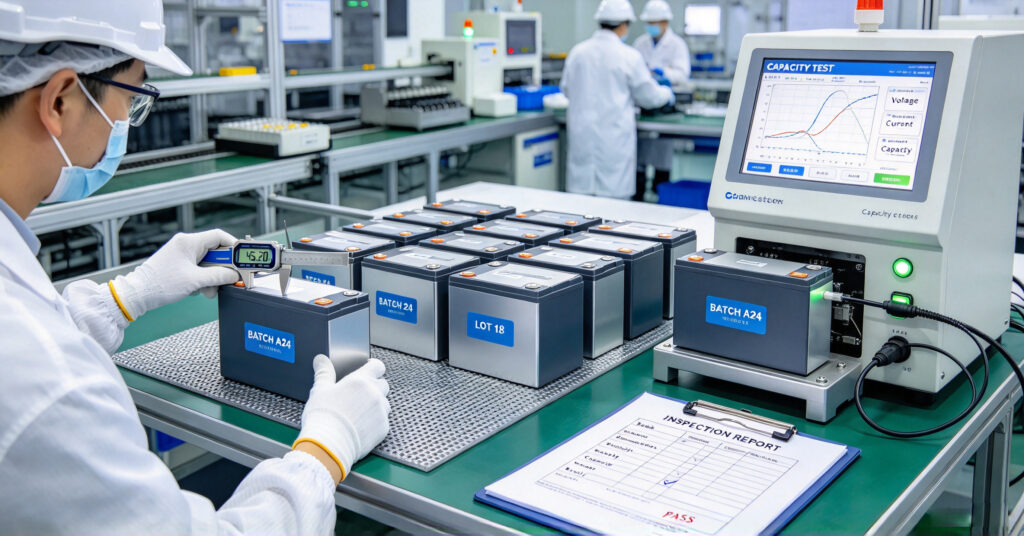
The physical checks come first and catch the most: enclosure finish and weld quality, connector and terminal condition, dimensions against the drawing, and whether the marking, rating label and serial numbering match the approved sample and the documents that will travel with the cargo.
The electrical checks are the substance. Capacity measured against the specified rate and temperature, internal resistance and the spread of it across the batch, whether the cells in a pack are consistent with each other, whether the management system reports the right values to the host, and whether the protection thresholds actually trip where the specification says they do.
Packaging and documentation close it. How the units are separated and restrained, whether the carton marking matches the packing list, and whether the test report and safety data sheet name the model being shipped. Any battery pre-shipment inspection that stops at the visual check misses the failures that cost the most.
| Area | What is checked | Why it matters later |
|---|---|---|
| Appearance and build | Welds, finish, terminals, dimensions | Corrosion and connection faults appear in service |
| Marking and identity | Rating label, serials, revision | Drives warranty and customs queries |
| Capacity and resistance | Delivered capacity, cell spread | Sets real usable energy and cycle life |
| Protection and communication | Trip thresholds, host reporting | Decides whether faults are caught at all |
| Packaging | Separation, restraint, carton marking | Survives the transport leg |
Sampling logic without a fixed table
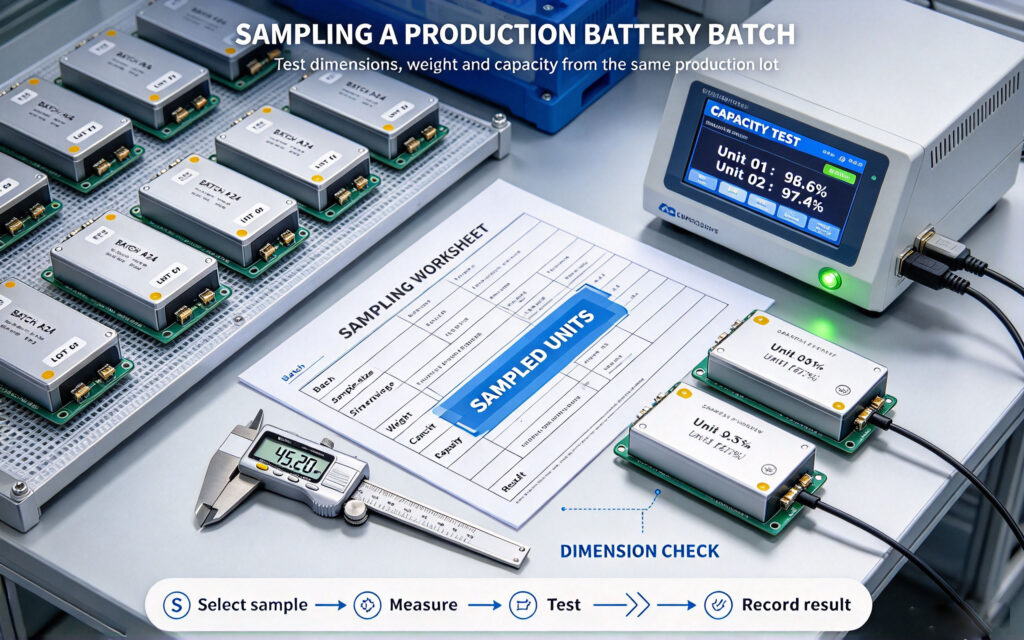
The principle behind any sampling plan is that the sample size grows far more slowly than the lot. Inspecting twice as many units does not buy twice the confidence, so plans are built around an acceptable quality level and a risk the buyer is willing to carry, and both of those are commercial decisions rather than statistical ones.
Severity is what should drive the number. A defect that makes a unit unsafe or unusable deserves a tighter threshold than a cosmetic mark on a panel, and critical and minor defects are normally treated with different limits within the same plan. Writing one flat threshold for everything is where most plans go wrong.
Test cost sets the practical ceiling. A capacity test takes hours and consumes part of the unit’s life, so it is run on a far smaller sub-sample than the visual and dimensional checks. The honest compromise is to screen widely on cheap tests and confirm narrowly on expensive ones.
How the lot is defined matters as much as how many are drawn. A batch built from one cell lot on one production run is a different proposition from a batch assembled across three deliveries, and samples drawn only from the first pallet tell you nothing about the rest.
Who should run it: you, a third party or the factory
Three models exist. The buyer’s own engineer brings the application knowledge and the authority to accept or reject on the spot, at the cost of travel and of only being able to inspect a limited set of things. A third-party inspector brings standard methods, independence and photos that hold up in a dispute, at a day rate.
Factory-accompanied inspection is the weakest form on its own and useful as a supplement: the manufacturer’s own outgoing report is evidence of what they checked, not of what passed. Where a buyer cannot attend, the common arrangement is a third-party inspection against criteria the buyer wrote, with the factory’s own test data supplied alongside.
Whoever runs it, the question of capability sits upstream. The how to evaluate battery manufacturers guide covers what to check about the factory’s own process before relying on any of this, because a strong battery pre-shipment inspection on a weak production line finds the same defects every visit.
Acceptance criteria belong in the contract, not the report
This is the point most buyers get wrong. An inspection report that says “capacity 96 percent of nominal” is useless if nobody agreed in advance what the floor is. The inspector is not there to decide whether the batch is acceptable; the contract is supposed to have decided that already.
Four things need to be written down before the batch is built. The measured limits, with tolerances, for each characteristic being checked. The test method and conditions those limits are measured under, since capacity measured at one rate and temperature is not capacity measured at another. The sampling plan, including what happens on a borderline result and who pays for the re-inspection. And the consequence: release, rework at the seller’s cost, or rejection.
The commercial terms are where this lives. The battery purchase contract guide covers how to write acceptance, remedies and re-inspection cost into the agreement so the inspection has something to enforce. A battery pre-shipment inspection without that backing is an expensive way to generate a document nobody has to act on.
The defects that turn up most often
The frequent list is short and unglamorous. Capacity below the specified floor, usually by a small margin that compounds across a string. Resistance spread across a batch that is wider than the specification allows, which shows up as imbalance once the packs are paralleled. Marking or serial numbering that does not match the approval.
Then the functional ones: a protection threshold that trips at the wrong point, a communication interface that reports the wrong values, or a display and labelling set that describes a different revision. And the packaging failures: insufficient separation, or restraints that let units move in transit.
The management system deserves its own attention here, because it is where cell-level problems become system-level ones. The BMS technology guide explains what the board measures and protects against, which is what makes the protection-function checks meaningful rather than a button press.
What the report should contain
Identification first: the purchase order, the model and revision, the batch and serial ranges, the date and who attended. Without traceability a report cannot be tied back to a batch later, which is exactly what a warranty claim will need.
Then method and raw readings rather than verdicts. Test conditions, the sample size actually drawn and from where, and the individual readings, not only a pass or fail column. Photographs of the units, the marking and the packaging, plus a list of deviations and what the inspector recommends.
The final element is the sign-off line and who has authority to use it. Where the buyer is not present, agree in advance who can release the batch and on what evidence.
Release, rework or reject: how the decision is made
Three outcomes exist for a battery pre-shipment inspection, and the criteria should have been written before the visit. Release is appropriate where deviations are within the agreed limits and are documented. Rework is appropriate where the defect is correctable on site, and the contract should already say who pays and whether the batch is re-inspected afterwards.
Rejection is the expensive one and is usually argued about, which is why the borderline case deserves explicit treatment: a margin inside which the seller may rework and resubmit, and a margin beyond which the batch is refused outright. Deciding that under time pressure, with a container waiting, is the worst moment to be negotiating.
The commercial frame around the decision is worth having ready. The cycle life versus price guide sets out what capacity and cycle commitments are actually worth over the life of the asset, which tells you how hard to push on a marginal batch, and how much a shortfall is really worth over the life of the asset.
battery pre-shipment inspection?
Battery pre-shipment inspection is the check run on a finished production batch before it is packed and shipped, confirming it matches the approved sample and the agreed specification. It covers appearance, dimensions, marking, electrical performance, protection functions and packaging.
Q. When should a pre-shipment inspection happen?
After the batch is built and tested by the factory and before it is loaded. Inspecting earlier means checking an incomplete lot; inspecting later means the container has already closed.
Q. How many units should be sampled?
Enough to give confidence without testing destructively at scale, set by defect severity and by the risk the buyer accepts. Critical defects take a tighter threshold than cosmetic ones, and capacity tests run on a smaller sub-sample.
Q. Who should carry out the inspection?
The buyer’s engineer, an independent third party, or the factory’s own outgoing check as a supplement. Third-party inspection is the usual choice when the buyer cannot attend, provided the criteria were written by the buyer.
Q. Should acceptance criteria be in the contract?
Yes. A report without agreed limits cannot trigger a remedy. Write the measured limits, the test method and conditions, the sampling plan and the consequence into the contract before the batch is built.
Q. What are the most common defects found?
Capacity below the specified floor, resistance spread wider than allowed, marking or serials not matching the approval, protection thresholds tripping incorrectly, and packaging that lets units move.
Q. What happens if a batch fails?
Release with documented deviations, rework at an agreed party’s cost followed by re-inspection, or rejection. Deciding the borderline case in advance is what prevents an argument with a container waiting.
Next step: write the limits before the batch is built
Inspection only enforces what the contract already says. Send the specification and the batch size.
- Then follow the cargo through the importing lithium batteries guide
- Or fix the terms first with the battery MOQ, lead time and payment terms guide
- For chisidal, send your usage and site details, and we will come back with product prices, lead time and warranty information.