
battery thermal management system is the set of components and controls that holds every cell in a pack within a safe, productive temperature band. It removes heat when cells work hard and adds heat when they sit in the cold, so capacity, cycle life and safety stay inside the limits the cells were built for. A good one is quiet in the background and only noticed when it is missing.
A lithium battery rarely fails in a single dramatic moment. More often it drifts out of range cell by cell, and the cost shows up later as lost capacity, a shorter service life, or at the extreme a thermal event. The part that prevents that slow drift is the one most specifiers touch last and understand least. This article walks through what a battery thermal management system actually does, why the gap between the hottest and coldest cell matters as much as the average, and how air and liquid cooling compare for real installations. We also cover the controls that decide when to act and the tradeoffs that drive a selection.
What a battery thermal management system actually does
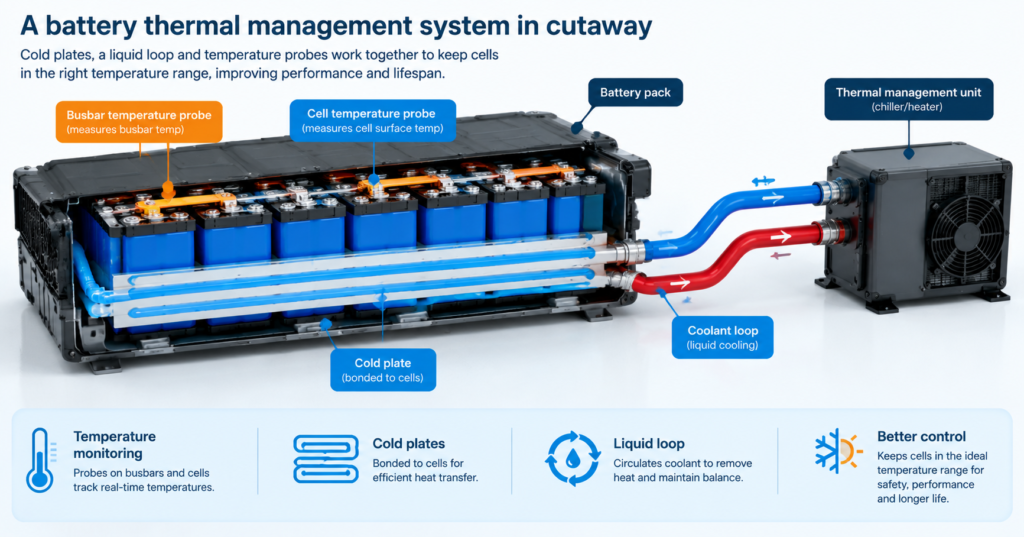
A battery thermal management system is the layer between the cells and the environment that keeps temperature where the chemistry wants it. It has three jobs: sense temperature at several points, move heat where it should not be, and decide when to act. Sensing uses probes on busbars, cell surfaces and coolant paths. Moving heat uses fans, pumps, plates or a combination. Deciding falls to the controller, which reads the sensors and commands the hardware against set limits.
The reason this matters is that a cell’s usable capacity and its rate of aging are both functions of temperature. A pack that runs above its design point ages faster and holds less, while one that runs too cold cannot deliver rated power. The system keeps all those effects inside a band the designer chose, not to chase a single number but to keep the whole pack consistent.
Why temperature uniformity matters as much as the average
It is tempting to watch one number — the average pack temperature — and call it healthy. But the cell that fails a pack is rarely the average cell; it is the hottest, the coldest, or the one in a corner airflow never reaches. A battery thermal management system earns its keep by shrinking the spread, not only by lowering the mean, because the spread quietly sets the pack’s real limit.
Two failure modes follow from a wide spread. The hot cell ages fastest and sets the pack’s end-of-life. The cold cell limits power because the inverter sees a weak link and derates the whole string. Either way the pack performs to its worst cell, so a designer should read the delta as carefully as the mean. Uniformity is a design target in its own right, and the main reason dense packs lean toward liquid rather than air. A wide spread also raises the risk one cell crosses into a regime the pack cannot recover from, which is the concern behind thermal runaway and fire suppression.
How air cooling works and where it still fits
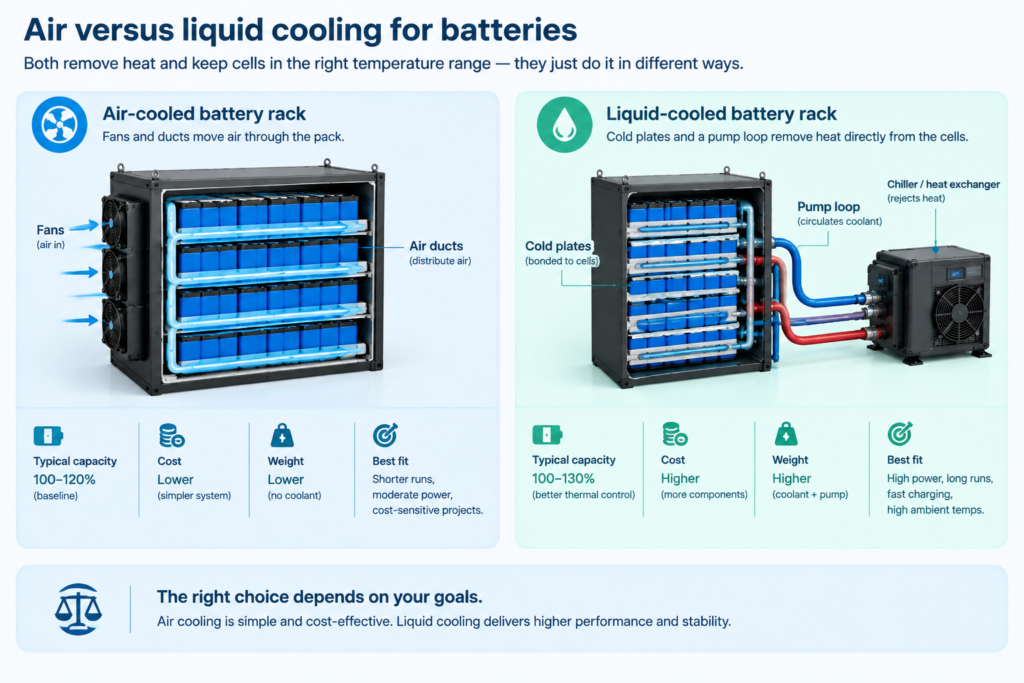
Air cooling moves heat by pushing air across the cells, by natural convection or by forced fans pulling cabin or outside air through the enclosure. It is simple, has few parts, and adds almost no weight. For low energy density, gentle duty cycles and a moderate climate, it is often enough and the cheaper choice to build and service.
Its limit is capacity. Air is a poor conductor and heat carrier next to a liquid, so as energy density or charge and discharge rates climb, the hottest cell drifts from the average and the system loses control of uniformity. That is why air cooling dominates small racks and mild climates and gives way to liquid as packs get denser. For higher density designs, the liquid-cooled BESS design path handles the heat a fan cannot.
How liquid cooling works and why dense systems choose it
Liquid cooling carries heat through a fluid loop — usually a water-glycol mix — running through cold plates or jackets bonded to the cells. Because the fluid moves far more heat per unit than air, it holds a tight spread even when cells work hard, with less noise. That control is why dense racks and high-rate systems increasingly use it.
The trade is complexity and weight. A liquid loop needs a pump, a plate, a reservoir, seals and a path that will not leak in service, and all of it adds mass and maintenance. But where space is tight and the duty is heavy, the uniformity it buys pays back in cycle life and usable power. The choice is rarely about which cools better in the abstract and more about which fits the pack’s density, rate and site.
| Approach | Cooling capacity | Cost to build | Added weight | Maintenance | Best-fit application |
|---|---|---|---|---|---|
| Air | Low to moderate | Lower | Minimal | Few parts, easy to service | Small racks, mild climate, light duty |
| Liquid | High | Higher | Notable | Pump, plates, seals to check | Dense racks, high rate, hot or dirty sites |
Other cooling approaches worth a look
Two alternatives appear in niche designs. Phase-change material sits against the cells and absorbs heat as it melts, smoothing peaks without active power; it is passive but has a finite budget and must be reset by cooling. Immersion drops the cells into a dielectric fluid that carries heat off every surface, giving the best uniformity, at the cost of fluid handling, weight and service complexity.
Neither is a default. They matter where air is insufficient and liquid is awkward — tight spaces or duty that spikes hard and briefly. For most projects the decision is air versus liquid, and these two are specialist options a designer keeps in reserve. The fundamentals of cell choice still begin with LFP cell selection, since the chemistry sets the window the cooling system must hold.
How a TMS decides when to act — controls and setpoints
A battery thermal management system is only as good as the logic that commands it. The controller reads cell and coolant temperatures and compares them to setpoints: a comfort band where nothing runs, a warning band where cooling starts, and a protect band where the system limits power. The spacing of those bands is a trade between efficiency and aging — start cooling early and you spend energy; start late and you let cells drift.
Good control also coordinates with the protection layer. When the monitoring sees an over-temperature or an over-current, the thermal side must respond, and that handoff is where BMS thermal protection earns its place. Setpoints are not universal; they follow the cell datasheet, the pack layout and the site climate, and they should be documented as part of the design rather than left at factory defaults.
Sizing and selection tradeoffs across cost, weight and climate
Choosing between approaches comes down to four variables. Cost favours air at low density and liquid as density climbs, because the cooling hardware is a smaller share of a bigger pack. Weight favours air, since a liquid loop adds mass that matters in mobile or roof-mounted units. Maintenance favours air’s few moving parts against liquid’s pump and seals. Climate is the tiebreaker: a hot site or a site with dirty air pushes toward liquid, which seals the cells off from the environment.
There is no single right answer, only the fit between pack, duty and place. A 48V rack-mount battery in a climate-controlled room may never need liquid, while the same energy in a hot warehouse will. Specifiers should size the cooling to the worst case and then check whether a simpler system would hold the band. The right call keeps every cell in range for the life the project needs.
battery thermal management system?
A battery thermal management system is the parts and controls that hold every cell within a safe temperature band. It senses temperature, removes heat when cells work, and warms them when cold, so capacity, life and safety stay inside the cell limits.
Q. What does a battery thermal management system do?
It senses cell and coolant temperatures, then moves heat with fans, pumps or plates to keep the pack inside a chosen band. Its job is to keep the spread between the hottest and coldest cell small, because a pack performs to its weakest cell.
Q. Is air cooling or liquid cooling better for a battery?
Neither is universally better. Air is cheaper, lighter and simpler and suits small racks in mild climates. Liquid handles higher density and heavier duty with tighter uniformity but adds cost, weight and maintenance. The right choice follows the pack’s density, rate and site climate.
Q. What are TMS setpoints?
Setpoints are the thresholds the controller acts on: a comfort band where nothing runs, a warning band where cooling starts, and a protect band where power is limited. Their spacing trades efficiency against aging and should follow the cell datasheet and site, not defaults.
Q. How does temperature uniformity affect battery life?
A wide spread lets the hottest cell age fastest and set pack end-of-life, while the coldest limits power and forces the inverter to derate the string. Keeping the delta small protects both life and usable power, which is why dense packs favour liquid cooling’s tighter control.
Q. What is immersion cooling for batteries?
Immersion drops the cells into a dielectric fluid that carries heat off every surface, giving the best uniformity of any method. It handles hard, brief spikes well but adds fluid handling, weight and service complexity, so it stays specialist rather than default.
Q. How do I choose a battery cooling method?
Weigh cost, weight, maintenance and climate. Air wins on cost and simplicity at low density; liquid wins on control at high density and hot sites. Size to the worst case and check whether a simpler system holds the band.
Request pricing for your project
Send us your usage and site details. For chisidal, we can share product prices, lead time and warranty information. Feel free to contact us for a quote.
- battery state of charge estimation
- battery state of health
- For chisidal, send your usage and site details, and we will come back with product prices, lead time and warranty information.