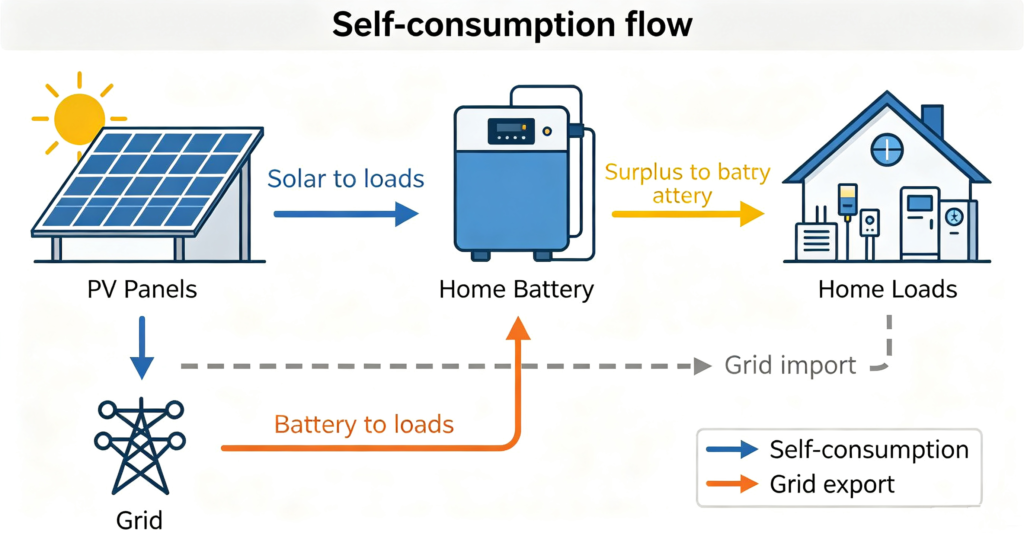
The main solar energy storage benefit for homeowners is self-consumption: a home battery catches the solar your roof makes at noon and releases it in the evening, so you buy less from the grid at peak rates. Where export payments are low and evening peak rates are high, that spread is the whole case for storage. Size the battery to your evening load, not your roof.
Most homeowners add storage for one reason — to use more of the power they already pay to make. Without a battery, midday surplus exports at a low feed-in rate; with one, that surplus becomes evening power you would otherwise buy back dear.
How self-consumption actually works
Solar panels often make more at noon than the home uses. A battery stores the surplus; when the sun drops, the battery releases it so the home draws less from the grid. The gain is the gap between cheap self-made energy and expensive grid energy — wider where feed-in tariffs are low and peak rates are high. This is the residential mirror of the commercial self-consumption case.
The simple payback logic
A one-line model: if a home self-consumes an extra 8 kWh/day that would otherwise export at a low rate and import at a high rate, the daily value is 8 kWh × the rate spread, minus round-trip losses. Over a month that compounds. Exact numbers need your tariff and generation profile; ask the supplier for a simulation rather than a generic payback claim. The rate spread — not the panel size — decides whether storage pays.
Size the battery to your evening load
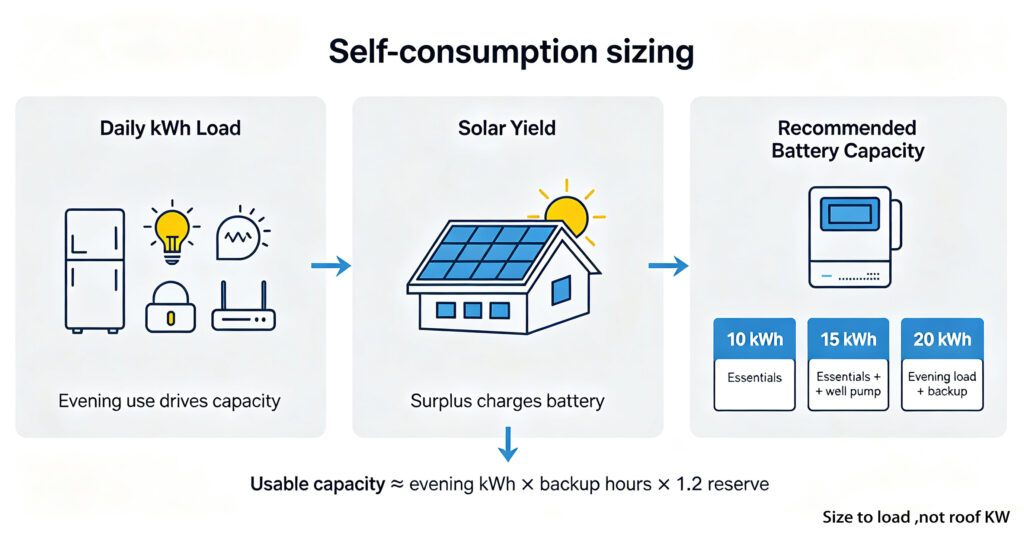
Capacity follows evening draw, not roof area. A home using ~8 kWh in the evening with one backup night wants roughly 8 × 1 × 1.2 ≈ 10 kWh usable at the right depth of discharge — a standard wall-mounted unit. Double the backup nights and you double capacity, not power. The sizing guide has the full worksheet.
Self-use vs export: the tradeoff
Where feed-in rates are high, exporting surplus may beat storing it; where they are low, storage wins. The break-even shifts with policy, so revisit it at quote time. A good supplier models both and shows the crossover, not just the sunny-day best case.
What to confirm before you buy
- Usable (not nameplate) capacity at your planned depth of discharge.
- Round-trip efficiency of the chosen chemistry (LiFePO4 returns most of what you store).
- Whether the unit islands the whole home or only critical loads during an outage.
- Which safety standard the enclosure meets in your market.
Common mistakes
Buyers size the battery to roof kW instead of evening kWh, or chase the lowest price and miss the enclosure standard. Match capacity to evening load; the cheapest box is rarely the cheapest ownership when export rules shift.
A worked self-consumption example
Suppose a roof makes 30 kWh on a sunny day but the home uses only 8 kWh during daylight; the other 22 kWh would export at a low rate. Add a 10 kWh battery and the home stores the surplus, then draws it in the evening instead of buying about 10 kWh back at peak. At a spread of, say, 0.20 USD per kWh between export and peak import, that is about 2 USD per day, or 60 USD per month, before losses. The solar energy storage benefits for homeowners 2026 are clearest where that spread is wide and the feed-in rate is low – which is exactly the typical residential tariff. Exact figures need your bill, not a generic claim.
Sizing worksheet: match the evening load
Write three numbers: evening kWh use, backup hours wanted, and peak kW of circuits run at once. Capacity is about evening kWh times backup hours times 1.2 reserve; power must exceed peak kW. A home using 8 kWh in the evening with one backup night wants about 10 kWh usable – a standard wall unit. Confirm against your real bill; the sizing worksheet does the math step by step.
What shifts the math
Two things move payback most: the export rate and any incentive. Where the utility pays well for exports, storing surplus competes with a generous buyback; where it pays little, storage wins. Incentives change year to year, so request a model with your current numbers rather than a fixed payback year. The battery is a financial tool – size it to the bill, not the roof.
Questions to ask your installer
- What self-consumption rate does your simulation show for my profile?
- Which export rate did you assume, and is it current?
- Does the unit island, or only self-consume?
- What enclosure safety standard applies in my market?
Q. Is adding a battery to existing solar worth it?
If your feed-in rate is low and your evening peak rate is high, yes — storage captures the spread between cheap self-made energy and expensive grid energy. Run the one-line model above with your real tariff; a supplier simulation confirms it.
Q. What self-consumption rate can I expect?
It depends on battery size and load timing. A modest wall-mounted battery typically lifts self-consumption well above the no-storage baseline; the exact figure needs your generation and usage profile, which the residential overview frames.
Q. Do I need solar to benefit from a battery?
No — a battery-only home charges from the grid for backup or time-of-use arbitrage. But the self-consumption benefit specifically needs solar; see the without-solar guide for that path.
Q. Will a battery pay back in 2026?
It depends on your tariff and incentives, not a fixed year. The payback logic is the same every year; only the rate spread and any incentive change. Request a model with your actual numbers rather than a generic payback claim.
Q. How big a battery do I need for self-consumption?
Match usable capacity to evening load plus reserve, not roof kW. A typical efficient home wants ~10 kWh for one backup night of essentials; more circuits or a well pump push it to 15–20 kWh.
Next step: run the numbers on your utility bill
Pull your peak, off-peak, and export rates; estimate evening kWh; then request a supplier simulation. Self-consumption is a financial tool — size it to the bill, not the roof.
- Compare against the leekooenergy residential 5 / 10 / 15 / 20 kWh tiers
- use #9 Battery Capacity Calculator to estimate
- have the installer run a simulation that includes export crossing points