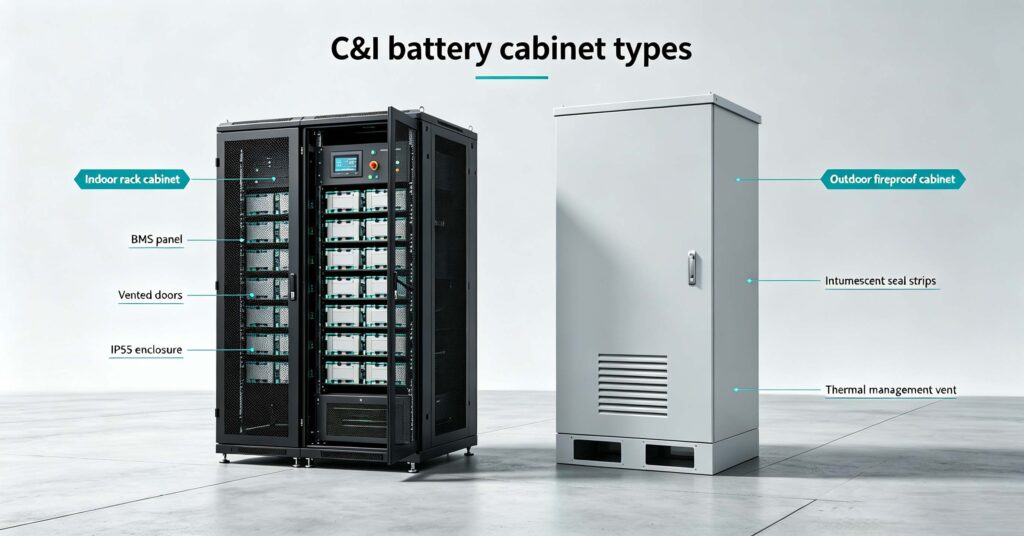
A battery storage cabinet is the metal enclosure that turns a stack of LiFePO4 modules into a code-compliant, serviceable, fire-aware C&I asset. A fireproof battery cabinet is the same idea taken one step further — the enclosure is rated to contain a thermal event inside the cabinet for a defined window, with intumescent seals, fire-rated vents and a managed exhaust path. For a commercial or industrial site, the cabinet choice is set by the install location (indoor plant room vs outdoor pad), the local fire code, and what the AHJ (authority having jurisdiction) will accept without an engineered alternative. The decision tree is short: indoor conditioned space → rack cabinet; outdoor exposed location → fireproof or IP-rated cabinet; mixed indoor/outdoor plant with adjacent occupancies → fireproof cabinet plus a thermal detection loop.
Most C&I storage projects fail at the cabinet stage, not at the cell stage. The cells are usually a known SKU from a known supplier; the BMS, hybrid inverter and energy management system are all integrated products; the balance-of-system is what determines whether the install passes inspection, survives a thermal event without spreading, and remains serviceable for the next fifteen years. This guide is the cabinet-side of that balance-of-system — the enclosure class, the certifications, the fire integration and the install checklist that separates a passing project from a re-work.
The cabinet taxonomy
C&I battery cabinets split into four physical families, and the right one is set by where it lives. Indoor rack cabinets are 19-inch or 23-inch steel enclosures, typically 600 × 800 × 2,000 mm, vented for passive thermal management and designed to sit in a conditioned plant room. Indoor fireproof cabinets are the same form factor with intumescent seals, fire-rated vent covers and an integrated thermal detection loop; they sit in mechanical rooms, electrical rooms or occupied-adjacent spaces where a fire event cannot be allowed to spread beyond the cabinet. Outdoor IP-rated cabinets are sealed enclosures (typically IP55 to IP66) with active thermal management (HVAC or liquid cooling), sun-shield paint and a rain-safety design; they sit on a concrete pad or a steel plinth outside the building. Outdoor fireproof cabinets combine the IP-rated enclosure with the intumescent fire integrity, and are the default for utility-adjacent, rooftop and remote-site C&I projects. The outdoor family overlaps with the outdoor-storage decision tree in #25 lightweight solar batteries.
The specifications that matter
| Spec | Indoor rack | Indoor fireproof | Outdoor IP-rated | Outdoor fireproof |
|---|---|---|---|---|
| Typical enclosure class | IP20 / IP21 | IP21 / IP43 | IP55 / IP66 | IP55 / IP66 |
| Fire integrity | None (passive vent) | 90 min F-rated (typical) | 30–60 min (typical) | 90+ min F-rated (typical) |
| Thermal management | Passive vent + rack fans | Passive + smoke exhaust | Active HVAC / liquid loop | Active HVAC + fire-rated vent |
| Cabinet material | Cold-rolled steel, powder-coated | Galvanised steel + intumescent seals | Hot-dip galvanised + outdoor paint | Galvanised + intumescent + outdoor paint |
| Certifications (typical) | CE / IEC 62619 / UN38.3 | CE / IEC 62619 / EN 14470-1 (where claimed) | CE / IEC 62619 / UL 1973 / IP rating cert | CE / IEC 62619 / UL 1973 / fire rating cert |
| Typical install | Conditioned plant room | Mechanical / electrical room | Outdoor pad, sun-exposed | Outdoor pad, adjacent to occupancy |
| Service access | Front + rear | Front only (rear sealed) | Front + side (per layout) | Front only (sealed perimeter) |
| Cost (relative) | Entry | Standard | Standard–Premium | Premium |
Fire integrity ratings above are typical for C&I-grade enclosures in this product class. Confirm the exact rating and certification scope with the cabinet supplier — “fireproof” without a documented F-rating is a marketing term, not a compliance term. Certifications vary by region and AHJ; verify what your local inspector will accept.
Where indoor rack cabinets work
An indoor rack cabinet is the right answer for a conditioned plant room, a dedicated battery room, or any indoor space where the surrounding occupancy is not on the other side of a fire-rated wall. The enclosure is passive — vented for thermal management, but not designed to contain a thermal event. If a cell goes into thermal runaway, the cabinet’s job is to give the BMS the time to isolate the affected module and to let the smoke detection loop alert the building’s fire system; the cabinet itself is not fire-rated. The install trade-offs — cable management, clearances, HVAC interaction — are walked through in #13 home battery installation at the residential scale and in #16 commercial solar + battery at the C&I scale.
For a server-room-adjacent install or a retrofit where the battery shares a room with existing electrical gear, the indoor rack cabinet is usually the cheapest compliant option. The cost premium for stepping up to an indoor fireproof cabinet is small relative to the rework cost of being told by the AHJ to provide one.
Where indoor fireproof cabinets work
Indoor fireproof cabinets sit in mechanical rooms, electrical rooms and any indoor space where a fire event inside the cabinet cannot be allowed to spread to the surrounding occupancy. The fireproof rating is provided by intumescent seals that expand under heat to close gaps, fire-rated vent covers that close on a smoke signal, and a managed exhaust path that vents the cabinet to the outside rather than into the room. The cabinet also integrates a thermal detection loop — usually a linear heat cable or a smoke detector inside the cabinet — that triggers the building’s fire system before the cabinet integrity is challenged.
For hospitals, data centres, light-industrial occupancies and any site where the AHJ treats the battery room as a “control area” with adjacent occupancies, the indoor fireproof cabinet is usually the default and is sometimes the only option the AHJ will accept without a costly engineered alternative.
Where outdoor cabinets work
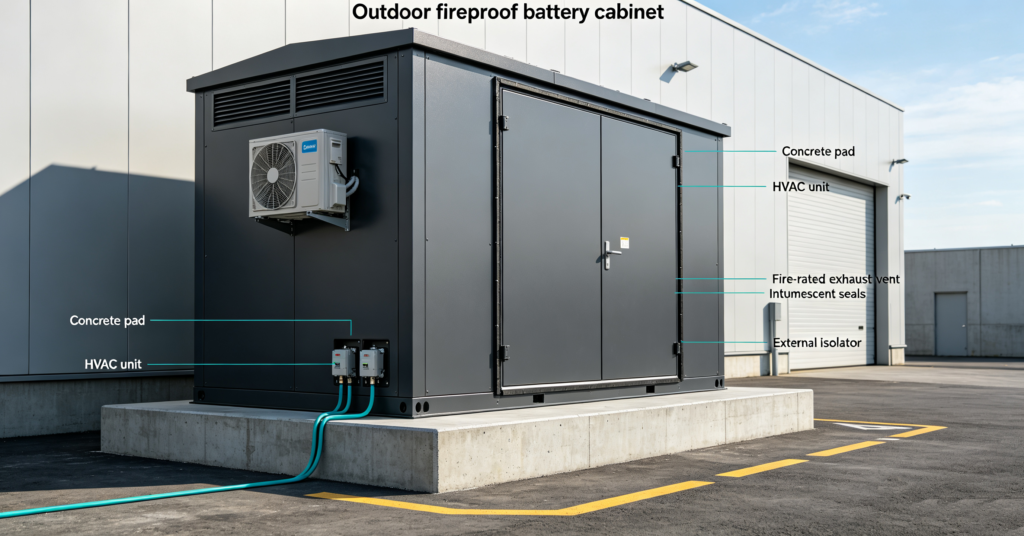
Outdoor IP-rated cabinets are the right answer for sites where the battery lives outside — exposed to sun, rain, dust and temperature swings. The enclosure handles the environment; the active thermal management inside (HVAC, liquid cooling or a hybrid loop) handles the cell temperature. For rooftop installs, remote-site C&I projects and any site where indoor plant room space is at a premium, the outdoor cabinet removes a constraint rather than adds one.
Outdoor fireproof cabinets add the fire integrity rating on top of the IP-rated enclosure, and are the right answer for outdoor installs adjacent to occupied buildings, fuel storage or other ignition risks. The combined rating — IP66 for water and dust, 90+ minutes F-rating for fire integrity — is what makes the outdoor fireproof cabinet the default for utility-scale and C&I projects where the AHJ requires a fire-rated enclosure but the indoor space is not available.
The integration checklist
A cabinet does not pass inspection on its own; it passes as part of an integrated install. The checklist that separates a passing project from a re-work:
- Smoke / heat detection: a detector inside the cabinet wired to the building fire system. The detector must be specified for the chemistry (LiFePO4 off-gases earlier than the smoke detector’s typical threshold).
- Ventilation: the cabinet’s vent path must exhaust outside the building, never into an occupied space. For indoor fireproof cabinets, the exhaust path must remain functional when the intumescent seals are closed.
- Thermal management: HVAC or liquid cooling sized for the cabinet’s continuous heat dissipation at the site’s peak ambient. A derate curve for ambient above 35 °C is part of the spec.
- Clearances: the cabinet manufacturer’s specified clearances for service access, airflow and fire separation. Reducing these to fit a tighter plant room is a common cause of inspection failure.
- DC isolation: a visible, lockable DC disconnect at the cabinet boundary, within reach of the door. The fire code wants to be able to drop DC without entering the cabinet.
- Grounding and bonding: the cabinet bonded to the site ground per the local electrical code, with the bond sized for the available fault current.
- Spill containment: for indoor installs, a containment tray under the cabinet sized for the electrolyte volume of the largest cell (LiFePO4 is benign but the AHJ does not always know that).
- Signage and labelling: arc-flash, chemical and voltage labels per the local electrical and fire codes. The cabinet supplier will provide a label set; verify it matches the local code before install.
Those eight items are what separates a cabinet that passes inspection on day one from one that fails on day ninety. The broader C&I integration logic, including the upstream inverter, transformer and grid-interconnection side, is in #16 commercial solar + battery storage.
Q.What is a battery storage cabinet?
A battery storage cabinet is the metal enclosure that houses a battery system at a commercial or industrial site — typically a 19-inch or 23-inch rack frame in a steel cabinet, with thermal management, BMS integration and electrical protection built in. The cabinet is what makes the battery installable, serviceable and code-compliant; the cells alone are not.
Q.What is a fireproof battery cabinet?
A fireproof battery cabinet is a battery cabinet that has been tested and certified to contain a thermal event inside the cabinet for a defined window (commonly 90 minutes F-rating). It uses intumescent seals that close under heat, fire-rated vent covers and a managed exhaust path. “Fireproof” without a documented F-rating is a marketing term.
Q.Do I need a fireproof cabinet for an outdoor C&I battery install?
Usually yes, if the cabinet is adjacent to an occupied building, fuel storage or any other ignition risk. Confirm with the local AHJ; many jurisdictions require a fire-rated enclosure as the default for outdoor C&I storage above a capacity threshold.
Q.What is the difference between a battery rack cabinet and a battery storage cabinet?
A battery rack cabinet emphasises the internal mounting system — the 19-inch or 23-inch rack frame that the modules clip into. A battery storage cabinet emphasises the enclosure as a whole — the thermal management, the fire integrity, the electrical integration and the service access. In practice the two terms are used interchangeably for the same product.
Q.What certifications should I ask for on a battery cabinet?
At minimum: IEC 62619 (industrial lithium cells), UN38.3 (transport), CE or UL listing (region-dependent), the IP rating cert for the enclosure class, and — for fireproof cabinets — a documented fire integrity rating from a recognised test house. The cabinet supplier should provide all five without prompting.
Next step: match the cabinet to the install location
The table above is the taxonomy; the next step is a site survey — location, ambient, occupancy adjacency, fire code — and a quotation for the cabinet family that fits. Send the site details and we will return a sized proposal with the certification documents attached.
- Review the broader C&I integration in #16 commercial solar + battery
- Walk the outdoor install trade-offs in #25 lightweight solar batteries
- Confirm the upstream side in #22 utility-scale battery storage
- Request a quotation for indoor rack, indoor fireproof or outdoor fireproof cabinets