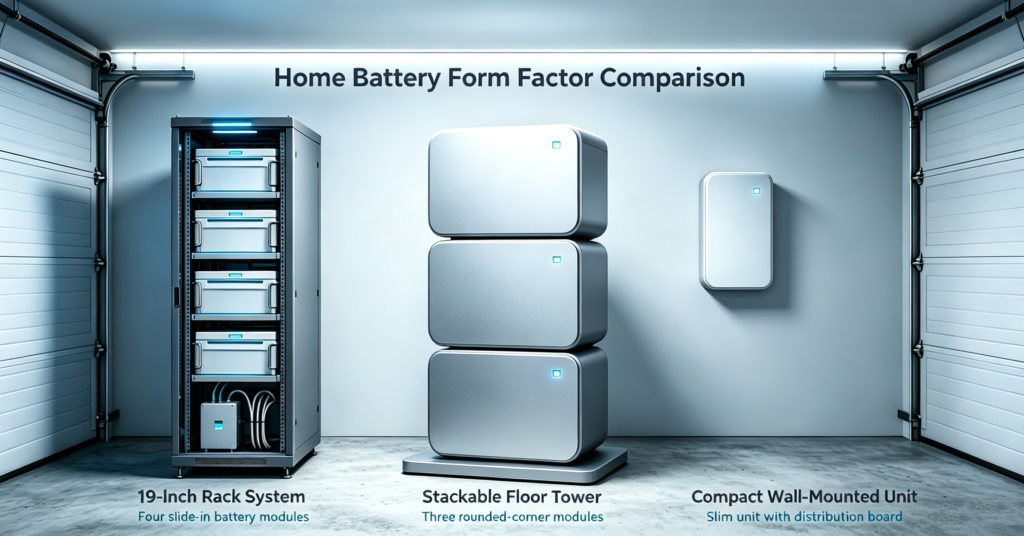
The shortest answer: choose the wall-mounted form when floor space is the constraint, the stackable form when you want to grow capacity one module at a time without a rack, and the rack-mounted form when you are standardising across many installations or planning several battery modules from day one. A home LiFePO4 battery pack delivers the same chemistry and the same cycle life in all three forms — the form factor decides where it can be installed, how it is wired, how it cools, how it is serviced and how far it can expand. This guide compares the three forms on the criteria that actually change a purchase decision.
Buyers often spend most of their research time on chemistry and capacity, then discover late in the project that the battery they chose does not fit the wall, the floor loading or the service clearances of the site. Form factor is not a cosmetic preference. It interacts with the building structure, the electrical panel layout, the ventilation of the room and the expansion plan for the next three to five years. Getting it right early avoids re-quoting, re-permitting and, in the worst case, replacing hardware that cannot be extended.
One distinction first, because it causes confusion in quotes: form factor is not the same as system architecture. A rack-mounted battery and a wall-mounted battery can both be part of a split system with a separate inverter, and an all-in-one cabinet can contain either form internally. The architecture question — one cabinet or two — is covered in #42 all-in-one vs split systems. This guide stays on the narrower question: what physical form should the battery itself take?
Why the form factor is a real decision
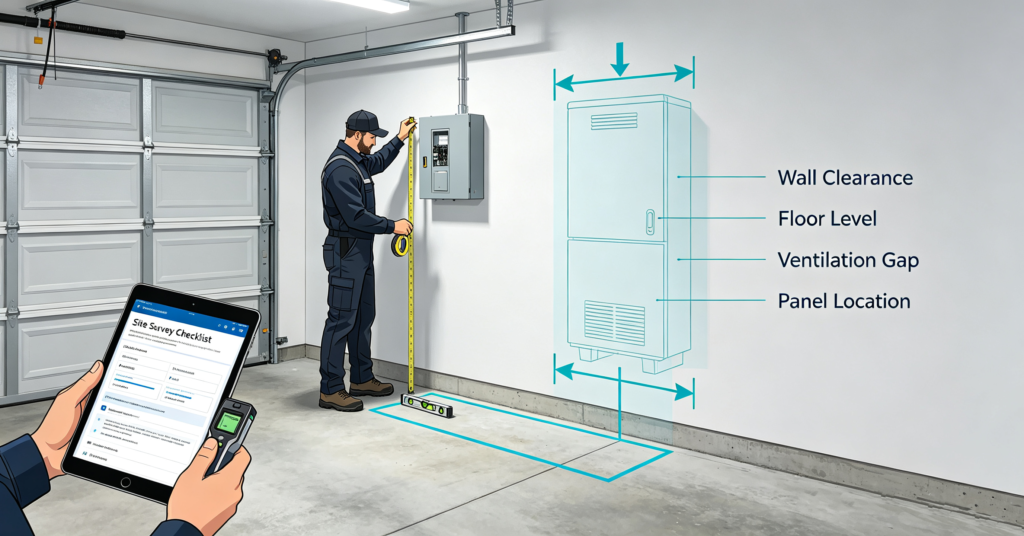
Four practical constraints decide the answer on most residential and small commercial sites. Space: a garage corner, a utility room wall and a plant closet each favour a different form. Weight: a high-capacity module can be safe on a concrete floor but questionable on a drywall wall; the mounting surface must be rated for the full installed weight, not just the first module. Wiring and service access: every form still needs clearance for cabling, isolation points and future maintenance — a battery squeezed behind pipework is a service problem even if it fits. Expansion: families and businesses rarely buy their final capacity on day one, and the three forms expand very differently.
There is also a commercial dimension that matters to installers and distributors. A form factor that the local installation base is familiar with shortens install time, reduces call-backs and simplifies spare-parts stocking. A form factor that is new to the market can be justified by better specs, but it deserves extra attention in the quote and the handover documentation.
Wall-mounted: the space saver
The wall-mounted home LiFePO4 battery pack is the default choice where floor space is scarce: garages, utility rooms, small plant rooms and apartments with a shared services wall. It keeps the floor completely clear, mounts at a height that makes the status display and isolator easy to reach, and presents a clean, appliance-like appearance that homeowners accept in visible spaces.
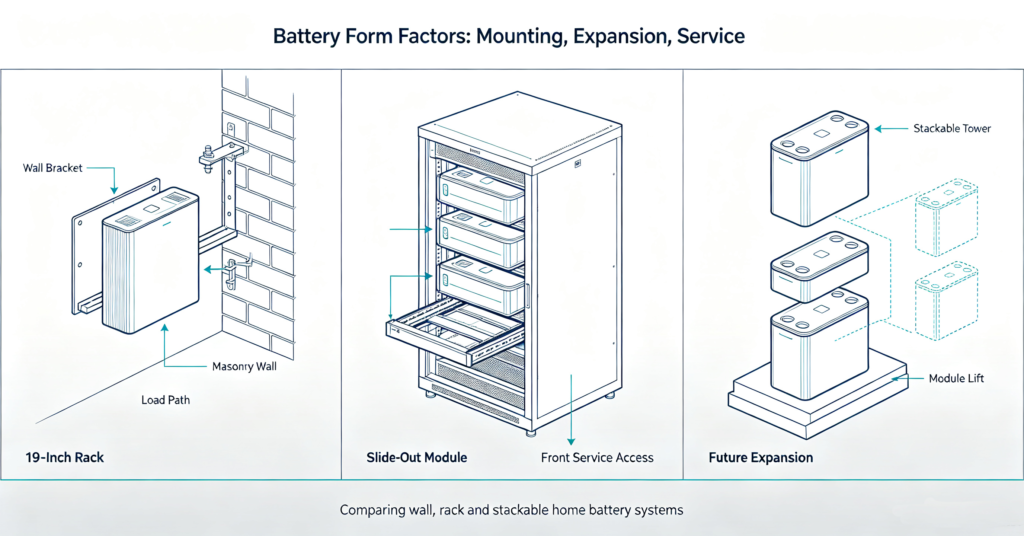
The trade-offs are capacity and weight. Wall units are typically built as one or two compact modules, so the practical capacity ceiling per wall is lower than a rack or stack of the same footprint of floor. The mounting itself matters more than buyers expect: the wall must be a structural material, the bracket must be level, and the installed weight — battery plus bracket plus cabling — must stay within the wall’s rating. In seismic regions, additional bracing rules may apply, and the local code decides what is acceptable. Because the unit sits on the wall, its cooling depends on the room air around it; a tightly enclosed closet with no airflow is a poor location for any battery, wall-mounted or not.
The wall form pairs naturally with compact residential inverters and with the voltage platforms common in households. The 51.2 V platform and the typical 100 Ah-class module sizes used in wall units are covered from a specification angle in #39 the 51.2 V residential SKU guide, and the voltage-platform decision behind it is explained in #12 48 V vs 51.2 V.
Rack-mounted: the standardiser
The rack-mounted form uses the 19-inch rack convention borrowed from IT and telecom equipment. Battery modules slide into a floor-standing frame, share a common bus and are managed as one system. This is the form that most European-style residential storage grew up around, and it is the natural choice for installers who run many similar projects: the rack, the modules, the busbar and the cabling layout repeat from site to site.
The rack form wins on density and service. Because modules are separate slide-in units, capacity scales in clean steps, a failed module can be swapped without dismantling the stack, and each module stays individually monitored by the battery management system. The frame itself carries the weight on the floor, so wall construction is irrelevant. The trade-offs are footprint and appearance: a rack needs its floor area and its front clearance, and in a visible domestic space it looks more like equipment than an appliance. Rack systems also assume the site can accept a taller structure — ceiling height and top clearance for cable entry are part of the site survey.
For projects that start with four or more modules, or for installers standardising a product platform across dozens of installs, the rack is usually the most economical form per kilowatt-hour installed, because the frame and bus infrastructure are shared across all modules.
Stackable: the incremental grower
The stackable form sits between the other two. Modules lock together vertically into a floor-standing tower without a rack frame — each module carries its own mechanical and electrical interface, and the tower grows by adding modules on top. No wall rating is involved, no rack is needed, and the initial install can start small: one base module plus the capacity the budget allows today.
Stacking suits buyers whose load is expected to grow — a family planning an electric vehicle or a heat pump, or a small business adding machinery in stages. It also suits sites with an awkward floor but a sound slab: the tower footprint is small and usually square, which fits corners and alcoves that cannot host a rack’s depth.
The cautions are mechanical and electrical. Every added module raises the centre of gravity, so the base must be level and, in seismic or high-traffic areas, restrained against tipping. The stacking connectors carry the full system current at the bottom interfaces, so module-to-module contact quality matters more than in a rack with a fixed bus. And because stackable towers are often marketed as “plug and grow”, buyers should still verify that the battery management system supports the mixed module counts they plan — the sizing method that keeps the array inside its safe operating window is covered in #09 how to size a home battery.
Comparison table
| Criterion | Wall-mounted | Rack-mounted | Stackable |
|---|---|---|---|
| Floor space used | None | Frame footprint plus front clearance | Small square footprint |
| Wall requirement | Structural wall rated for full weight | None — frame carries load on floor | None — floor slab carries load |
| Typical capacity ceiling | One to two compact modules per wall | Highest — many modules in one frame | Medium — limited by tower height and base stability |
| Expansion path | Add a second unit if wall and cabling allow | Slide in additional modules | Stack additional modules on top |
| Service access | Good at mounted height | Excellent — front slide-out modules | Good — unstack from the top down |
| Cooling approach | Room air around the unit | Module spacing and rack ventilation | Module-to-module airflow channels |
| Appearance in living space | Most appliance-like | Equipment-like; best in utility areas | Neutral tower; compact footprint |
| Install repeatability for fleets | High | Highest — standard platform | High |
| Best for | Tight spaces, visible interiors, retrofits | Multi-module projects, standardised installs | Incremental growth, awkward corners |
| Watch out for | Wall rating, seismic bracing, closet airflow | Ceiling height, front clearance, depth | Base levelling, tipping restraint, connector quality |
How the form interacts with the rest of the system
Form factor choices ripple into three later decisions. First, capacity planning: the sizing calculation in #09 produces a target kilowatt-hour figure, and that figure should be checked against what each form can physically host on the site before the order is placed. Second, voltage platform: wall and stackable residential units cluster around the low-voltage platforms, while rack systems span both low-voltage residential racks and higher-voltage commercial frames — the platform trade-offs are in #12. Third, system architecture: whichever form is chosen, the battery still has to live somewhere relative to the inverter, which is the decision covered in #42. A buyer who answers the form question, the platform question and the architecture question has effectively specified the battery section of the project.
For projects that outgrow the residential forms entirely — multi-tenant buildings, workshops, small industrial sites — the form conversation continues at a larger scale with cabinets and containers. That transition, and where a home LiFePO4 battery pack stops being the right category, is covered in #14 residential energy storage systems for the household side and in the C&I storage guides for the commercial side.
A six-question decision checklist
- What can the site structurally offer? A rated structural wall, a sound floor slab, or both — this single fact usually eliminates one form immediately.
- What capacity is needed on day one, and in three years? If the end state is three or more modules, the rack or stack forms pay for themselves; if it is one or two, wall-mounting keeps the floor clear.
- Who services the system, and how often? Front-slide rack modules are the friendliest for frequent maintenance; wall units are easiest for a quick visual check.
- What does the room’s airflow look like? Any form needs ventilated surrounding air; an enclosed closet needs a ventilation plan regardless of form.
- What does the local code say about mounting and seismic restraint? Wall bracing and tower restraint rules vary by jurisdiction and can override preferences.
- What does the rest of the fleet look like? Installers standardising on one platform should weigh repeatability heavily — the rack form exists for exactly this reason.
Which form factor is cheapest to install?
For a single-module system on a suitable wall, the wall-mounted form usually has the lowest installation effort because there is no floor work and no frame assembly. As module count grows past two or three, the rack form becomes the most economical per kilowatt-hour because one frame and one bus serve all modules. Exact costs vary by market and labour rates, so compare quotes for the specific module count rather than by form alone.
Can I mix form factors in one system?
Mixing a wall unit and a floor unit in one battery system is sometimes possible when the modules share a platform and the battery management system supports the configuration, but it should never be assumed. Verify with the manufacturer which module combinations and parallel arrangements are supported before ordering, and keep the whole array on one monitored platform.
Is a stackable tower as safe as a rack?
Both forms can be fully safe when installed to the manual. A stackable tower adds two things to check: a level, stable base so the tower cannot tip, and sound module-to-module connectors at the interfaces. Racks distribute the same risks differently — frame anchoring and front clearances. Safety comes from correct installation and a well-designed BMS, not from the form itself.
Does the form factor affect cycle life?
No. Cycle life is a property of the cells, the operating temperature window and the depth of discharge, not of the enclosure shape. A home LiFePO4 battery pack in a wall, rack or stack form from the same cell platform should deliver comparable cycle life if it is operated in the same conditions. The form affects cooling and therefore temperature — which is why ventilation matters for every form.
What if I later want to move from wall-mounted to a bigger system?
Plan the exit at purchase time: choose a platform family that includes rack or stackable modules with the same voltage and communication protocol, so later capacity can be added alongside or instead of the wall unit. Where a full change of platform is unavoidable, the wall unit can often be redeployed to a second site — another reason to keep it on a standard, well-supported platform.
Next step: turn the form decision into a specification
The form factor is one of three linked decisions — form, voltage platform and system architecture. Finish the set before requesting quotes.
- Check voltage platforms in #12 48 V vs 51.2 V
- Size the capacity first in #09 how to size a home battery
- Browse wall-mount and stackable SKUs in #39 the 51.2 V residential guide
- Settle the architecture question in #42 all-in-one vs split
- Ask leekooenergy for the rack, stackable and wall-mounted option sheets for your platform and target capacity