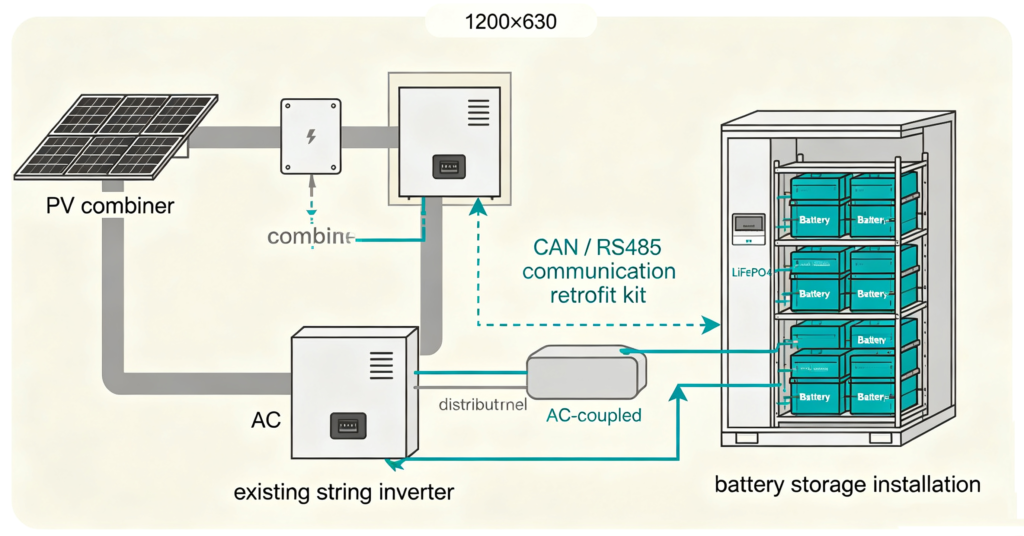
A battery storage installation retrofit is the act of adding a battery bank to a PV system that was originally designed as a grid-tie solar system without storage — and most existing PV systems can take a battery without replacing the inverter, provided three checks pass. The first check is the inverter’s AC-coupled battery interface: most modern string inverters can accept an AC-coupled battery through a separate battery inverter or hybrid inverter on the AC bus, and a few accept a DC-coupled battery directly. The second check is the communication protocol between the new battery’s BMS and the inverter — without a protocol match, the battery cannot tell the inverter how much current to take or give. The third check is the DC-side rating: if the new battery pushes more current than the inverter’s PV input or output can handle, the inverter will clip the production. The one-line version worth quoting: an existing PV system can almost always grow a battery; the question is whether the inverter stays, the battery talks to it correctly, and the wiring and rating support the new current path.
A retrofit is not a new installation. The PV array is already on the roof, the inverter is already on the wall, the wiring is already in the conduit — the question is how to add a battery without ripping any of that out. This article is written for the homeowner or small commercial buyer who already has PV and wants to know whether a battery can be added cheaply, for the installer who has to decide between retrofit and replacement, and for the distributor that needs to spec the right battery for the existing inverter fleet in the field. The fresh-installation process is in #13 home battery installation; the protocol-level compatibility is in #18 battery-inverter compatibility; this article stays on the retrofit decision.
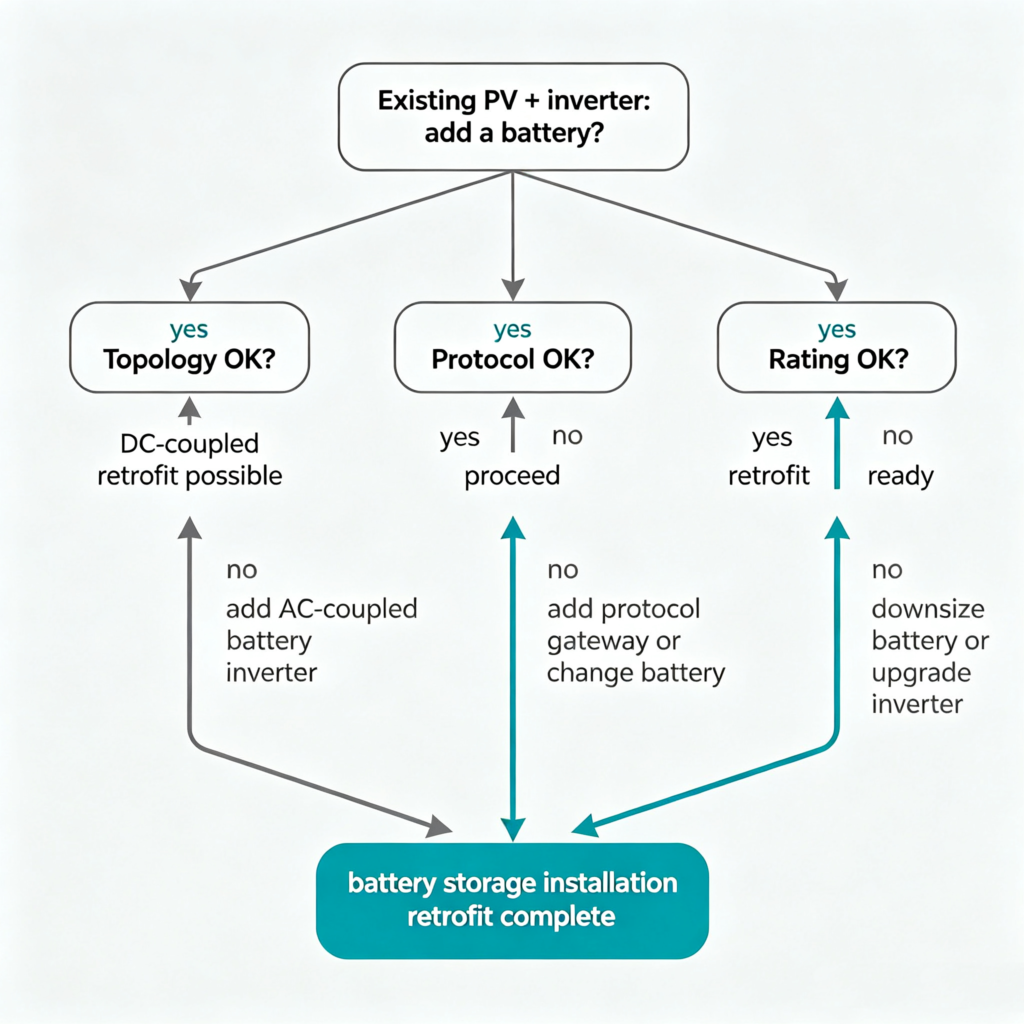
The retrofit decision tree in one table
Three checks decide whether a battery can be added to the existing inverter, and each has a yes/no answer that maps to a different work scope. The table below is the workbench for the discussion that follows.
| Check | Question | Pass criterion | If it fails |
|---|---|---|---|
| 1. Topology | Does the existing inverter have a battery interface (DC-coupled input or AC-coupled battery port)? | explicit battery terminals / AC-coupled battery inverter listed in datasheet | add a separate AC-coupled battery inverter (e.g. an extra single-unit battery hybrid) |
| 2. Protocol | Does the battery’s BMS speak CAN, RS485 or Modbus that the inverter recognises? | manufacturer publishes an interoperability list that includes the existing inverter model | add a protocol gateway, or replace the battery with one on the inverter’s list |
| 3. Rating | Is the existing inverter rated for the battery’s continuous charge and discharge current? | battery max charge/discharge kW ≤ inverter’s continuous AC output kW × a derate factor | size the battery down, or upgrade the inverter |
The three checks are listed in order of how often they kill a retrofit. Topology is the most common blocker — many older string inverters have no battery port at all. Protocol is the second most common — the battery physically connects but cannot talk to the inverter, so the inverter defaults to “battery not present”. Rating is the least common in residential work but the most common in commercial — a 100 kWh battery paired with a 10 kW inverter will not charge in one sun hour.
Topology: DC-coupled vs AC-coupled retrofit
The first question is whether the existing inverter can take the battery on its DC bus or whether the battery has to live on the AC bus through its own inverter. A modern hybrid inverter accepts both — the PV array and the battery share the same DC bus. An older string inverter accepts neither natively; the retrofit path is to add an AC-coupled battery inverter on the AC bus alongside the existing string inverter.
| Topology | What is added | Efficiency penalty | When it fits |
|---|---|---|---|
| DC-coupled (existing inverter accepts battery) | battery bank + DC cable + communication cable | lowest (single conversion) | inverter has a battery terminal; battery BMS speaks the inverter’s protocol |
| AC-coupled (separate battery inverter) | battery bank + dedicated battery inverter + AC connection to distribution panel | extra conversion (DC → AC → DC for charging; DC → AC again for discharging) | existing inverter has no battery port; battery and PV must run independently |
| Replace-inverter (full hybrid swap) | replace string inverter with hybrid; reuse existing PV array | lowest (single conversion) | existing inverter is old, undersized, or its battery interface is locked to a specific battery brand |
AC-coupled retrofits are the most common because most existing PV systems were installed before batteries were standard. The AC-coupled battery inverter charges the battery from the AC bus when there is excess PV production, and discharges back to the AC bus when loads need it. Round-trip efficiency is a few percentage points lower than DC-coupled because of the extra conversion, but for a retrofit it is usually the cheapest and fastest path. The architecture is the same one used in #43 AC-coupled vs DC-coupled; the difference is that #43 is a greenfield design, while a retrofit often has the existing inverter as a constraint.
Protocol: how the battery and inverter talk
The second check is whether the new battery’s BMS speaks the inverter’s communication protocol. Without protocol match, the inverter defaults to “battery not present” and the battery sits idle. Most modern inverters accept CAN bus (most common), RS485 (older and industrial), or Modbus (commercial). The protocol’s data dictionary (state of charge, voltage, current, temperature, alarms) has to match the inverter’s expected register map. The protocol-level compatibility is in #18 battery-inverter compatibility; for a retrofit, three practical steps clear the protocol check:
- Ask the inverter manufacturer for the current interoperability list — most publish a list of batteries tested and supported.
- Ask the battery manufacturer for the protocol implementation — a reputable supplier publishes the protocol document or provides it under NDA.
- If neither side matches, the fallback is a protocol gateway — a small device that translates between protocols — at the cost of an extra failure point and configuration step.
Rating: does the existing inverter have headroom for the battery?
The third check is whether the existing inverter can charge and discharge the battery at the rate the buyer expects. A 10 kWh battery with a 5 kW max discharge current needs an inverter that can take 5 kW from the AC bus and feed 5 kW to the AC bus without clipping. The typical residential rule is to keep battery power below 60–80% of the inverter’s continuous AC rating, so the inverter has headroom for both the battery and the PV array. The way to size the battery correctly is the topic of #61 battery energy storage system design.
When to replace the inverter instead of retrofitting
Sometimes the right answer is to replace the existing string inverter with a hybrid inverter that natively accepts the battery. Three signals point toward replacement:
- The existing inverter is more than 10 years old — its end-of-life is approaching, and a battery investment built around it will be orphaned within a few years. The right comparison is on a 10-year basis, not today’s invoice.
- The existing inverter is undersized for the planned battery — if the battery is 10 kWh and the inverter is 3 kW, replacement is the only honest answer because no protocol gateway fixes the rating problem.
- The existing inverter’s protocol is locked to a specific battery brand — if the buyer’s preferred battery is on a different protocol list, replacement becomes the cheaper path.
Buying for an installer or retrofit fleet
For an installer or a regional retrofit fleet, the procurement question is “what battery kit fits the most existing inverters in my service area”. Three rules keep the answer disciplined:
- Pick the battery by the inverter on the wall: pick a battery whose protocol list explicitly includes the inverter models common in your service area.
- Standardise the DC-side kit: the BMS cable, the DC disconnect, the fuse, the communication gateway and the rack or cabinet should be the same kit across projects; only the battery size varies.
- Stock one firmware tool: inverter and BMS firmware both update over the lifetime of the system; the installer who can flash a firmware update on a service call avoids the warranty ticket that says “battery not detected”.
Q. Can I add a battery to any existing inverter?
Not to any inverter, but to most. The inverter needs either a DC battery terminal or support for an AC-coupled battery inverter on the AC bus. String inverters with no battery port require the AC-coupled path.
Q. What if the existing inverter is too old?
If the existing inverter is more than 10 years old, replacement is often the better answer because the inverter’s own end-of-life is approaching and the battery investment would be orphaned. A cost comparison on a 10-year basis usually makes the case.
Q. Do I need to change the wiring?
Usually no. A DC-coupled retrofit reuses the existing PV wiring and adds a short DC run from the battery to the inverter. An AC-coupled retrofit reuses the existing AC bus and adds a new AC branch from the battery inverter. Both are smaller jobs than a fresh install.
Q. Will the battery work during a grid outage?
Only if the existing inverter is a hybrid inverter with islanding mode, or if the AC-coupled battery inverter has its own islanding function. A string inverter without islanding shuts down during a grid outage and so does the battery that feeds it. The grid-forming question is part of the inverter spec, not the battery spec.
Q. How long does a battery storage installation retrofit take?
An AC-coupled retrofit on an existing 5–10 kW PV system typically takes one working day for the electrical work plus a half-day for commissioning and protocol handshake. A DC-coupled retrofit is similar. A full inverter replacement plus battery usually takes one to two days.
Next step: check the three retrofit questions before quoting
The right battery storage installation retrofit is the one that adds a battery to an existing inverter without ripping out the PV array, the inverter or the AC bus — provided topology, protocol and rating all pass.
- Confirm the new-installation baseline in #13 home battery installation
- Check the protocol match in #18 battery-inverter compatibility and #30 BMS technology
- Decide between retrofit and replacement in #17 how to choose a storage / hybrid inverter
- Size the battery correctly for the existing inverter via #61 battery energy storage system design
- Ask leekooenergy for the retrofit kit that matches your existing inverter fleet — battery, BMS protocol list, DC-side kit, and a commissioning checklist that walks through the three checks in order — a battery storage installation retrofit that lands cleanly on the inverter already on the wall