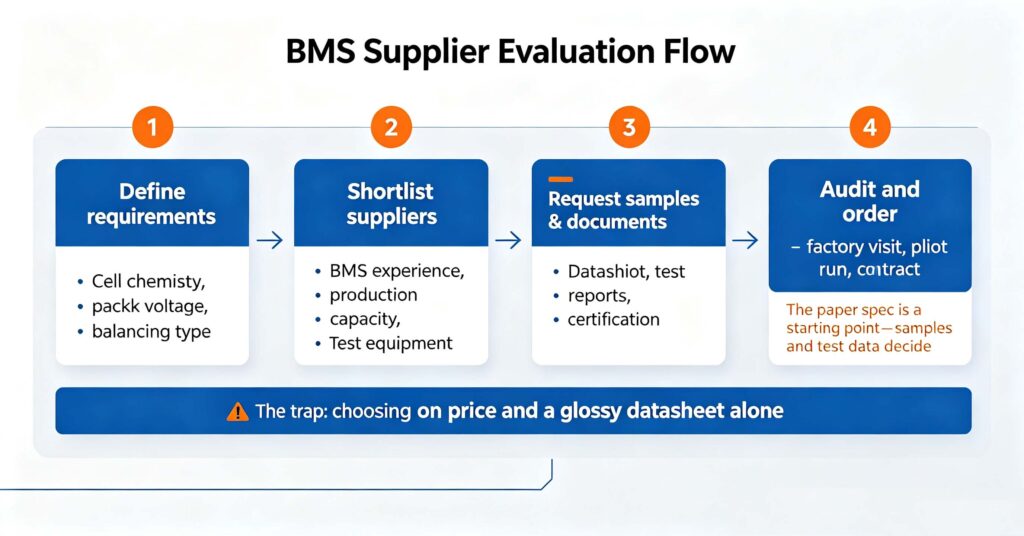
Battery management system suppliers range from full manufacturers with in-house development and production lines to trading companies that resell generic boards, and the evaluation difference matters more than the price difference. A capable supplier should be able to show you the development team behind the BMS, the test equipment it uses (cell simulator, battery tester, EMC chamber, aging racks), the certifications it holds, and the integration support it can give for your pack design — because the BMS is not a commodity you bolt on, it is the component that decides whether the pack is safe, balanced and reliable. The professional sequence is: define your requirements first, shortlist suppliers against a checklist, request samples and test documents, then verify claims with an audit or a pilot run before committing volume. The most common trap is choosing a battery management system supplier on price and datasheet alone, then discovering that communication, customization response and after-sales support were never tested.
For buyers spending company budget, the cost of a wrong BMS supplier is measured in rework, field failures and safety incidents, not in the price difference per board. This guide covers supplier types, the questions that separate real capability from claims, and the RFQ information that gets you accurate quotes. For the fundamentals of what a BMS does, see #28 battery management system 101 first.
Types of battery management system suppliers and when each fits
Not every battery management system supplier is the same kind of business, and the distinction usually shows up in communication speed, customization ability and after-sales depth.
| Supplier type | What they do well | What buyers must verify |
|---|---|---|
| Full manufacturer (in-house R&D) | Custom BMS development, firmware changes, deep integration support | Production capacity, test equipment, minimum order and lead time |
| Assembler / value-added | Standard boards, quick delivery, local support | Where the core firmware comes from, who updates it |
| Trading company / reseller | Low price, wide catalogue | Technical support depth, warranty responsibility, traceability |
The safest start is usually a full manufacturer, but only when the project justifies the custom work. For standard packs with common cell chemistries and voltages, a good assembler may be entirely adequate. For more on how BMS functions map to protection and balancing, see #30 BMS technology: how systems talk and protect.
What to verify before you shortlist BMS suppliers
A shortlist should be built on documented capability, not on who replies fastest. The checklist below separates the items that are easy to fake from the items that require real infrastructure.
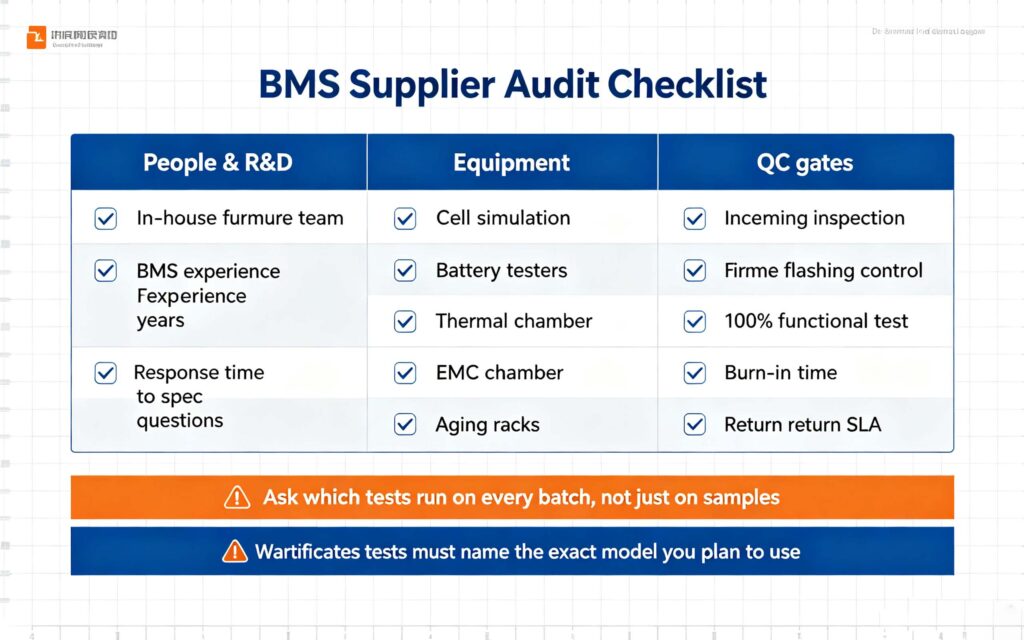
Development capability: ask who designs the hardware and who writes the firmware. A supplier that only assembles boards from another vendor may not be able to change parameters, fix bugs or add features when your pack design changes.
Test and verification equipment: a serious supplier owns or has access to cell simulators, battery testers, thermal chambers and EMC testing. Request a list, and ask which tests are done on every batch versus only on samples.
Certifications: ask for the actual certificates — not just claims — for the BMS standard applicable to your market, and confirm whether the certificate covers the exact model you plan to use. Certification coverage varies by model and configuration.
Production and QC process: request the QC flow: incoming cell/pack parameters, firmware flashing control, functional test coverage, burn-in or aging time, and the defect return process. For more on what a BMS must protect, see #49 how a BMS protects batteries.
Questions to ask battery management system suppliers before an order
These questions are designed to expose the difference between a real supplier and a reseller, and to define the scope that affects price and lead time.
- What is your standard BMS line for my cell chemistry and pack voltage? The answer should reference specific models, not “we can do anything”.
- Who writes the firmware, and how are parameter changes handled? Ask for the change process and typical turnaround for a parameter adjustment.
- Which tests run on every production batch? Batch coverage matters more than sample testing for consistency.
- What is the warranty, and what does the return process look like? Confirm who pays freight and how defects are confirmed.
- Can you provide reference projects for similar pack designs? References are verifiable; claims are not.
- What happens if a field failure is traced to the BMS? The answer reveals whether the supplier treats responsibility as theirs or as yours.
For monitoring-oriented BMS products specifically, compare with the manufacturers covered in #83 battery monitoring system manufacturers.
RFQ information that gets accurate quotes
A vague RFQ produces vague quotes. The information below turns a quotation into something comparable across battery management system suppliers.
- Pack parameters: cell chemistry (LiFePO4, NMC, LTO), series/parallel configuration, nominal and max voltage, max charge and discharge current.
- Balancing requirement: passive or active balancing, balancing current, and whether balancing strategy is configurable.
- Communication: CAN, RS485, UART, Bluetooth, WiFi — and the protocol the host system speaks.
- Environment: operating temperature range, enclosure, and any vibration or IP rating requirements.
- Certification target: the markets and standards the BMS must satisfy, since this drives testing cost and lead time.
- Volume and schedule: target quantity, whether it is a one-time buy or a rolling order, and the required delivery date.
Before sending an RFQ, buyers should also confirm the overall pack requirements, which the BMS must match; see #3 lithium ion battery pack sourcing for what to specify.
Common mistakes when choosing BMS suppliers
Most BMS procurement problems trace back to a small set of avoidable decisions.
Choosing on price alone: the cheapest board often has the thinnest support. When a field issue appears, the cost of a slow supplier dwarfs the saving per board.
Skipping sample validation: a datasheet is a promise under ideal conditions. The sample stage is where real behavior — current limits, balancing performance, communication stability — shows up.
Ignoring firmware ownership: if you cannot change parameters or get updates, you are locked into whatever the board shipped with.
Not testing support responsiveness: send a technical question before you order. The speed and quality of the reply is a preview of after-sales support. For related field issues, see #108 common BMS faults and troubleshooting.
Q. What should I look for in battery management system suppliers?
Look for documented capability in three areas: in-house development (hardware and firmware ownership), test and verification equipment, and batch-level QC process. Ask which tests run on every batch rather than only on samples, and request certificates that name the exact model you plan to use. Communication responsiveness is also a reliable preview of after-sales support.
Q. What is the difference between a BMS manufacturer and a BMS reseller?
A manufacturer designs and produces the BMS in-house, which usually means it can customize firmware, adjust parameters and fix bugs. A reseller or trading company sells products made by others, often at a lower price, but with thinner technical support and less control over the product. The right choice depends on whether your project needs customization or standard boards.
Q. How do I compare quotes from different BMS suppliers?
Compare quotes only when they are based on the same specification: cell chemistry, pack voltage, balancing type, communication protocol, environment and certification target. If one quote includes testing or firmware setup and another does not, the price difference is not real. Send the same complete RFQ to every supplier so the quotes are comparable.
Q. What information should I provide for a BMS quotation?
Provide pack parameters (cell chemistry, series and parallel configuration, voltage range, charge and discharge current), balancing requirement, communication protocol, operating environment, certification target, target volume and delivery schedule. Complete information reduces quote ambiguity and avoids surprise cost and lead time later. A vague RFQ produces vague quotes.
Q. How long does a custom BMS development project take?
A parameter-level customization on an existing platform is usually much faster than a new hardware design. New hardware development, firmware work and certification testing can extend the timeline significantly, so confirm the scope of customization and the certification process before ordering. Ask for milestone dates, not a single delivery promise.
Next step: shortlist suppliers you can verify
Battery management system suppliers are not interchangeable: development ownership, test infrastructure and after-sales depth decide whether the BMS works in your pack and keeps working. Build a checklist, request samples and test documents, and verify claims before volume commitment.
- Understand BMS technology first with #30
- Review BMS protection requirements in #49
- Specify the full pack in #3
- Ask leekooenergy for a BMS supplier package: the development and test capability statement, batch QC flow, certificates for the exact model, and a complete RFQ answer — so you compare real capability, not price alone