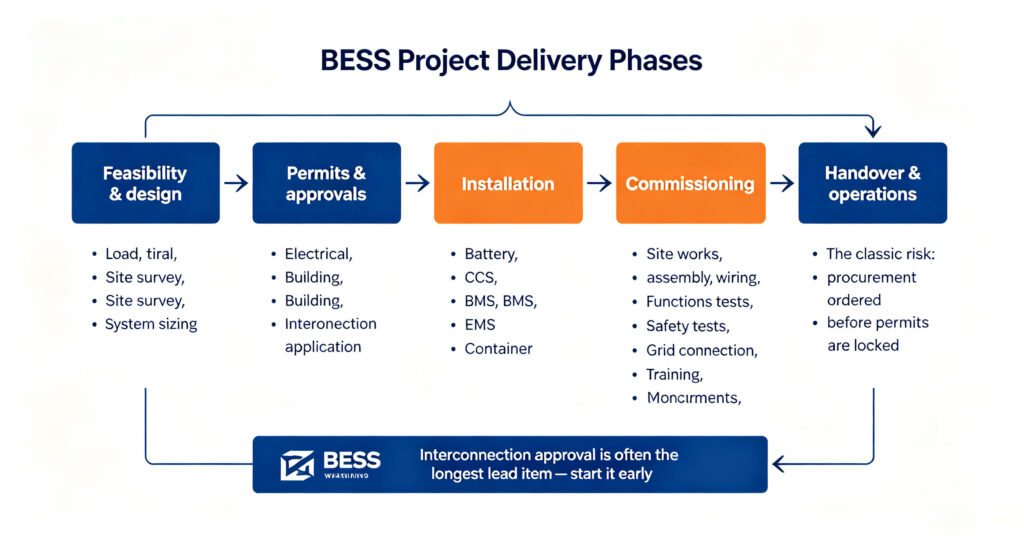
BESS project delivery is the managed sequence of six phases — feasibility and design, permits and approvals, procurement, installation, commissioning, and handover to operations — where the decisions that cause most delays happen before installation starts. The two controls that keep a project on schedule are locking the design and interconnection application early (interconnection approval is usually the longest lead item), and ordering procurement only after the permits and specs are fixed, because changing equipment mid-delivery resets the timeline. Responsibility typically splits between the owner (site, permits, commercial), the integrator or EPC (design, procurement, installation, commissioning) and the equipment suppliers (battery, PCS, BMS, EMS), and the handover is only complete when test records, as-built documents and training are delivered. Projects fail on schedule when milestones are verbal; they survive when every phase has an owner, a date and a written acceptance criterion.
For a C&I buyer, a storage project is a delivery problem as much as a technology problem: the same equipment can land on time or a year late depending on how the phases are managed. This guide maps the six phases, who owns what, and the milestones that control risk. For the design method behind phase one, see #61 battery energy storage system design first.
The six phases of BESS project delivery
Each phase has a distinct output, and the output of one phase is the input of the next. Skipping a phase moves the risk, it does not remove it.
- Feasibility and design: load and tariff analysis, site survey, system sizing, single-line diagram, equipment selection.
- Permits and approvals: electrical and building permits, utility interconnection application, and any local requirements. Start this early — it is the long-lead item.
- Procurement: battery, PCS, BMS, EMS, enclosure, and auxiliary equipment, with specs locked to the approved design.
- Installation: site civil works, equipment placement, electrical and communication wiring, and safety checks.
- Commissioning: functional and safety testing, control integration, and grid connection tests with the utility.
- Handover and operations: training, as-built documents, test records, monitoring setup and warranty registration.
The design output feeds the whole delivery, which is why the sizing and configuration logic in #61 BESS design matters before any procurement starts.
Who owns what in the delivery
Unclear responsibility is the most common source of project friction. The split below is typical, but it must be written into the contract.
| Party | Typical responsibilities | The gap to close |
|---|---|---|
| Owner | Site, permits, utility relationship, commercial terms | Confirm who files each permit and who pays each fee |
| Integrator / EPC | Design, procurement, installation, commissioning, project management | Define the acceptance test and handover documents in the contract |
| Equipment suppliers | Battery, PCS, BMS, EMS delivery and technical support | Confirm lead times, spare parts and firmware responsibility |
For how to select the EPC that carries this responsibility, see #66 choosing a BESS EPC contractor.
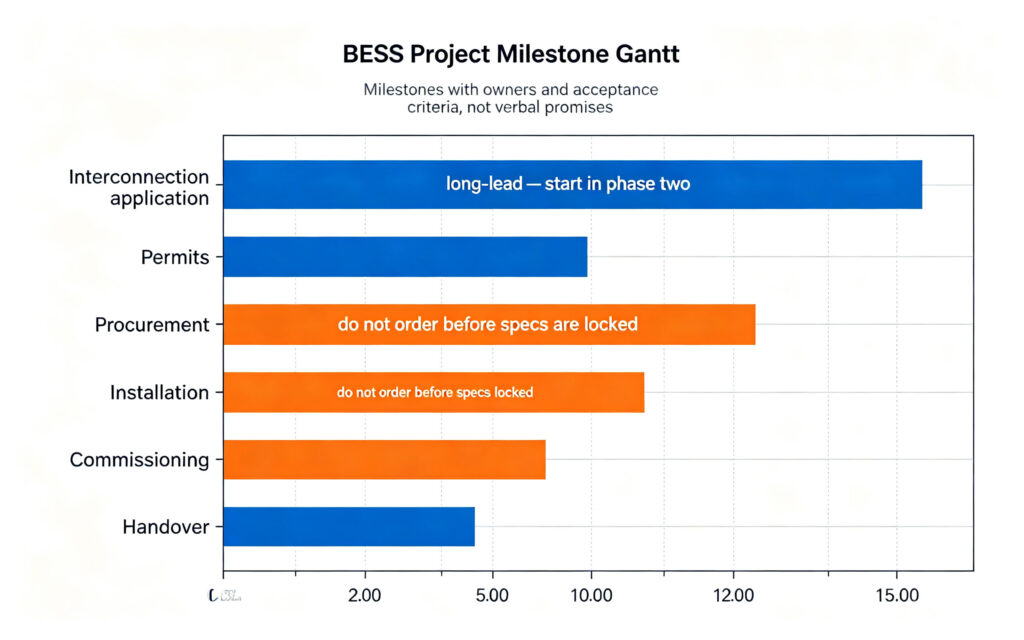
Milestones that control the schedule
BESS project delivery runs on written milestones, and the ones below are the points where delay actually happens.
- Interconnection application submission: the longest lead item in most projects; submission date drives the whole calendar.
- Design freeze: the point after which equipment changes require a change order. Freeze it before procurement.
- Permit approval: no permit, no installation start. Track it as a gate, not a background task.
- Equipment delivery to site: logistics and customs can move this date more than production can.
- Commissioning start and grid connection: the testing phase needs utility involvement and a reserved test window.
- Handover sign-off: documents and training complete; the warranty and payment milestones attach here.
The commissioning phase inside this schedule is detailed in #111 BESS commissioning and grid connection — plan its tests into the contract, not as an afterthought.
Common risks and how to control them
The risks that derail storage projects are commercial and procedural more often than technical.
Procurement before design freeze: ordering equipment on preliminary specs leads to change orders and rework. Lock the design, then buy.
Underestimating interconnection: utility approval timelines are underestimated repeatedly. Start the application in the permits phase and track it as a critical path item.
Vague acceptance criteria: without a written test list, “commissioned” means whatever the contractor says. Define it in the contract.
Single-source dependencies: one long-lead component (often the battery or the container) holds the schedule; identify it early and order it first. For the supply-side choices, see #91 how to choose an energy storage integrator.
Q. What are the phases of a BESS project?
A BESS project runs through six phases: feasibility and design, permits and approvals, procurement, installation, commissioning, and handover to operations. Each phase has a defined output that feeds the next. The two schedule controls are starting the interconnection application early and freezing the design before procurement, because both resets are expensive after the fact.
Q. Who is responsible for what in a BESS project?
Typically the owner handles site, permits, utility relationship and commercial terms; the integrator or EPC handles design, procurement, installation, commissioning and project management; and equipment suppliers deliver battery, PCS, BMS and EMS with technical support. The split varies by contract, so it must be written down, including who files each permit and who defines the acceptance test.
Q. How long does a BESS project take?
Timelines vary widely with system size, permits and interconnection, from months for small C&I systems to well over a year for larger projects. Interconnection approval is often the longest lead item and should be started early. The honest way to manage it is written milestones — interconnection submission, design freeze, permits, delivery, commissioning, handover — each with an owner and a date.
Q. What is the biggest risk in BESS project delivery?
The biggest risks are procedural: ordering equipment before the design is frozen, underestimating interconnection timelines, and accepting a project without written acceptance criteria. These create rework, schedule slips and handover disputes that no equipment quality can fix. Locking the design, tracking interconnection as critical path and defining the test list in the contract control most of them.
Q. What should be delivered at BESS project handover?
Handover should deliver test records from commissioning, as-built drawings, certificates, operating and maintenance instructions, training for the operations team, and warranty registration. The handover sign-off usually attaches to payment milestones, so the document list should be defined in the contract before production. A handover without documents is a project without proof.
Next step: manage the project, not just buy the hardware
BESS project delivery succeeds on phase control: design freeze before procurement, interconnection started early, milestones with owners, and acceptance criteria written into the contract. Structure the responsibility split, track the long-lead items, and sign off only on documents and tests you can verify.
- Run the design method in #61
- Plan commissioning in #111
- Select the EPC in #66
- Ask leekooenergy for a BESS project delivery package: a phase-by-phase scope, the long-lead item list for your site, milestone template and the commissioning test protocol — so your project is managed, not improvised