
DIY vs Prebuilt Battery Pack: Cost, Risk and What You Inherit
diy vs prebuilt battery pack looks like a cost question and is really a liability question. Self-assembly can beat a finished product on cell cost per kilowatt-hour, but the buyer inherits the BMS logic, the enclosure, the certification, the insurance position and the warranty that a finished pack would have carried. The price gap between the […]
Battery Cell vs Module vs Pack: The Levels of a Storage Battery
battery cell vs module vs pack describes the levels of one storage battery: the cell, where the chemistry and the ampere-hour rating live; the module, where cells are wired together and mechanically held; the pack, which adds an enclosure, protection and battery management; and the rack or system, which joins packs with distribution and communications. Knowing […]
Battery Backup vs Peak Shaving: Two Business Cases, One Bank
battery backup vs peak shaving are two business cases that can run on the same bank: backup is a power problem measured in kilowatts for minutes, peak shaving is an energy problem measured in kilowatt-hours against a demand window. They size differently, cycle differently and pay back from different lines on the bill. One asset, two […]
Gel vs AGM Battery: Choosing a Sealed Lead-Acid for Storage
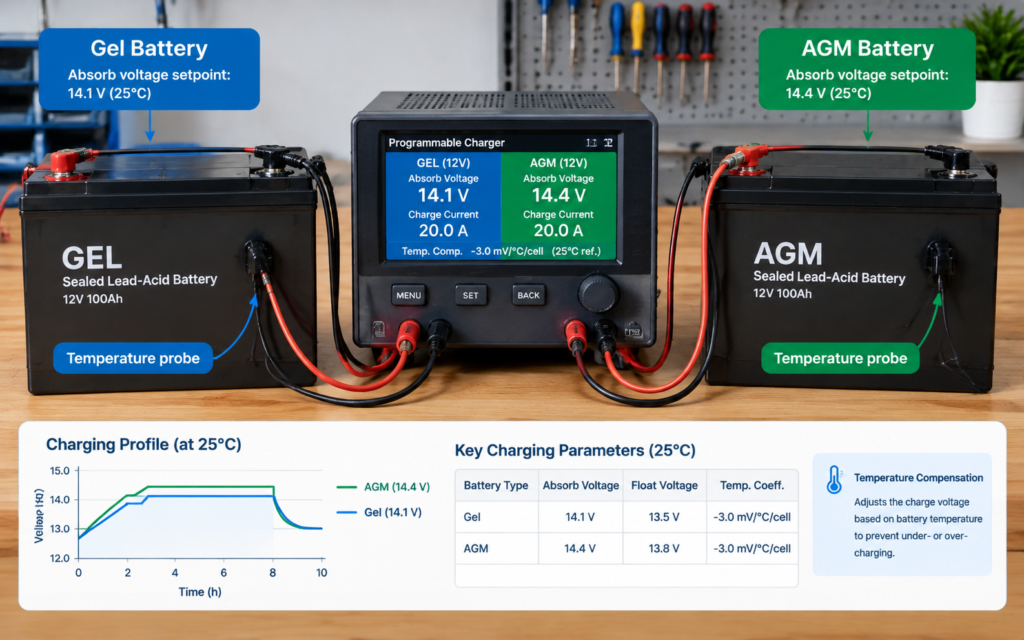
gel vs agm battery is a choice between two ways of immobilising the same electrolyte: gel thickens the acid with silica, AGM wicks it into a glass mat. That mechanical difference sets the charging voltage each one needs, how deep it can cycle, how it behaves in heat and what it costs. Sealed lead-acid is not […]
BESS Container vs Cabinet: Choosing the Right Enclosure Class
bess container vs cabinet is a choice between two enclosure classes rather than two products. A container is a factory-integrated, multi-megawatt-hour block that arrives pre-commissioned and needs a pad, a heavy lift and a route wide enough for it. A cabinet is a smaller modular unit that fits through a door, scales one unit at a […]
Sodium-Ion Battery vs LiFePO4: What Changes for Storage Buyers
sodium-ion battery vs lifepo4 compares two intercalation chemistries that share an architecture and differ in ion size, cell voltage, energy density, cold behaviour and supply maturity. Sodium trades lower density for cheaper materials, better low-temperature charging and simpler transport. LFP trades material cost for density, scale and a long field record. This guide compares them in […]
Private Label Storage Batteries: What Buyers Should Settle First
private label storage batteries are storage units built by a factory and sold under the buyer’s own brand name — the same cells, case and BMS, with your label, packaging and documentation. It is the fastest route for a distributor or installer network to reach market without building a factory, and the decisions that matter are […]
Solar Panels on a Flat Roof: Ballast, Tilt and Drainage
solar panels on flat roof are the most flexible case in rooftop solar, because nothing about the roof fixes the direction or the angle: the array can be aimed wherever the site survey says and tilted for the season. That freedom comes with two new problems — holding the array down without punching holes, and keeping […]
Shade Tolerant Solar Panels: What Partial Shade Really Costs
shade tolerant solar panels is more of a marketing phrase than a category: no module makes energy from shadow. What differs is how a module behaves when part of it is shaded — how much of the string it drags down, and whether the array is wired so shade on one panel stops the rest. This […]
Solar Panel Orientation: Which Way Your Array Should Face
solar panel orientation is the compass direction the glass faces — the azimuth — and it decides when during the day the array peaks, not just how much it makes. True south is the default in the northern hemisphere, but east and west roofs are workable and sometimes better matched to when a building actually uses […]