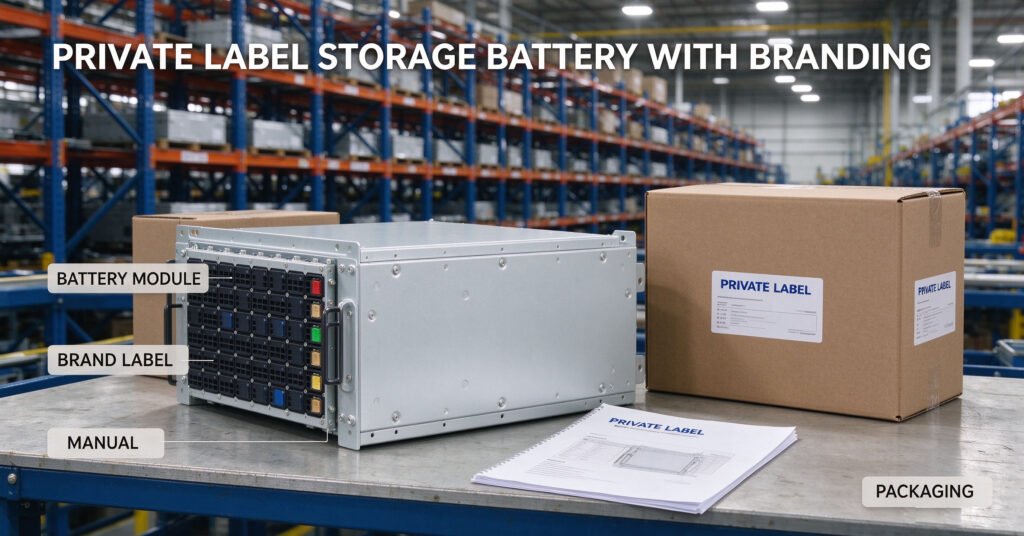
private label storage batteries are storage units built by a factory and sold under the buyer’s own brand name — the same cells, case and BMS, with your label, packaging and documentation. It is the fastest route for a distributor or installer network to reach market without building a factory, and the decisions that matter are not the logo. This guide covers what is genuinely customisable, who carries certification once the name changes, and the MOQ, tooling and quality-control reality behind the quote.
The label is the easy part. Everything that determines whether a private label programme works — certification, warranty liability and batch consistency — sits behind it.
What private label actually covers
Three arrangements get called the same thing and they are not. In a straight private label deal, the factory builds an existing model and applies your brand, packaging and manuals — little or no engineering change. In an ODM arrangement you specify the configuration, case and feature set, and the factory does the design work on a platform it already owns. In an OEM arrangement the product is built to your design, which usually means tooling and a longer programme.
Private label storage batteries most often sit in the first two. That distinction matters commercially because it sets who owns the design, who can sell it to someone else, and how quickly the first container ships. A private label on an existing platform can move in weeks; an OEM programme measured in quarters. The what battery storage BESS means guide covers the system vocabulary this all sits inside.
The four things you can genuinely customise
Branding is the visible layer and the least consequential. What actually affects the product is the configuration layer: capacity and voltage class, cell format and chemistry, the case and form factor, and the BMS behaviour and communications. The LiFePO4 versus lithium ion NMC comparison matters here, because chemistry choice sets the cost, cycle life and safety envelope long before anyone chooses a label colour.
| Layer | Typical customisation | Lead-time impact |
|---|---|---|
| Branding | Label, manual, packaging, app name | Weeks; usually no engineering change |
| Configuration | Capacity, voltage class, case format | One to two production cycles |
| BMS and communications | Protocols, limits, monitoring interface | Requires firmware work and testing |
| Tooling | New case, new front panel | Quarters; non-recurring engineering cost |
The trap is asking for tooling when configuration would do. A custom case is a capital expense with a long payback; a different capacity on an existing case is not. Most private label programmes are better served by choosing from the factory’s existing formats — a rack module in a standard enclosure, for example, of the class covered in the 48V 300Ah rack mount lithium battery guide — and spending the differentiation budget on the BMS behaviour and the documentation instead.
Certification and who carries it
This is the question that decides whether a private label programme is viable, and it is the one buyers ask last. A safety certification is issued to a specific product from a specific manufacturer. When the brand on the front changes, the question is whether the certificate can be extended to cover the buyer’s name — and the answer depends on the scheme and on whether the factory has arranged for that.
The practical split is this: the factory holds the cell and pack test reports, and the buyer’s name can usually be added under the factory’s existing certification where the scheme allows it. Where it does not, the buyer is effectively applying for certification in their own name, which means their own testing, their own file and their own liability. Transport documentation sits alongside this — a battery is a dangerous goods consignment, and the test summary has to travel with it under the buyer’s name as well. The 48V 200Ah LiFePO4 battery guide covers how specification choices move cost, which is the commercial half of the same decision.
MOQ, tooling and lead time
Minimum order quantities exist because a production line has to be set up, cells allocated and a batch built to a single specification. On an existing platform with branding only, MOQs are modest. As the customisation moves into configuration and firmware, the MOQ rises, because the factory is committing production capacity to a variant it cannot easily sell elsewhere.
Tooling is the step change: a new case or front panel carries a non-recurring engineering cost and a minimum commitment, and it makes sense only at volumes that justify it. Lead times follow the same logic — branding weeks, configuration a production cycle or two, tooling quarters. The honest way to read a quote is to ask which of these three it assumes, because a price quoted for a branding-only run will not hold for a firmware change. Battery cells are also a commodity with a real spot market, so price validity windows are short and worth confirming in writing.
Quality control before shipment
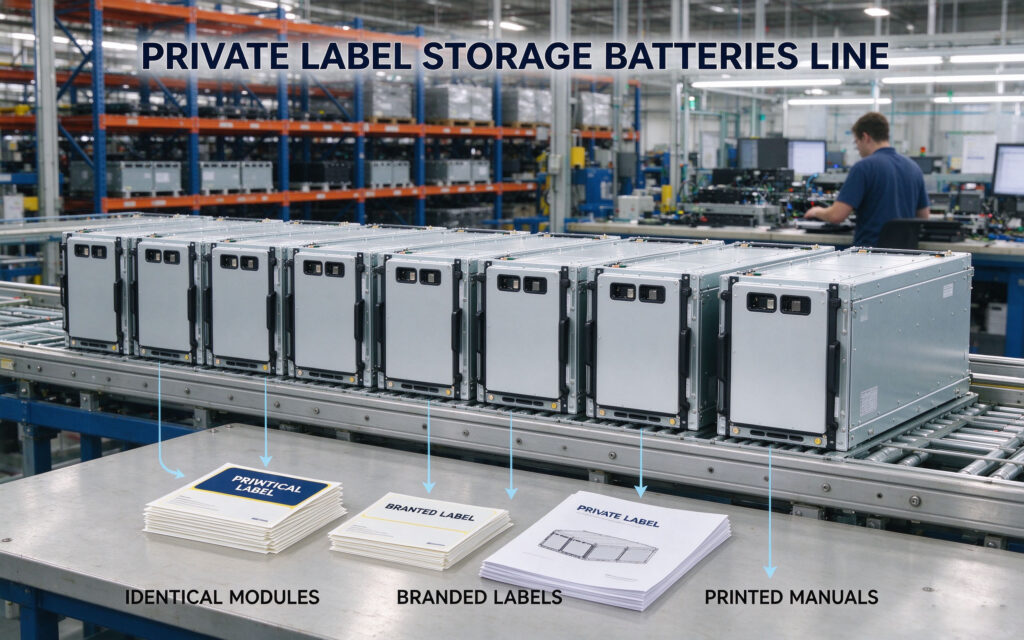
A private label buyer carries the brand risk while the factory holds the process, so inspection is the buyer’s only real control. Three things are worth insisting on. Cell traceability down to batch, so a field failure can be traced to a lot rather than to a whole programme. Capacity and internal resistance testing on the finished pack, with the records shipped with the order rather than summarised. And a pre-shipment inspection against an agreed checklist, including the branding and documentation, because a container of correctly built batteries with the wrong manual is still a problem.
For private label storage batteries the failure mode that hurts most is batch inconsistency rather than outright defect: units that pass individually but diverge over a year, so a warranty claim arrives as a pattern rather than an event. That is why the capacity and resistance records matter more than a pass certificate. The li-ion cell voltage guide guide covers the measurement vocabulary, and the how lithium ion charging works guide the charging behaviour that determines how a pack should be tested and specified.
Choosing a private label battery partner
Five checks separate a workable partner from an expensive one, and they apply whether the programme is styling private label storage batteries for one market or a whole catalogue for several. Does the factory hold certification on the actual platform being labelled, and can the buyer’s name be added under it? Are cell batches traceable, and will the test records ship with the goods? Who carries warranty liability in the buyer’s market, and is that written into the agreement rather than assumed? Is there aftersales support in the destination market, or does every claim become an international shipment? And does the factory have the capacity to hold a consistent specification across repeat orders, which is what the brand depends on.
Then match the programme to the market. A distributor serving residential installers needs a different catalogue depth than one serving commercial projects, and the capacity classes differ accordingly — the 5kwh battery guide and the 10 kilowatt hour battery guide cover the two ends of that range. Where the programme targets a chemistry outside the lithium mainstream, the sodium-ion home energy storage systems guide is the adjacent read.
Q. private label storage batteries?
Storage batteries built by a factory and sold under the buyer’s own brand name, with the buyer’s label, packaging and documentation. The cells, case and BMS are the factory’s platform; the brand on the front is yours.
Q. What is the difference between private label, OEM and ODM?
Private label applies your brand to an existing product. ODM has the factory design to your specification on its own platform. OEM means the product is built to your design, usually with tooling and a longer programme.
Q. Who holds the certification on a private label battery?
Usually the factory, and the buyer’s name can often be added under the existing certificate where the scheme allows it. If it does not, the buyer must certify in their own name and carries the testing and liability.
Q. What is a typical MOQ for private label batteries?
It depends on how much changes. Branding-only runs on an existing platform carry modest minimums; configuration and firmware changes raise them, and new tooling carries a non-recurring cost and a higher commitment.
Q. Can I change the case design on a private label order?
Yes, but that is tooling rather than branding. A new case or front panel carries engineering cost and a longer lead time, and only makes sense at volumes that justify it.
Q. How do I check quality on a private label battery order?
Insist on cell batch traceability, capacity and internal resistance records on finished packs shipped with the order, and a pre-shipment inspection against an agreed checklist including branding and documentation.
Q. Who handles warranty claims under a private label?
Commercially it is the brand on the front, whatever the factory agreement says. The practical question is whether aftersales support exists in the destination market or whether every claim becomes an international shipment.
Next step: send the market and the volume band
Private label quotes depend on platform, certification route and volume. Send the target market, the capacity classes and the annual band.
- Compare chemistry and cost in the LiFePO4 versus lithium ion NMC guide
- Set the capacity classes against the 5kwh battery guide
- For chisidal, send your usage and site details, and we will come back with product prices, lead time and warranty information.