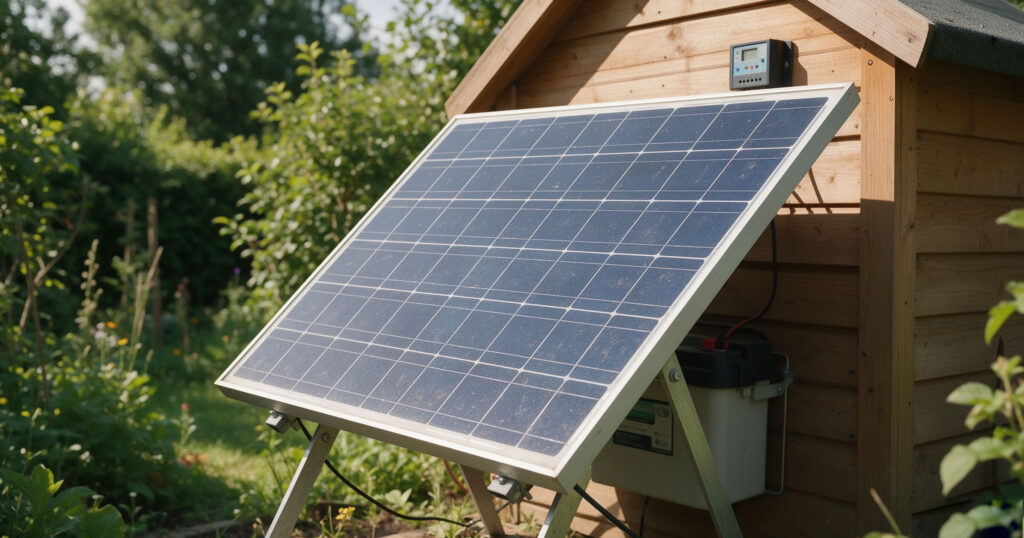
A 200 watt solar panel is a small-module class built for supplemental arrays, compact off-grid banks and tight roofs where full-size modules waste space. It will not carry a house on its own, but paired into a string it behaves like any other panel. This guide explains what the 200 W rating actually measures, the daily output you can plan around, how the module sits on the watt ladder, and the array and battery decisions that decide whether the class fits the job.
Small modules get dismissed as toys, but the class solves a real problem: adding capacity where a full-size panel will not fit, or powering loads that never needed a mainstream module in the first place.
What the 200 W rating actually measures
Every panel rating is a laboratory figure. A 200 watt solar panel is tested under standard test conditions — a defined light intensity, a cell temperature near room conditions, and light aimed straight at the module — and the number on the label is what it produced in that chamber. A real roof is warmer, dustier, angled differently and partly shaded for part of the day, so the rating is a ceiling rather than a promise.
None of that makes the number useless. It is the common currency that lets two modules be compared, and it is the input every string-sizing tool expects. The discipline is to treat it as the starting point of a derating conversation: temperature losses, soiling, mismatch, inverter conversion and shading each take a bite, and the bites add up to a figure well below the label on most installations. The solar panel tilt angle guide covers how much of that discount comes from geometry alone.
The daily output you can plan around
Planning output starts from peak sun hours, not daylight hours. A site that sees the equivalent of four to five hours of full test-condition sun per day is a good site; three to four is typical for much of the temperate world in the shoulder seasons. A 200 watt solar panel on such a site produces somewhere between roughly six-tenths and one kilowatt-hour per day in spring and summer, and materially less in winter.
| Season | Peak sun hours (typical) | Daily energy per module | What it covers |
|---|---|---|---|
| Summer | Five to six | Around 1.0–1.2 kWh | A fridge compressor day, or a long evening of lighting and charging |
| Spring / autumn | Three and a half to five | Around 0.7–1.0 kWh | Steady top-up for a small bank |
| Winter | One and a half to three | Around 0.3–0.6 kWh | Maintenance charging, not primary supply |
Those figures are per module and assume a clean, well-aimed array. The honest planning habit is to budget against the winter number and treat the summer surplus as the recharge window, because a system sized on summer output fails in December. The whether solar panels work on cloudy days guide works through the cloudy-day version of the same arithmetic.
Where 200 W sits on the watt ladder
Modules are sold in a handful of practical classes, and each class exists because of a different constraint — roof area, handling, string current or budget. The 200 W class sits at the small end of the serious range: above the 100 W trickle class, below the mainstream 400 W residential module, and well below the large-format units now common on commercial roofs.
| Class | Typical use | Physical class | Handling |
|---|---|---|---|
| 50–100 W | Maintenance charging, gates, sensors, small DC loads | One-person carry | Lightest; often sold in kits |
| 200–300 W | Supplemental arrays, compact off-grid banks, replacements | One-person carry with care | Compact; fits awkward roof sections |
| 400–450 W | Mainstream residential arrays | Two-person lift | Full-size; standard residential format |
| 500 W and up | Space-constrained or commercial arrays | Two-person lift, mechanical aid | Heavy; higher string current |
The class boundaries are soft, but the use cases are not. A 400 watt solar panel sized for a whole roof and a 200 watt solar panel sized for a shed are solving different problems with the same physics, which is why the wattage families get their own guides rather than one generic page.
Array design around a 200 W module
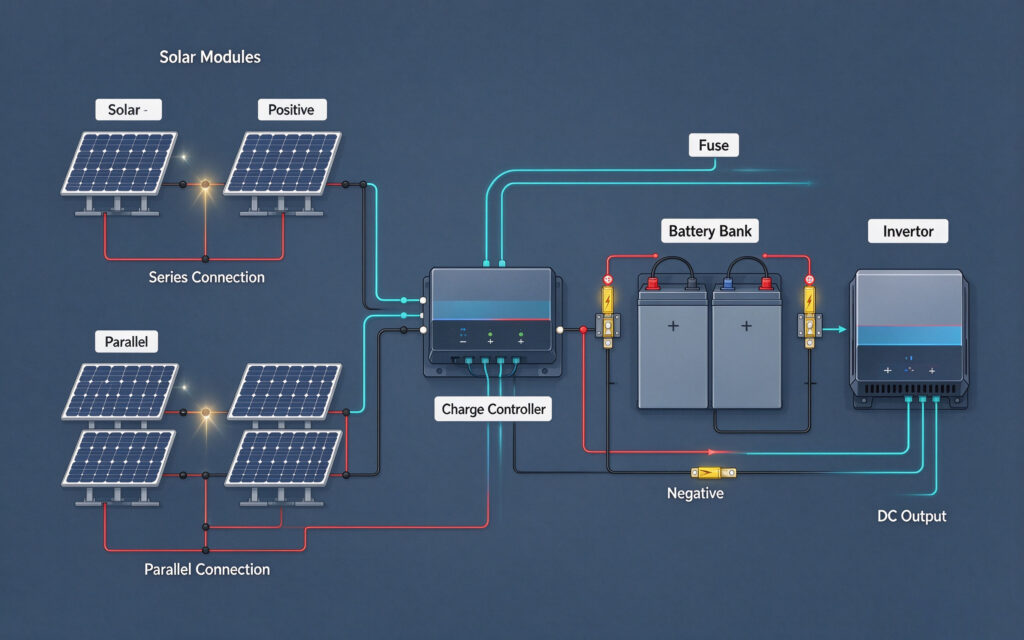
Small modules buy flexibility. Because the current per module is low, a string of them can be wired in series to reach a battery or inverter voltage window without hitting the current limits that constrain large-format arrays, and wired in parallel they add current without straining a controller. That is why the class shows up in DIY and off-grid builds far more than in grid-tie residential work.
Two design details decide whether the array behaves. First, the string voltage has to stay inside the charge controller or inverter window across the temperature range the site sees — cold mornings raise voltage, and a string designed on paper can exceed the limit in January. Second, mismatch matters more in small arrays: one shaded module drags a whole series string down, so partial-shading sites are usually better served by parallel strings or modules with bypass diodes. The solar panels in series or parallel guide works through the trade-off in full.
Pairing a 200 W panel with batteries
The natural partner for a single 200 watt solar panel is a small bank — a 50 to 100 amp-hour deep-cycle group at 12 volts is the common pairing, giving a recharge window of a day or two of good sun for a modestly loaded bank. Two or three modules turn that into a proper small off-grid system for lighting, communications gear and a refrigerator, and the arithmetic is forgiving enough to plan on paper.
What the class cannot do is carry surge-heavy loads. A pump, a compressor or a power tool starting against a bank charged by one or two small modules will exhaust the bank faster than the array can refill it, which is the classic failure mode of undersized small systems. Where the load list includes motors, either the array grows or the chemistry moves to lithium, whose deeper usable capacity stretches the same watt-hours further. The 100 amp hour deep cycle battery guide explains the capacity side of that pairing, and the how to size a home battery method is the load-first way to size it.
Buying notes for the 200 W class
The 200 W market splits into three tiers, and the price gap between them is wider than the quality gap. Name-brand modules carry real warranties and documented test reports; house-brand panels from generalist sellers usually do not; unbranded stock is a gamble that occasionally pays off. For a supplemental array feeding a real battery, the middle tier is usually the false economy and the top tier is cheap insurance.
Check four things on the spec sheet beyond the wattage: the cell technology and its temperature behaviour, whether bypass diodes are fitted, the junction box and cable quality, and the warranty terms — particularly whether it covers power output over time or only manufacturing defects. Frame material and mounting-hole spacing matter if the module has to fit an existing rack. And buy one module before buying eight: a single unit installed and measured for a season tells you more than any spec sheet.
200 watt solar panel?
A 200 watt solar panel is a small photovoltaic module rated at 200 watts under standard test conditions, typically used for supplemental arrays, compact off-grid banks and loads that never justified a full-size panel.
Q. How much power does a 200 watt solar panel produce per day?
Roughly 0.6 to 1.2 kilowatt-hours per day depending on season and site, with summer output around double a typical winter day. Plan against the winter figure and treat summer as the recharge window.
Q. What can I run with a 200 watt solar panel?
Lighting, communications gear, a refrigerator compressor through a day, or steady top-up charging for a small battery bank. Surge-heavy loads like pumps and power tools exhaust small arrays quickly.
Q. Can I connect 200 watt panels in series and parallel?
Yes. Series raises voltage to match a controller or inverter window; parallel adds current. Keep the string inside the voltage limits across the site’s full temperature range, and watch mismatch in part-shade.
Q. Is a 200 watt panel enough for an RV or cabin?
For lighting, charging and a fridge, a pair of modules plus a modest bank covers a cabin’s essentials. Add cooking or heating loads and the same array falls behind within a day.
Q. How long does a 200 watt solar panel last?
Quality modules typically carry output warranties measured in decades, with gradual degradation rather than sudden failure. Real lifespan depends on mounting, climate and whether the electronics survive as long as the cells.
Q. Do I need a charge controller with a 200 watt panel?
Almost always, for battery work. A controller matches the panel to the bank and prevents overcharge. Many 200 W class panels are sold in kits with a matched controller included, which is the sensible route for first builds.
Next step: match the module to the load list
Small-module classes work when the loads are known and honest. Send the load list, the roof or mounting area and the battery plan.
- Step up to the 100 watt solar panel class for trickle and maintenance duty
- Compare the large-format option in the 500 watt solar panel guide
- For chisidal, send your usage and site details, and we will come back with product prices, lead time and warranty information.