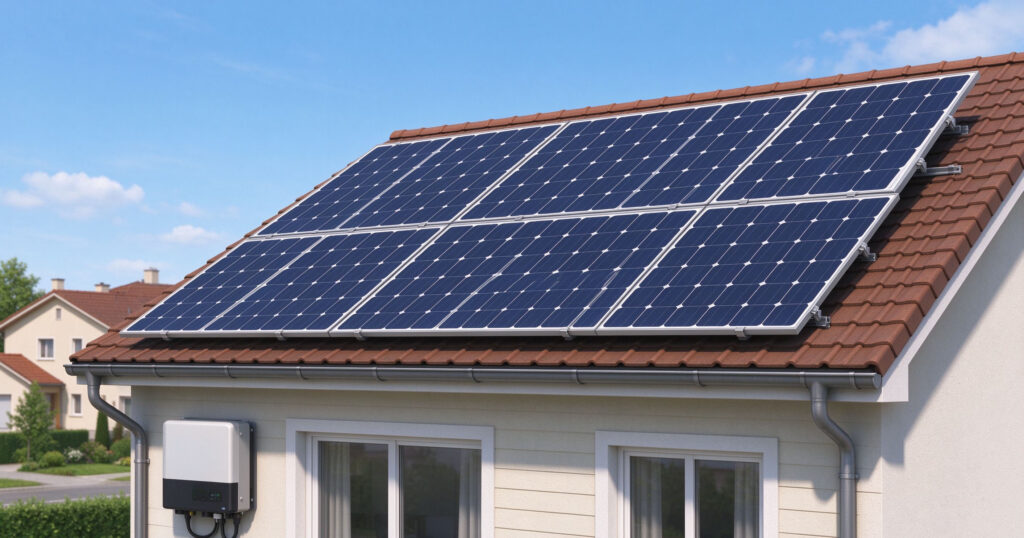
A 400 watt solar panel is the mainstream size in modern residential and light-commercial arrays — large enough to keep panel counts low, small enough for one or two people to handle. But the 400 W figure is a laboratory rating measured under standard test conditions, and no roof sees those conditions. This guide explains what the rating means, the daily output a buyer can plan around, where 400 W sits on the watt ladder, and how module choice interacts with string design and inverter windows.
Panel wattage is a comparison unit, not a promise. What matters is the kilowatt-hours the module delivers on your roof, in your climate, across the year.
What the 400 W rating actually measures
The number on the datasheet is measured under standard test conditions: a defined irradiance of 1,000 watts per square metre, a cell temperature of 25 degrees Celsius, and an air mass of 1.5. Those are laboratory conditions, chosen so that different manufacturers’ modules can be compared on the same basis. A real roof differs in every respect — irradiance moves continuously through the day and the year, cell temperature runs well above 25 degrees in sun, and soiling, shading and mismatch all take a cut.
The practical consequence is that a 400 watt solar panel will not produce 400 watts on your roof. It will approach its rating briefly around solar noon on a cool, clear day, and sit well below it for most of the day. What the rating is genuinely useful for is system arithmetic: array size in kilowatts is panel count times rating, and that figure is what inverter sizing, permitting and payback calculations are built on. The solar panel lifespan guide guide covers how the output declines over the system’s life.
The output you can plan around
Daily energy depends on climate and season more than on the module. A useful planning habit is to think in peak sun hours — the equivalent number of hours at full rating that would deliver the same daily energy. Sunny regions with long summer days run high single-digit peak sun hours in the best season; cloudy maritime climates can sit in the low single digits in winter. Multiplying the array rating by peak sun hours gives a first-order daily energy estimate, before derating for temperature, soiling, shading and conversion losses.
Two seasonal effects are worth naming. Winter days are short, so daily energy falls even where the climate is mild. Summer heat raises cell temperature, which reduces voltage and therefore output — a panel at fifty degrees Celsius produces materially less than the same panel at twenty-five, even under identical sun. Orientation and tilt decide how much of the annual total arrives in the worst month, which is the month that matters for a battery-coupled system. The solar panel tilt angle guide covers the geometry, and the whether solar panels work on cloudy days guide covers the cloudy-day case in detail.
Where 400 W sits on the watt ladder
Modules are sold in a ladder of wattage classes, and the class determines both the handling logistics and the array design. Smaller modules — 100 to 200 watts — suit portable kits, RVs, small off-grid sheds and any application where one person must carry and place the unit. Mid-range modules in the 300 to 500 watt band dominate residential and light-commercial roofs because they balance per-panel output against single-person handling. Large-format modules above 500 watts are increasingly common in commercial arrays where cranes and two-person crews are the norm.
| Watt class | Typical use | Handling | Array implication |
|---|---|---|---|
| 50–150 W | Portable kits, RV, small off-grid loads | One person, easily | High panel count per kW; simple 12 V strings |
| 200–300 W | Sheds, cabins, supplemental residential | One person with care | Moderate count; flexible for tight roofs |
| 350–450 W | Mainstream residential and light commercial | One to two people | Low count per kW; the current default |
| 500 W and up | Commercial and utility-scale roofs | Two people or mechanical aid | Fewest connections; heavier mounting loads |
A 400 watt solar panel sits in the dominant band for a reason: it is the largest class that is still comfortable to handle on a pitched roof, which keeps installation labour and mounting hardware proportionate. The solar panel mounting brackets guide covers the hardware that class implies.
Array design around a 400 W module
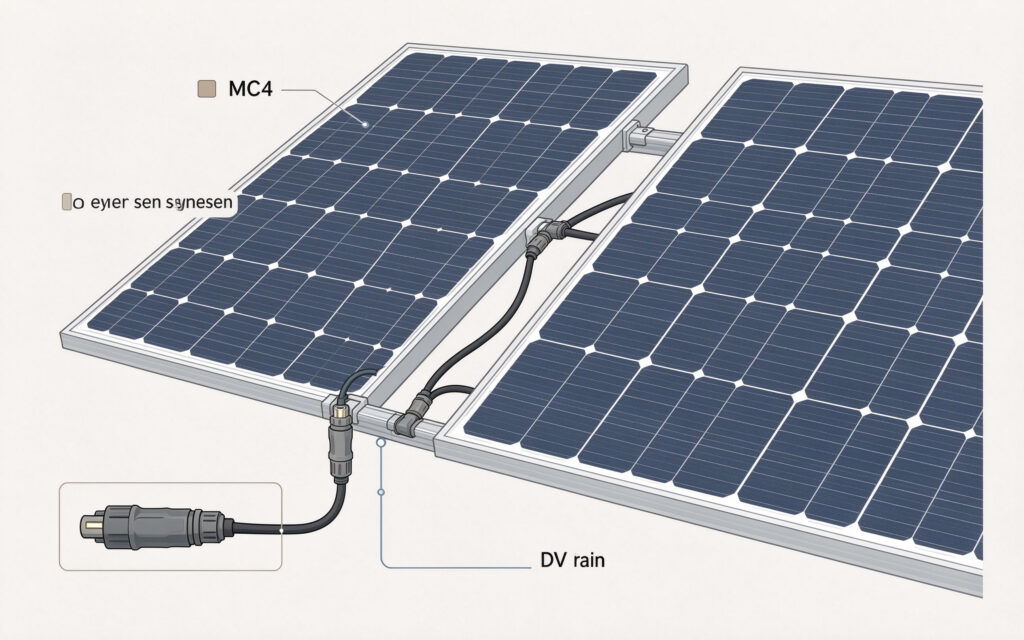
Module choice constrains the string. Panels in a string are wired in series, so their voltages add while the current stays constant; the string voltage must sit inside the inverter’s maximum-power-point window across the whole temperature range. A string of 400 W class modules on a residential roof commonly lands in a range of ten to sixteen panels depending on the module’s voltage ratings and the inverter’s window, and the cold-morning open-circuit voltage is the number that decides the maximum, not the nameplate.
Where the roof is broken by dormers and hips, smaller modules fit more of the available plane; where the roof is a clean rectangle, larger modules cover it with fewer attachments. Both are legitimate designs, and the choice is a roof-geometry question rather than a wattage religion. The ground mounted solar panels guide covers the ground-mount alternative where roof area is the binding constraint, and the solar panels in series or parallel guide works through the series-versus-parallel decision.
Matching the inverter and the rest of the system
On a grid-tied array, the inverter’s DC input window and MPPT tracker count decide how many strings the design can run, and the AC rating decides how much of the array’s peak the inverter can accept. An oversized array relative to the inverter clips output in the best hours of the year — usually an acceptable trade, occasionally not, depending on the tariff. On a battery-coupled system the arithmetic shifts: the array has to cover the daytime load, charge the bank, and leave headroom for the battery charge current the inverter can accept.
None of this is decided by the panel alone, which is the point. A 400 watt solar panel is a good default, and the right answer on most roofs — but it earns its place inside a string design and an inverter selection, not in isolation. The solar panels for commercial buildings guide covers how the same logic scales to flat commercial roofs.
Buying notes for the 400 W class
Compare modules on efficiency, temperature coefficient and warranty rather than on peak watts alone, because two modules with the same 400 W rating can differ by a meaningful margin in annual energy on a hot roof. Check that the voltage ratings suit your intended string length and inverter window before ordering. And confirm the module dimensions against the mounting system and the transport route — the 400 W class is a size that fits most roofs, but not every delivery path.
Q. 400 watt solar panel?
A 400 watt solar panel is a photovoltaic module rated at 400 watts under standard test conditions — the mainstream size for residential and light-commercial arrays, balancing per-panel output against single-person handling.
Q. How much power does a 400 watt solar panel produce per day?
In strong sun, commonly on the order of one and a half to two kilowatt-hours per day per panel; less in cloudy climates and winter. The honest estimate comes from peak sun hours for your location, not from the nameplate.
Q. How many 400 watt panels do I need for a home?
A typical residential array lands in the range of eight to twenty panels depending on consumption, roof orientation and climate. The count follows the array kilowatts you need, divided by 0.4 kW per panel.
Q, What size inverter for a 400 watt panel array?
It depends on string count and local rules, but a common residential pairing runs in the several-kilowatt range for a ten-panel array. The inverter’s DC window and MPPT capacity matter more than its nameplate alone.
Q. Can I mix 400 watt panels with other wattages?
In a string, mismatched modules cost output because the string current follows the weakest module. Mixing is possible with separate strings and separate MPPT inputs, but it complicates the design and rarely pays.
Q. Is a 400 watt panel enough to run a house?
One panel covers a fraction of a typical home. An array of them — commonly eight to twenty depending on consumption and climate — can cover most or all of a home’s daytime use.
Q. How much does a 400 watt solar panel cost?
Module pricing moves with market cycles, so quotes are the only reliable guide. Per-watt pricing is usually the useful comparison unit across wattage classes.
Next step: design the string, then buy the panels
Module choice follows roof geometry and inverter windows. Send the roof dimensions, orientation and the target array size.
- Scale the same logic to flat roofs with the solar panels for commercial buildings guide
- See the after-dark side in the whether solar panels work at night guide
- For chisidal, send your usage and site details, and we will come back with product prices, lead time and warranty information.