
A 500 watt solar panel belongs to the large-format class: modern cell layouts that push half a kilowatt out of a single module roughly the size of a mainstream one. Fewer modules per array means fewer connections, less racking and less labour — and a heavier, higher-current panel that demands more from the inverter and the roof. This guide explains what the 500 W rating measures, the output you can plan around, the array and handling constraints, and when the class beats the mainstream alternative.
Half-kilowatt modules are now mainstream on commercial roofs and increasingly common residentially. They trade handling ease for system economy, and the trade is only worth making with the constraints understood.
What the 500 W rating actually measures
As with every module class, the label is a laboratory figure: rated power under standard test conditions, at a defined irradiance and cell temperature, with light normal to the surface. A 500 watt solar panel reaches its number through a larger cell area and modern cell architecture rather than any change in the physics, which means the same derating rules apply — temperature, soiling, mismatch and conversion losses all take their share on a real roof.
What does change at this size is the electrical character. Half-kilowatt modules run at substantially higher current than their mainstream predecessors, and current is what heats cables, stresses connectors and sets the minimum size of everything downstream. The rating on the label is easy; living with the current is the engineering. The solar panel tilt angle guide covers the geometric losses, and the solar panels in series or parallel guide the string arithmetic.
The output you can plan around
Per module, the daily energy scales directly with the rating: where a 400 W mainstream module delivers a good summer day in the range of roughly 1.6 to 2.4 kilowatt-hours, a 500 W module adds a quarter to that again. The planning value is not the per-module number, though — it is the array-level arithmetic. Because a 500 W array uses fewer modules for the same target, the count of connections, fuses and racking clamps falls proportionally, and on labour-priced markets that is where the class earns its keep.
| Target array | Mainstream 400 W modules | 500 W modules | Difference in parts count |
|---|---|---|---|
| 4 kW | Ten modules | Eight modules | Two fewer strings, twenty fewer clamps |
| 6 kW | Fifteen modules | Twelve modules | Three fewer strings, thirty fewer clamps |
| 10 kW | Twenty-five modules | Twenty modules | Five fewer strings, fifty fewer clamps |
The saving is real but modest, and it has to be weighed against the handling penalty covered below. Where roof area is the binding constraint — small commercial roofs, awkward residential sections — the class is compelling. Where area is plentiful, the mainstream module’s easier handling usually wins.
Where 500 W sits on the watt ladder
The ladder now runs from the 100 W trickle class through 200 W supplemental, 400 W mainstream residential, and into the 500 W-and-up large-format tier that dominates new commercial installations. The 500 W class is the entry point to that top tier rather than its ceiling, and it is the rung where residential buyers first meet large-format handling.
The class also spans a real technology split. Standard half-cell monocrystalline modules dominate the volume; bifacial variants capture additional energy from rear-side irradiance when installed over reflective surfaces, at a premium and with a dependence on the mounting environment. Neither is universally better — bifacial gain depends on the ground or roof beneath it. The 400 watt solar panel guide covers the mainstream rung, and the 1000 watt solar panel guide the kilowatt-class extreme.
Array design around a 500 W module
Two constraints bind at this class. The first is string current: half-kilowatt modules push enough current that cable sizing, connector rating and combiner fusing stop being afterthoughts, and the number of modules per parallel string is often limited by the controller or inverter’s input current rather than by voltage. The second is the voltage window: fewer modules are needed to reach the minimum start-up voltage of a string inverter, which is an advantage on small arrays and a trap on large ones where cold-morning voltages approach the inverter’s ceiling.
Bifacial variants add a third consideration: rear-side gain depends on the surface below the array and on the mounting height, so the same module delivers differently over a white roof, gravel and grass. Treat any bifacial gain figure as environment-specific rather than a module property. The solar panels for commercial buildings guide covers the commercial-roof context where the class is most at home.
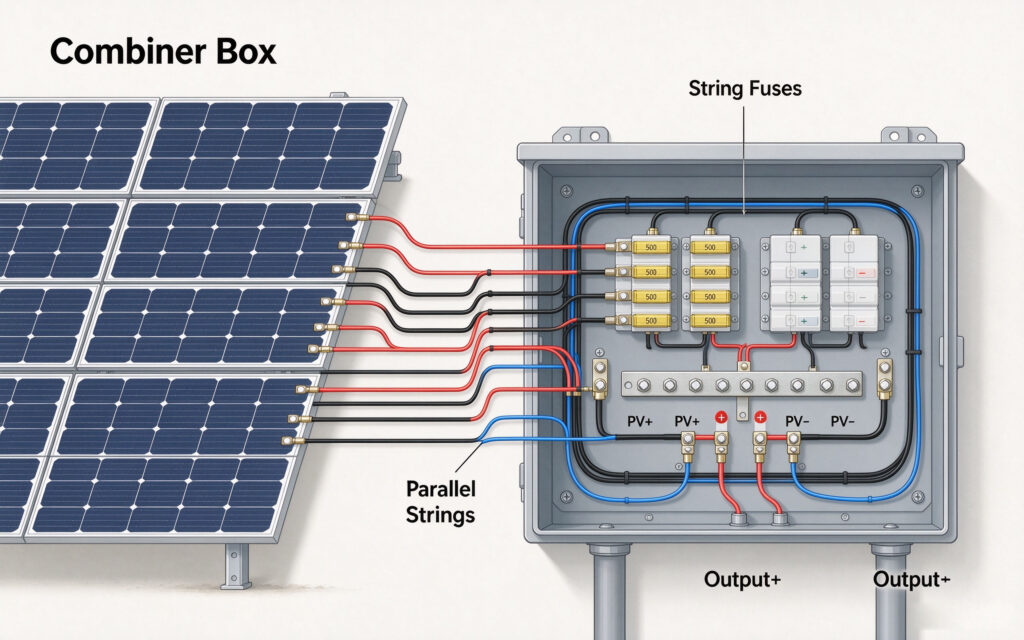
Charge controllers have their own ceiling in this arithmetic. A controller rated for a given input current limits how many half-kilowatt modules can share a parallel string before the current limit is reached, and exceeding it quietly throttles the whole array rather than failing loudly. Where the planned module count presses the controller’s rating, the choices are a larger controller, more strings with fewer modules each, or a module-level electronics approach that changes the constraint entirely.
Handling, roof loading and mechanical fit
A half-kilowatt module is a two-person lift, and on a pitched roof that changes the installation economics before a single cable is run. The larger glass area catches more wind, so clamp placement and rail spacing follow the module’s certified load ratings rather than the habits that suited smaller panels, and older buildings may need a structural review before the array is approved.
Three practical checks belong in every large-format installation. Confirm the module’s certified mechanical load ratings against local wind and snow expectations. Confirm the clamp positions are within the certified zones — clamping outside them voids the rating regardless of how solid the joint looks. And confirm the inverter’s maximum input current is not exceeded by the planned parallel strings, because the failure mode is a tripped inverter on the first cold, clear morning rather than anything visible at install time.
Buying notes for the 500 W class
Warranty quality separates the 500 W market more than efficiency figures do. Look for a product warranty covering the module and a separate performance warranty with a stated degradation curve, and check that both are backed by a manufacturer with a service presence in the target market. Module-level electronics matter too: optimisers or microinverters change the mismatch calculus, and their cost has to be counted in the array comparison rather than bolted on afterwards.
Finally, resist spec-sheet maximalism. A module half a percent more efficient but stocked locally with a real warranty beats a marginally better panel shipped from across the world with none — the class is chosen for system economics, and availability is part of the economics. The solar panel lifespan guide guide covers the long-term view of that choice.
500 watt solar panel?
A 500 watt solar panel is a large-format photovoltaic module rated at 500 watts under standard test conditions, used to build arrays with fewer modules, fewer connections and less racking than mainstream sizes allow.
Q. How many 500 watt solar panels do I need for a home?
Divide the target array size by 0.5 kW: a 6 kW array is twelve modules, a 10 kW array is twenty. Real designs trim or pad the count for roof geometry, shading and inverter current limits.
Q. Is a 500 watt panel better than a 400 watt panel?
Not inherently — it is better where roof area is tight or labour is expensive, because fewer modules cover the same target. Where area is plentiful, the mainstream module’s easier handling and lower cost usually win.
Q. How much does a 500 watt solar panel weigh?
Large-format modules in this class typically weigh meaningfully more than mainstream panels — plan on a two-person lift and check roof loading and clamp ratings before committing to an array.
Q. Can I mix 500 watt and 400 watt panels on one inverter?
Usually only within the same string voltage window, and mixing modules in one string wastes the stronger module’s output. Separate strings, each within the inverter’s voltage and current limits, are the cleaner design.
Q. Do 500 watt panels need special mounting?
They need mounting that respects their larger glass area and higher wind load: certified clamp zones, appropriate rail spacing, and a structural check on older buildings. Standard rails often work; standard habits do not.
Q. Are bifacial 500 watt panels worth it?
They can be, over reflective surfaces like white roofs or light gravel, where rear-side irradiance is real. Over grass or dark roofing the gain shrinks toward nothing, so treat the premium as environment-dependent.
Next step: count parts, not just watts
Large-format arrays win or lose on handling, current limits and roof loading. Send the target size, roof type and inverter model.
- See the replacement-market class in the 300 watt solar panel guide
- Ground-mount the class with the ground mounted solar panels guide
- For chisidal, send your usage and site details, and we will come back with product prices, lead time and warranty information.