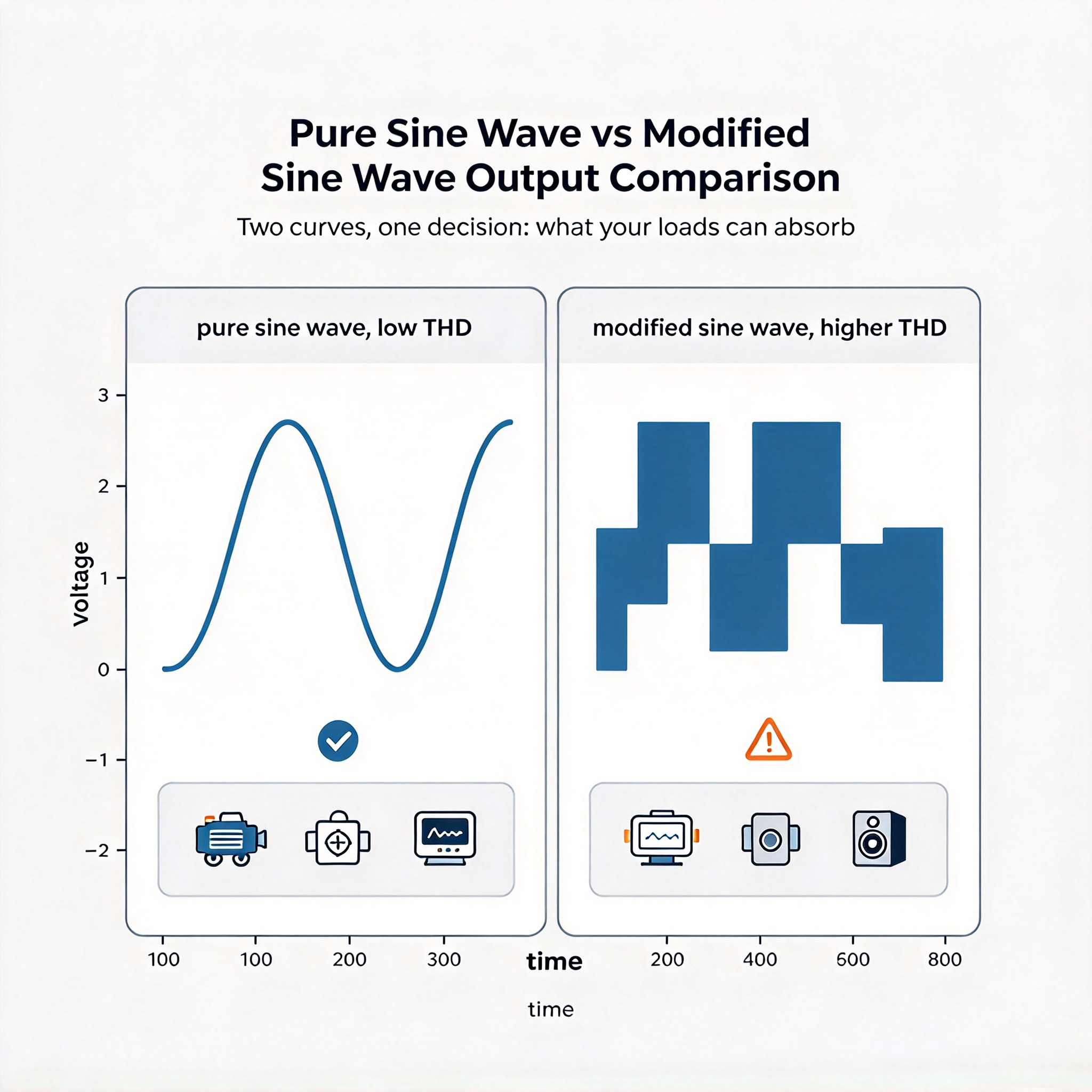
power inverters pure sine wave output means the AC the unit delivers is a smooth, grid-like sine with low total harmonic distortion — generally under about 3% THD for the pure sine wave tier — while a modified or stepped wave approximates that curve with square or stair steps and far higher distortion. The practical difference shows up as heat, noise and motor life, so the choice is made on your load list, not on the spec sheet alone, especially where motors, medical devices or audio gear sit on that list.
The phrase power inverters pure sine wave has become shorthand in RFQs and on datasheets, but the shorthand hides three separate questions: how clean the wave actually is, which of your loads care, and what the cleaner wave costs you per unit.
Power Inverters Pure Sine Wave vs Modified Sine Wave: the output waveform table
Both waveforms deliver AC at the rated voltage and frequency, so on a specification sheet they can look equivalent. What differs is the shape of the voltage curve, and the shape decides how much of that energy the load can use cleanly. A pure sine wave follows the same smooth curve the utility delivers; a modified sine wave — also sold as a quasi or stepped wave — squares the curve off or rebuilds it from stair steps, pushing part of the energy into harmonics the load was never designed to absorb. The stage that produces either shape is covered in the DC to AC conversion stage walkthrough; this article stays on the output side.
| Dimension | Pure sine wave | Modified / stepped wave |
|---|---|---|
| Waveform shape | Smooth continuous curve | Square or staircase approximation |
| Typical THD band | Low, commonly under about 3% | High, in the tens of percent |
| Motors, pumps, compressors | Rated speed and temperature | Extra heat, hum, shorter life |
| Switching power supplies | Behave as designed | Peakier current, nuisance trips |
| Audio, test, medical gear | Clean, no injected noise | Buzz, reading errors, alarms |
| Efficiency | Higher at most load levels | Lower, weakest at light load |
| Unit cost band | Higher | Lower |
Read that table as a trade rather than a ranking. A modified wave still runs a large share of simple loads and it is cheaper to build; a pure sine wave costs more and takes a class of field complaints with it — the buzzing transformer, the warm pump, the meter that reads a few percent high. A buyer shortlisting power inverters pure sine wave units is really buying that lower complaint rate, not a nicer curve.
Which loads are sensitive to waveform quality
The useful question is not “is this load sensitive” but “what breaks when the wave is not clean”. Some loads stop, some run hot and age early, some only annoy the operator. Sorting them that way gives a specification you can defend instead of a preference you have to argue for.
Motors, pumps and compressors
An induction motor is built around a rotating magnetic field that a sine wave supplies smoothly. Feed it a stepped wave and the extra harmonics turn into losses: the motor draws more current for the same shaft power, runs hotter, and hums. On a refrigerator, a well pump or a duty-cycling compressor, that heat is the difference between a service life counted in years and one counted in months. Where the motor must not fail — a borehole pump, a cold-room compressor — a pure sine wave is cheap insurance.
Medical and life-support equipment
Medical devices are the conservative case. Makers of oxygen concentrators, CPAP units and patient monitors commonly state a sine wave supply in their installation notes, and some units will not run on a stepped wave at all. If a device alarms during an outage, the first question asked is what it was plugged into. For clinic, care-home and home-care deployments the sine wave tier is non-negotiable rather than an upgrade.
Precision electronics, audio and measurement
Here waveform quality becomes audible or visible rather than merely thermal. Harmonics leak into speakers as buzz and into measurement front ends as offset and noise, so a mixing desk, a broadcast rack or a calibration bench will show its power supply in its output. Switch-mode supplies in laptops and routers are more tolerant, but they draw a peakier current on a stepped wave and run their input capacitors hotter. Repeated nuisance trips on these loads are usually worked through with the inverter troubleshooting checklist before anyone suspects the waveform.
Loads that rarely notice the difference
Be honest about the other side. Resistive loads — heaters, incandescent lamps, simple kettles — convert a stepped wave almost as happily as a sine one, and older transformer-based tool chargers are usually fine. If the whole load list sits inside this group and budget is binding, a modified wave is a defensible buy rather than a mistake, provided the buyer was told.
How to choose a waveform by your load list
Work from the load list outwards rather than from the catalogue inwards. Write down every load, mark the ones with a motor, a medical certification, an audio or measurement function, or a manufacturer statement about supply waveform, and let that marked list set the specification — one inverter cannot feed two different waveforms.
The second pass is the running profile: a load that runs ten minutes at a time accumulates far less heat than the same load running overnight. The third pass is consequence — spoiled cold chain, missed shift or clinical risk, against which the waveform premium disappears. For procurement teams, power inverters pure sine wave output belongs in the specification rather than in the negotiation.
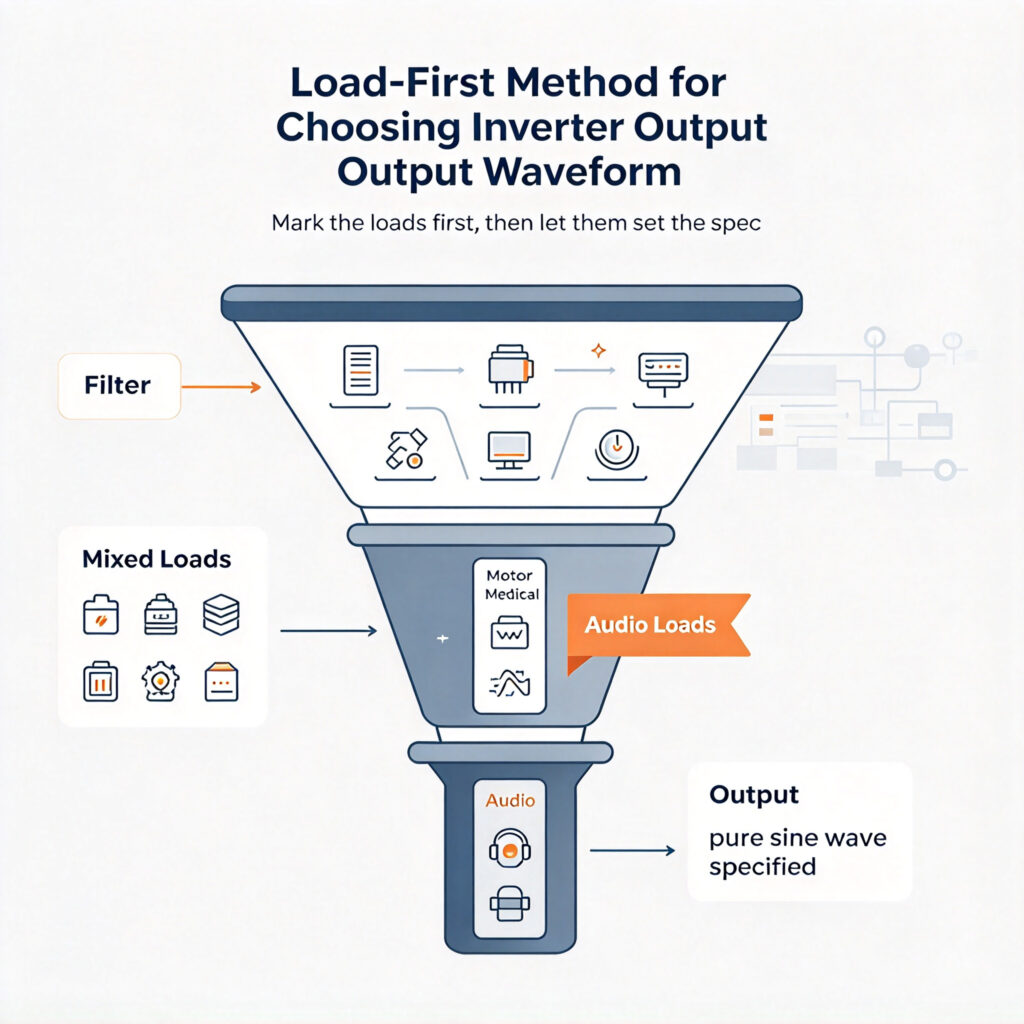
Where the marked list is empty and the loads really are resistive, a modified wave saves money per unit, and at volume that saving is real. Document the reasoning on the quotation so the buyer is choosing the trade rather than discovering it after commissioning.
Where a modified wave is still the right buy
There is a genuine market for stepped output: site cabins with a lamp and a charger, basic backup for resistive heating, remote-site tools, and price-sensitive lines where the buyer has been shown the difference and accepted it. Two rules keep that choice honest — never put a load with a stated sine wave requirement on a stepped unit, and keep the two tiers separate in your own catalogue so the cheaper unit never lands on a medical or motor quotation by accident. Complaints that do surface arrive as unexplained heating and end up in the inverter repair and fault diagnosis workflow rather than being traced back to a specification decision.
Selection checklist before you specify
Five checks close the waveform question before an enquiry goes out, and each one produces a line you can attach to it.
| Check | What to record | Why it decides the tier |
|---|---|---|
| Sensitive load list | Every motor, medical, audio and measurement load, with duty cycle | One flagged load sets the whole system tier |
| THD tier and condition | Quoted THD plus the load level it was measured at | A number without a condition cannot be compared |
| Continuous and surge power | Steady draw and motor starting surge | Surge is where a marginal waveform trips first |
| Battery class and DC window | Nominal pack voltage and operating range | Quality degrades at the edge of the window |
| Compliance baseline | Target market and required standards | Sets what can be offered at all |
The battery class line deserves a second look, because many sine wave units target a 48 V pack. Those windows are worked through in the 48V inverter guide and, for North American services, in the 48V split phase inverter notes.
Compliance closes the list: baselines such as IEC 62109 for power converters, UL 1741 for grid-connected units and IEEE 1547 for interconnection behaviour set the frame a compliant product sits inside, but the applicable edition and local amendments must be confirmed for your market — treat the numbers as a starting point to verify locally, not as the final word. Where the load list carries any flagged device, power inverters pure sine wave output is the safer specification; where the enclosure is open too, the same list drives the choice in the all in one inverter options guide. For chisidal projects, send the marked load list, the running profile, the battery class and the target certification set, and the waveform tier can be confirmed as one matched specification.
Q. Power inverters pure sine wave vs modified sine wave: which one do I need?
Choose by load list, not by price. If any load has a motor that runs for hours, a medical certification, an audio or measurement function, or a manufacturer statement requiring a sine wave supply, specify the pure sine wave tier. If every load is resistive — heating, simple lighting, basic tools — a modified wave is acceptable and cheaper.
Q. What THD is acceptable for an inverter?
The pure sine wave tier is quoted in low single digits, commonly under about 3%, while stepped units sit in the tens of percent. Read the figure as a band, and ask at what load level it was measured before comparing quotations.
Q. Can I run a fridge or a well pump on a modified sine wave inverter?
They will often start, but the motor draws more current for the same shaft power and runs hotter, which shortens its life and can trip thermal protection. For pumps that duty-cycle for hours, that heat is the failure mechanism, so the sine wave tier is safer.
Q. Do laptops and phone chargers need a pure sine wave inverter?
Most modern switch-mode adapters tolerate a stepped wave, but they draw a peakier current and run their input capacitors hotter. If the same system also feeds audio, measurement or networking gear, specify sine wave output rather than mixing tiers.
Q. Is a pure sine wave inverter more efficient?
Across most of the load range, yes, and the gap is widest at light load. The larger saving is indirect: motors and transformers on a clean wave waste less energy as heat and hum, so downstream equipment runs closer to its rated efficiency.
Q. Why does my equipment buzz on a modified sine wave inverter?
The buzz is the harmonics. A stepped wave carries energy at multiples of the fundamental, and transformers, motor laminations and speaker coils turn it into audible noise and heat — the same mechanism that shortens motor life.
Next step: confirm the waveform tier against your load list
Mark the loads, add the duty cycle, and send the list with your target certification set. The tier then follows from the list instead of being argued over after delivery.
- Check the sizing relationship first in the storage hybrid inverter selection guide before you fix the specification
- For chisidal, send your usage and site details, and we will come back with product prices, lead time and warranty information.