
The solar panel tilt angle is the pitch at which a fixed array is set relative to horizontal, and it decides how much direct sun the glass catches across the year. This guide explains the latitude starting point, why the best annual angle is not the best winter angle, how orientation interacts with pitch, and what to do when a roof dictates an angle you would not have chosen.
Tilt is the one design variable that costs nothing and changes yield measurably. There is no motor, no additional component, and no ongoing cost — just the angle at which the frame is set. That makes it worth getting right, and it also means the most common mistakes are avoidable: copying a neighbour’s pitch, assuming steeper is always better, or accepting whatever the roof offers without checking what it costs.
Start from latitude, then adjust
The usual starting point for a fixed array is a tilt roughly equal to the site’s latitude, which balances production across the year. It is a starting point rather than a rule, because the optimum shifts with what you want the system to do and with the local weather pattern. A site with clear summers and cloudy winters wants a different pitch from one with the reverse.
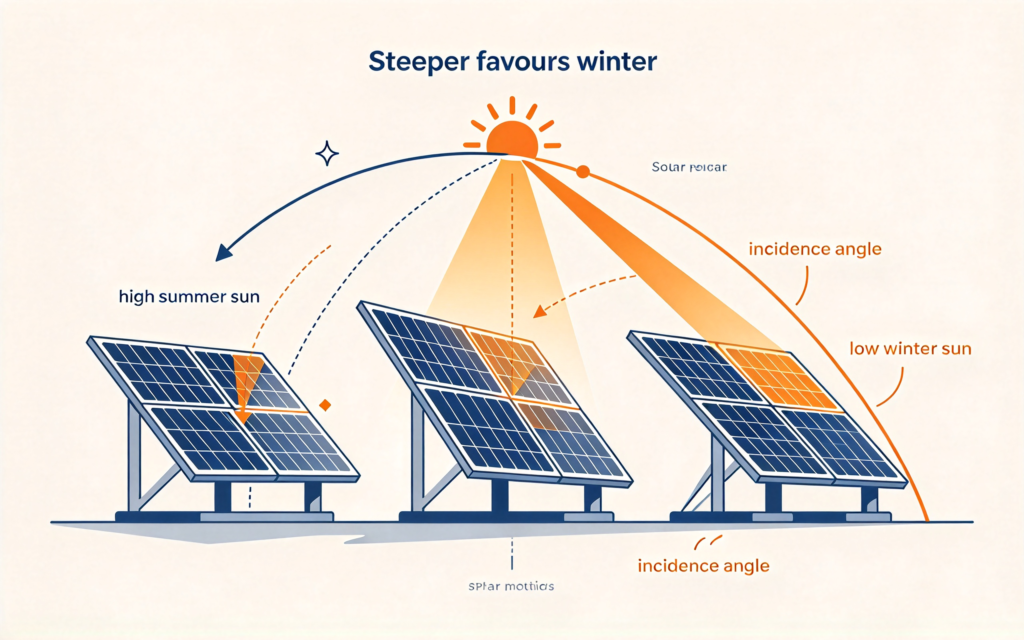
Think of tilt as choosing which part of the year you favour. A shallower tilt favours summer, when the sun is high. A steeper tilt favours winter, when the sun stays low and the array needs to face it more squarely. Because most grids offer the same value for a kilowatt-hour in July as in January, the annual optimum usually favours the sunnier season — which is why the latitude rule sits slightly shallower than a naive “point it at the sun” instinct suggests. The solar panel tracking systems guide covers what happens when you let the array move instead of choosing one angle.
Winter weight and off-grid realities
Grid-tied and off-grid systems optimise for different things. A grid-tied array sells or offsets energy at a flat rate and should generally maximise annual kilowatt-hours. An off-grid array has to survive the worst week of the year, and the binding constraint is the shortest, cloudiest stretch — which argues for a steeper solar panel tilt angle that favours winter, even at the cost of some summer production.
The same logic applies to any load that is largest in winter: heating, shorter daylight hours, or a battery that has to carry the house through the night. If your system has to deliver in December, design the pitch for December and accept the summer surplus. The how many solar panels you need guide works through how the angle feeds into the quantity you need.
| Goal | Tilt bias | Why |
|---|---|---|
| Max annual kWh | Near latitude | Balances seasons |
| Winter reliability | Steeper | Faces the low winter sun |
| Summer peak matching | Shallower | Faces the high summer sun |
| Better self-consumption | Steeper | Spreads production into the day |
Orientation matters as much as pitch
In the northern hemisphere the ideal orientation is true south; in the southern hemisphere, true north. Azimuth and tilt interact: a badly oriented array can be partly compensated with pitch, but not fully. An east or west-facing roof loses some annual production compared with an ideal orientation, and the loss is smaller than most people expect — often single-digit percentages for modest deviations.
East and west orientations have a compensating virtue. They shift production earlier and later in the day respectively, and a split array across both produces a flatter, longer generation curve. Where self-consumption matters more than total export, that flatter curve can be worth more than the lost total. The pros and cons of solar panels piece covers how these trade-offs show up in a real household profile.
When the roof decides for you
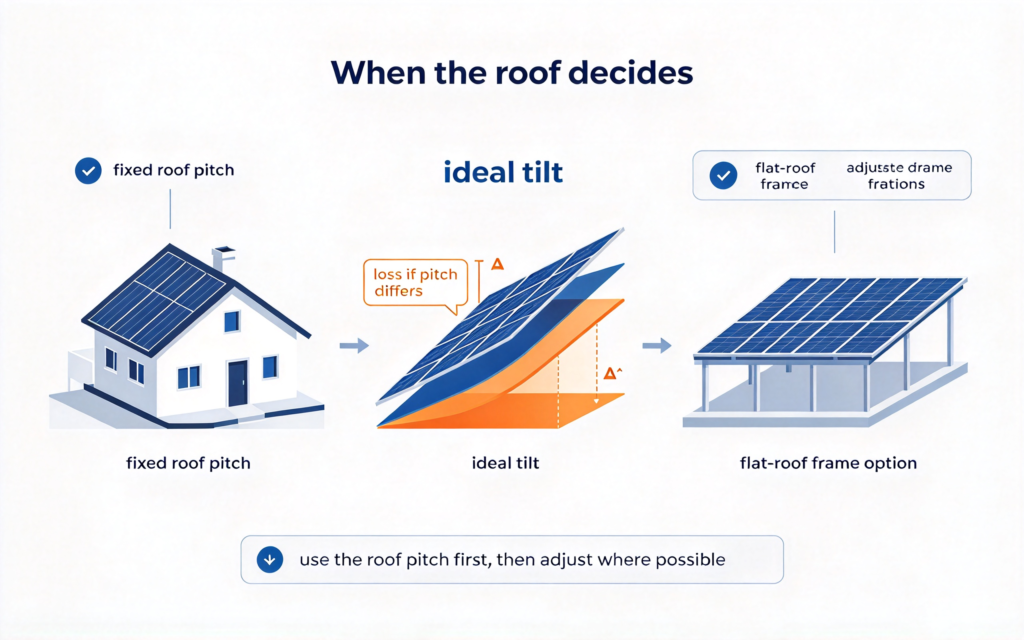
Most rooftop arrays simply take the roof pitch, and that is usually the correct decision. The yield difference between the roof angle and a theoretical optimum is often small, while tilting frames on a pitched roof add cost, wind loading, visual impact and maintenance for a modest gain. Accepting the roof is frequently the right engineering answer.
Flat roofs are the exception, because there the solar panel tilt angle genuinely is a free choice. A tilted frame adds production over a lay-flat arrangement, but it also adds wind uplift, ballast or penetrations, and row-to-row shading that limits how closely rows can be spaced. The optimum on a flat roof is usually a modest tilt with generous row spacing rather than a steep pitch packed tight. The ground mounted solar panels guide covers the same spacing logic for ground arrays.
Shading, spacing and row pitch
Tilt creates shading between rows. The steeper the array and the lower the winter sun, the longer the shadow it casts, so steeper tilts need wider row spacing on ground mounts and flat roofs. Designing a steep tilt without widening the spacing simply trades one loss for another.
Check the shading at the time of year that matters, not just at noon on a summer day. Winter shadows are long, and a row that is clear in June can be shaded in December. A shading assessment at the site is worth more than any rule of thumb about panel angles.
Adjustable frames and whether they are worth it
Seasonally adjustable frames let you change the solar panel tilt angle a few times a year — steeper for winter, shallower for summer. The yield gain over a well-chosen fixed angle is real but modest, and it has to be weighed against cost, the extra hardware that can fail, and the simple fact that someone has to remember to go out and adjust them. On a ground mount where access is easy and the owner is engaged, they can pay back; on a roof, they rarely do.
A more common compromise is to pick a fixed angle slightly steeper than the annual optimum. That gives up a little summer production for better winter and shoulder-season performance, which suits households whose consumption is highest outside the summer months. It captures much of the benefit of an adjustable frame with none of the hardware or the remembering.
How to sanity-check a design
Compare the proposed pitch against the latitude, then ask what the design is optimising for. If nobody can answer that, the pitch was chosen by default. For an off-grid or battery-heavy system, confirm the design was checked against the worst month rather than the annual average — that single question catches most undersized winter designs.
Finally, verify against production. Once the system is running, compare monthly yield to the expectation and to the same month in later years. For chisidal-supplied systems, send the location, the roof pitch and orientation, and the load profile, then ask for the tilt and spacing that were actually modelled rather than assumed.

Choosing the angle for the job
The right solar panel tilt angle follows from what the system is for: near latitude for maximum annual energy, steeper for winter reliability and self-consumption, and the roof pitch whenever the cost of changing it exceeds the gain.
Q. solar panel tilt angle?
The solar panel tilt angle is the pitch of a fixed array relative to horizontal. It decides how much direct sun the glass catches across the year, and the usual starting point is a tilt near the site latitude.
Q. What is the best tilt angle for solar panels?
There is no single best angle — it depends on the goal. Near latitude maximises annual production; a steeper tilt favours winter; a shallower tilt favours summer. Confirm against a modelled estimate for your site.
Q. Should I tilt panels steeper in winter?
A fixed array cannot be re-tilted seasonally without an adjustable frame, and those add cost and maintenance. If winter delivery is critical, design a steeper permanent angle rather than planning to adjust it.
Q. Does orientation matter more than tilt?
Both matter and they interact. A modest deviation from ideal orientation usually costs less than people expect, and pitch can partly compensate. An east-west split can be worth more than the lost total if it flattens the generation curve.
Q. Can I just use my roof pitch?
Usually yes. The yield gap between the roof pitch and a theoretical optimum is often small, while tilting frames add cost, wind loading and maintenance. On a flat roof, tilt is a genuine free choice.
Q. How does tilt affect row spacing?
Steeper tilts cast longer winter shadows, so they need wider spacing between rows. Designing a steep pitch without widening spacing trades one loss for another.
Q. Does tilt affect self-consumption?
Yes. A steeper angle spreads production more evenly across the day and into the winter months, which can raise the share you consume directly even where total annual yield falls slightly.
Next step: model the angle against your goal
Tilt is free to change on paper and expensive to change later. Send the location, roof pitch and orientation, plus what the system has to deliver.
- Quantity interacts with angle — see how many solar panels you need
- If the array will move instead of sitting fixed, compare solar panel tracking systems
- For chisidal, send your usage and site details, and we will come back with product prices, lead time and warranty information.