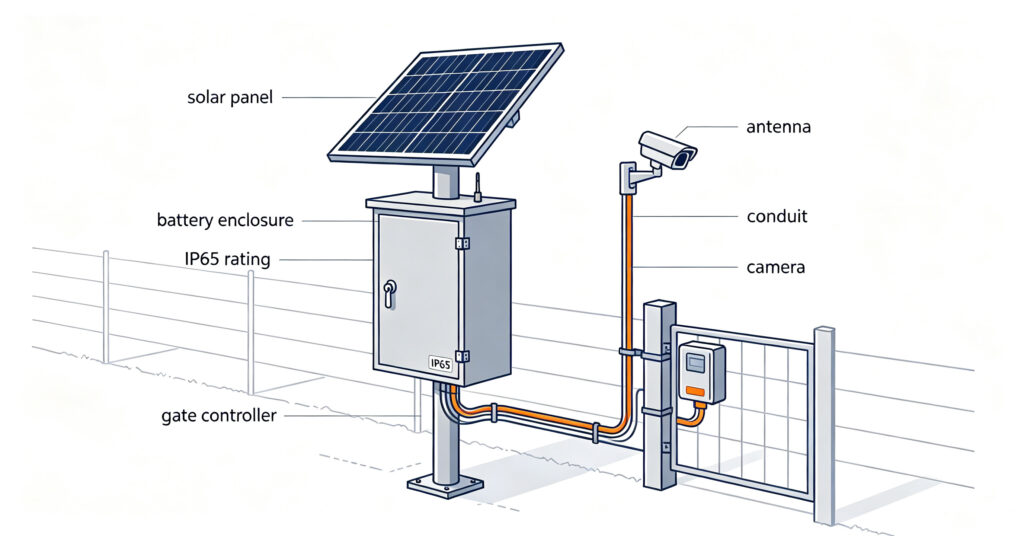
Outdoor solar power is a self-contained photovoltaic system that runs equipment away from the grid — cameras, gates, pumps, sensors, telemetry, lighting or tools — with a panel, a charge controller, a battery and a load, all mounted where the weather and the public can reach them. The sizing arithmetic is the same as for any off-grid system, but the engineering that decides whether it survives is different: enclosure sealing against driven rain, thermal limits on a battery sitting in a sealed box in full sun, low-temperature charging behaviour, physical security, and shading from things that grow. The one-line version worth quoting: outdoor systems rarely fail on wattage; they fail on water, heat, cold, theft and the tree that was not there when the site was surveyed.
This guide is for the person specifying a system that will be installed and then visited once or twice a year: a farmer, a security or telecom contractor, a site facilities manager, or an engineer writing a specification for a tender. It covers the load categories, the five environment constraints, the sizing method, and the installation details that decide service life. Living off-grid with household loads is a different problem, covered in #131 off-grid battery backup for cabins and farms; portable units that are carried to site rather than left there are compared in #82 LiFePO4 portable power station.
Four load categories
Outdoor loads fall into four profiles, and each one stresses the system differently.
| Load type | Typical power | Duty profile | What it demands from the system |
|---|---|---|---|
| Cameras, sensors, telemetry | Low watts, continuous | 24/7, flat | Autonomy days; stable low-current supply |
| Gates, locks, barriers | Low average, high surge | Short bursts, unpredictable | Surge capability and reserve capacity |
| Pumps, irrigation, aerators | Medium to high | Scheduled hours, often daylight | Motor startup surge; optional direct daytime running |
| Lighting, signage | Low to medium | Night-only | Night energy budget; seasonal variation |
The duty profile matters more than the nameplate wattage. A gate opener that draws a large current for two seconds, ten times a day, needs an inverter with surge headroom and a battery that can deliver that surge without the voltage collapsing — and it needs almost no daily energy. A camera that draws a small current for twenty-four hours needs the opposite: no surge capability, but a genuinely large energy budget if the site wants three days of autonomy through a wet week.
Five environment constraints
These are the five things that kill outdoor systems, in the order they usually do it.
- Water ingress. Driven rain, condensation and insects. Every enclosure entry needs a sealed gland, and cable entries should face downward where possible. Condensation inside a sealed box is a real failure mode in humid climates and is solved with a drain or a breather, not with more sealant.
- Heat. A sealed enclosure in full sun can reach temperatures that derate the battery and shorten its life. Shade the enclosure, ventilate it without letting water in, or bury it — and remember that a battery’s specified operating range is not the same as its specified charging range.
- Cold. Charging a lithium battery below freezing causes permanent damage, so a system that must charge in winter needs either a low-temperature charge cutoff in the management system or a heated enclosure. Cold also reduces usable capacity temporarily, which is a sizing problem rather than a fault.
- Theft and tampering. A padlock is not a deterrent on a remote site. Use tamper-resistant fasteners, conceal or cage the equipment, and put the battery inside a locked enclosure rather than behind a removable panel.
- Shading and soiling. Vegetation grows, dust accumulates, and birds perch. A site that was clear at installation is not guaranteed to be clear in year three, and a partial shade pattern across one string costs more energy than its area suggests.
Panel tilt is worth a decision of its own: a steeper tilt sheds rain and snow and reduces soiling, while a shallower tilt maximises summer yield. For a site that must survive winter, tilt for winter and accept the summer surplus.
Sizing method
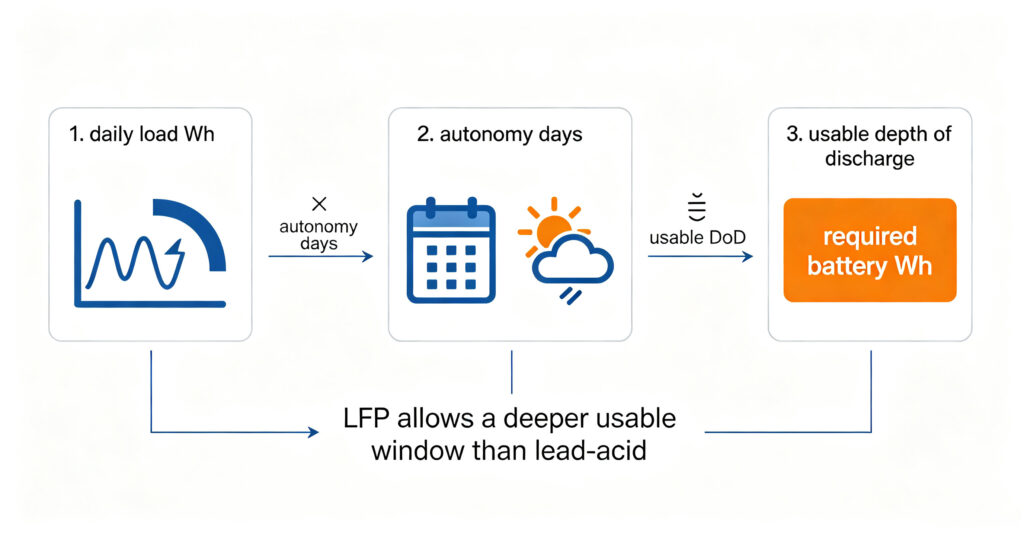
Three steps size an outdoor solar power system, in this order.
- Daily energy: average load watts multiplied by hours per day, plus the surge allowance for anything with a motor. For a 24/7 load this is simply watts times twenty-four.
- Autonomy: multiply the daily energy by the number of consecutive sunless days the system must ride through. Two to three days is a common choice for security and telemetry; a week or more is used where a service visit is expensive.
- Usable capacity: divide the autonomy energy by the depth of discharge the chemistry allows. This is where a lithium iron phosphate bank earns its cost, because a far larger fraction of the nameplate capacity is usable than on a lead-acid bank of the same rating.
Panel sizing then follows from the daily energy and the worst-month irradiance, not the best-month figure. A system sized on summer sun will run out in winter; a system sized on winter sun will be oversized in summer and waste energy, which is the cheaper of the two mistakes by a wide margin. Where the load can be scheduled — a pump, an aerator, an irrigation valve — running it during daylight removes it from the battery budget entirely and is the single most effective cost reduction available.
Chemistry and platform come next. Lithium iron phosphate is the default for fixed outdoor installations because it tolerates a wide temperature range, allows deep discharge, and does not need the maintenance access a flooded battery requires. Voltage platform follows from power: small sensor sites run happily at 12 V, while anything with a pump or a sustained load is better at 24 V or 48 V to keep the current and the cable size sane. The platform trade-offs are in #157 24V solar battery and #12 48V vs 51.2V.
Installation details that decide service life
Six details separate outdoor solar power that runs for years from a system that is revisited every season.
- Mount the panel where it cannot be shaded by the thing it powers — a panel under the same pole as the camera is often shaded by the camera arm.
- Use solar-rated cable and sealed glands throughout, with drip loops on every entry.
- Put the charge controller and battery in the same enclosure so the temperature they see is the temperature the controller compensates for.
- Torque and label every termination; a label is the difference between a two-minute fix and a two-hour investigation in the rain.
- Add a low-temperature charge cutoff or a heated enclosure if the site freezes.
- Plan the first service visit for after the first winter, and put it in the contract.
Where the site has no grid but does have a critical load — a telemetry link, a security camera on a remote entrance — the designer should decide whether a small generator input is worth including, because it converts an autonomy problem into a fuel-logistics problem, and those two cost very different amounts over ten years. The comparison of storage against generation is in #47 home battery vs generator, and the telecom-grade version of this design problem is in #152 cellular battery backup.
Q. What is outdoor solar power?
Outdoor solar power is a self-contained photovoltaic system that runs equipment away from the grid, mounted permanently at the site. It typically combines a panel, a charge controller, a battery and a protected enclosure, and powers loads such as cameras, sensors, gates, pumps, lighting and telemetry without a grid connection.
Q. How much panel and battery do I need for a security camera?
Work out the camera’s average watts multiplied by twenty-four for daily energy, multiply by the number of sunless days you want it to survive, then divide by the usable depth of discharge of the battery chemistry. Size the panel from that daily energy using the worst-month irradiance for the location rather than the summer figure.
Q. Can a lithium battery charge below freezing?
Not safely. Charging a lithium cell below 0 °C can plate lithium metal on the anode and cause permanent damage, so a system that must charge in winter needs either a battery management system with a low-temperature charge cutoff or a heated enclosure. Many outdoor installations use both.
Q. What IP rating should an outdoor battery enclosure have?
At minimum a rating that keeps out driven rain and dust, commonly IP65 for a sealed outdoor cabinet. The rating only holds if the cable entries are sealed with proper glands and the door gasket is intact, so the installation matters as much as the box.
Q. How do I stop an outdoor solar system being stolen?
Use tamper-resistant fasteners, put the battery inside a locked and caged enclosure rather than behind a removable panel, conceal or height-mount the panel where practical, and consider a concealed GPS tracker or a tamper alarm on high-value sites. A visible padlock alone is not a deterrent on a remote site.
Next step: size for the worst month, then harden for the site
Outdoor solar power is won at the survey, not at the checkout. Get the load profile and the winter irradiance right and the rest is procurement.
- Compare platforms in #157 24V solar battery
- Check the telecom-grade design in #152 cellular battery backup
- Review off-grid living loads in #131 off-grid backup for cabins and farms
- Send leekooenergy your load watts and hours, your required autonomy days and the site’s winter temperature range — and ask for a configuration that states the panel wattage on worst-month irradiance, the usable battery capacity at the depth of discharge assumed, the enclosure rating, and the low-temperature charging arrangement