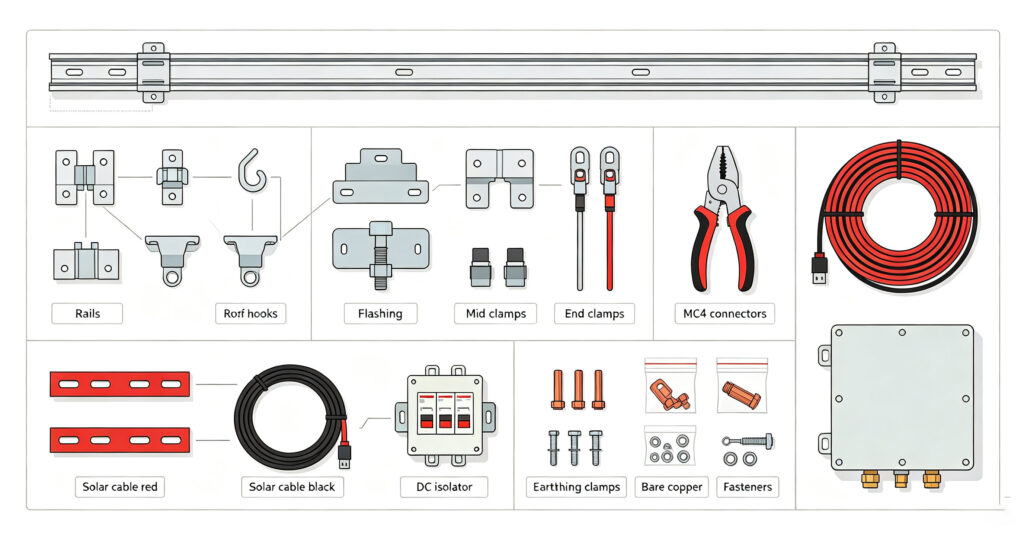
A solar installation kit is the set of mounting, cabling, protection and earthing hardware that turns loose photovoltaic modules into a working array — everything except the panels and the inverter themselves. In the trade this is called the balance of system, or BOS, and it is where most budget overruns and most commissioning delays come from. A kit that is specified correctly includes roof or ground attachment hardware sized to the local wind and snow load, rails and clamps matched to the module frame thickness, solar-rated cable sized for the string current and run length, DC isolation and over-current protection, surge protection, and a complete earthing path. The one-line version worth quoting: the panels are the cheapest line on the quote and the easiest to agree on; the installation kit is where two quotes that look identical stop being identical.
This guide is written for the person checking a kit before it goes on a truck — an installer, a contractor, or a buyer comparing two offers that list the same panel wattage. It covers the material boundary, the three subsystems inside a solar installation kit, how each one is sized, and the items that are most often missing from a quote. Panel-level selection is not repeated here; the module parameters are compared in #74 PV panel kits, and the first-time-assembly sequence is in #95 DIY solar panel kit.
Where the kit boundary sits
Three categories make up a complete solar installation kit, and knowing which category a part belongs to is how you tell whether a quote is complete.
- Structural: everything that holds the array to the building or the ground — roof hooks or ground screws, rails, clamps, flashings, and the fasteners. Sized from wind exposure, roof material and module dimensions.
- Electrical DC: everything that carries current from the module junction box to the inverter input — solar cable, connectors, a combiner or string fusing arrangement, an isolator, and surge protection. Sized from string current, voltage and run length.
- Safety and earthing: the equipment earthing conductor, module frame bonding, the array earth electrode, and any equipotential bonding the local code requires. Sized from the local electrical code rather than from the array.
What a solar installation kit does not normally include: the modules, the inverter, the battery, the metering, and the grid-connection paperwork. Storage is quoted separately, and the capacity question is answered in #06 solar battery kit; the retrofit path for an array that already has an inverter is in #78 adding a battery to an existing inverter.
Structural hardware: attachment first, rails second
The attachment method is decided by the substrate, and getting it wrong is expensive because it is the part under the flashings.
| Substrate | Typical attachment | Watch for |
|---|---|---|
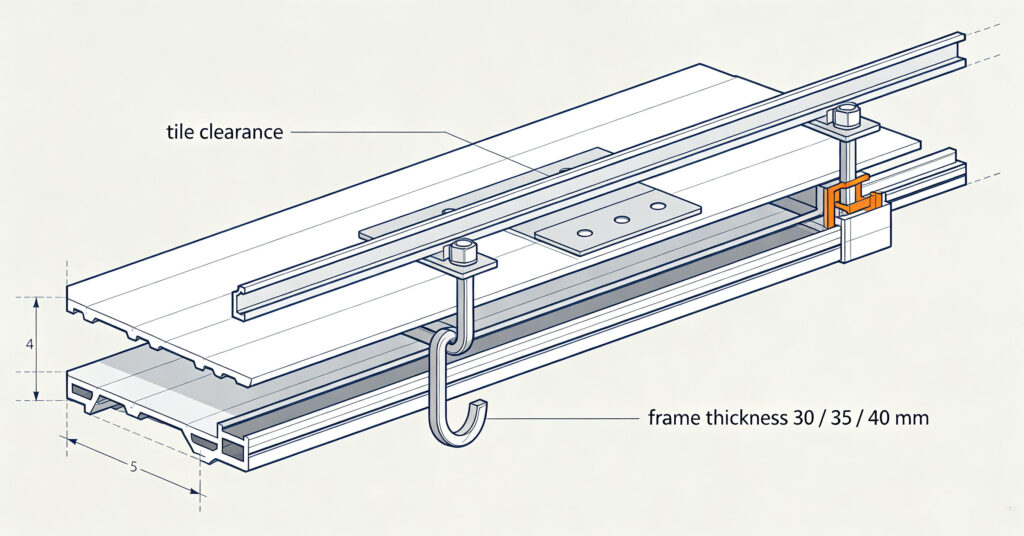
| Tiled pitched roof | Roof hooks under the tile, or a tile replacement flashing | Hook must clear the tile above; confirm tile profile before ordering |
| Metal trapezoidal sheet | Standing-seam clamps, or sheet-to-purlin brackets | Clamp must match the seam profile; penetrating fixings need sealing washers |
| Flat membrane roof | Ballasted frame or mechanically fixed feet with membrane-compatible flashing | Wind uplift calculation, and membrane warranty approval |
| Ground mount | Ground screws or concrete footings on a galvanised or aluminium frame | Soil bearing, frost depth and corrosion class |
Rails and clamps come after the attachment is settled. The rail span is limited by the wind and snow load for the site, and the clamp must match the module frame thickness — a clamp bought for a 30 mm frame will not grip a 35 mm frame safely, and mixing frame thicknesses in one array is a slow way to create a loose module. Stainless or anodised aluminium fasteners are worth the premium; a corroded clamp is a re-roof job, not a tightening job. The site survey that produces these numbers is set out in #110 battery installation site assessment, and the safety envelope around the work is in #128 installation safety requirements.
DC cabling: sized by current, then checked by length
Cable sizing is a two-step check and skipping the second step is the most common quality gap in a cheap solar installation kit. Step one is current: the cable must carry the string short-circuit current with margin, and the usual practice is to size for at least 1.25 times that value. Step two is voltage drop: at the current the string actually runs, the voltage lost over the run length should stay within the few percent the system designer allows, and on a long run that forces a larger cross-section than the current alone would suggest.
Three material choices follow from the environment, not from the price. The cable must be solar-rated — UV and ozone resistant, with a temperature rating that suits a black cable sitting on a hot roof; ordinary building wire is not acceptable outdoors. The connectors must be from one system and one maker: mixing connector brands is a known failure point because the locking geometry and the contact tolerances are not specified to work together. Every connector termination should be made with the correct crimping tool, because a hand-crimped contact is the single most likely future fault in the DC side.
Protection devices are then added at the right points: string fusing where the array configuration requires it, a DC isolator within reach of the inverter, and surge protection on both the DC and AC side where lightning exposure or local code calls for it. Array-level fault finding once the kit is installed is covered in #109 solar inverter troubleshooting.
Sizing the kit to the array
Four numbers take a kit from a generic bundle to a correct one.
- String voltage and current: from the module datasheet and the series count, and from the lowest expected temperature for the site — cold modules produce a higher open-circuit voltage, which is what sets the cable and equipment voltage rating.
- Run length: the one-way distance from the array to the inverter, which drives the voltage drop check.
- Wind and snow load: which sets rail span, clamp spacing and the number of attachment points.
- Module frame thickness and dimensions: which sets clamp type, rail length and layout.
An installer who has those four numbers can order a solar installation kit in one pass. Without them, the usual outcome is a second delivery for the parts that did not fit, and the second delivery costs more than the saving on the first one. The design sequence that produces all four is in #162 how to build a solar power system.
What is missing from most kit quotes
Six items appear late in projects with predictable regularity, and every one of them is cheap to include at order time and expensive to add after the scaffolding is down.
- Tile replacement flashings and spare tiles: a few cracked tiles are normal on an old roof, and no kit includes them by default.
- Cable glands and conduit: the roof penetration needs a sealed entry, and exposed cable runs need mechanical protection.
- Earthing hardware: module frame bonding washers, the equipment earthing conductor, and the earth electrode are frequently quoted separately.
- Isolator and surge protection: sometimes treated as optional when the local code treats them as required.
- Spare connectors and a crimp tool: one bad termination on a Friday afternoon should not stop a job.
- Documentation: the as-built string layout, the torque values used, and the test results the commissioning engineer signs.
On the last point, commissioning is where a project formally changes hands, and what gets signed is described in #111 BESS commissioning steps. For grid-connected work the local utility connection rules sit outside the kit entirely.
Buying a kit for repeated installs
For a contractor fitting dozens of arrays a year, the buying logic changes from “is it complete” to “is it identical every time”. Four questions decide that.
- One attachment system across roof types? Fewer attachment families means fewer parts in the van and fewer mistakes on site.
- Are clamp and rail part numbers stable across years? A system that is revised every season makes last year’s spares useless.
- Is the hardware certified for the market? Structural and electrical marks differ by region, and the certification question for storage hardware is laid out in #107 battery export certification.
- What is the spare-parts lead time? Ask for the single most frequently needed clamp and confirm it ships in days, not weeks.
Q .What is a solar installation kit?
A solar installation kit is the mounting, cabling, protection and earthing hardware needed to turn photovoltaic modules into a working array. It covers roof or ground attachment, rails and clamps, solar-rated DC cable and connectors, string fusing or combiner hardware, a DC isolator, surge protection and the earthing path. Modules, inverters and batteries are normally quoted separately.
Q. Does a solar installation kit include the inverter and battery?
Usually not. A kit sold as an installation or mounting kit covers the balance of system. A kit sold as a complete solar kit may bundle modules, an inverter and sometimes a battery, but the two products are specified differently and should be checked line by line rather than assumed.
Q. How much cable does a typical array need?
It depends on the string layout and the distance from the array to the inverter, not on the array wattage alone. Work out the string configuration, measure the one-way run to the inverter, then size the cross-section on string current and check the voltage drop over that length. A long run can force a larger cable than current rating alone suggests.
Q. Can one kit fit any roof type?
No. Attachment hardware is substrate-specific: tile roofs use hooks or replacement flashings, standing-seam metal roofs use seam clamps, flat membrane roofs use ballasted or mechanically fixed frames, and ground mounts use screws or footings. The rail and clamp parts may be shared, but the attachment is not.
Q. What is the most common missing item in a kit?
Earthing hardware and roof flashings. Module frame bonding washers, the equipment earthing conductor and the earth electrode are frequently quoted as separate lines, and a few spare tiles or replacement flashings are rarely included though breakages on older roofs are routine.
Next step: quote the kit line by line
A solar installation kit that is complete on paper is the difference between one site visit and three. Compare offers on attachment type, cable cross-section and protection devices, not on panel wattage.
- Check the module and array parameters in #74 PV panel kits
- Work through the assembly sequence in #95 DIY solar panel kit
- Confirm the storage side in #06 solar battery kit
- Ask leekooenergy for a BOS checklist filled in for your roof type, wind and snow load, string configuration and run length — so the kit you order arrives complete and the second delivery never happens