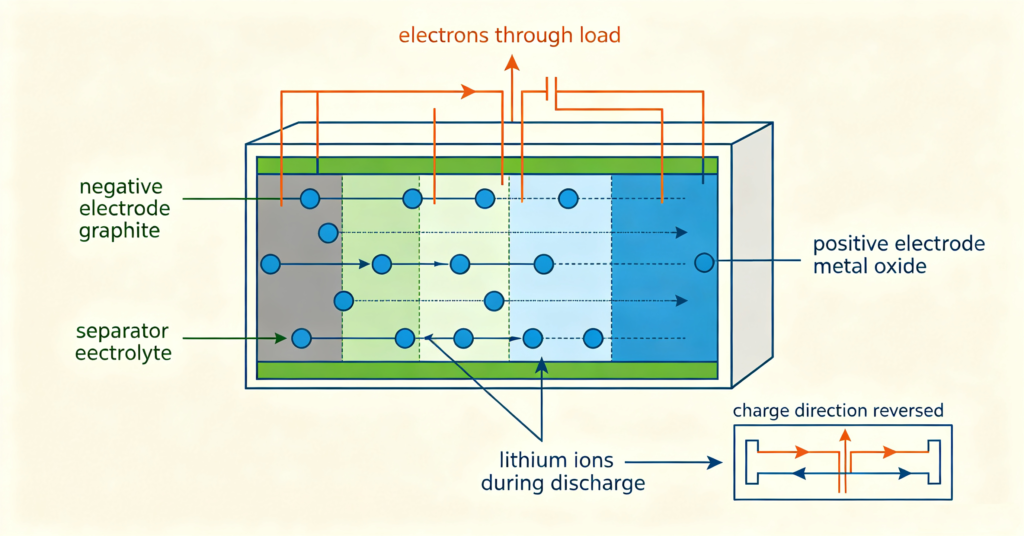
The short answer to what is lithium ion battery technology: it is a family of rechargeable batteries that store energy by moving lithium ions between a positive and a negative electrode through an electrolyte. Charge pushes the ions into the negative electrode; discharge lets them flow back to the positive side while electrons travel through the external circuit to power a device. Lithium is the lightest metal and the most electropositive one, which is why this chemistry packs more energy per kilogram than lead acid, nickel-metal hydride or most alternatives — and why it dominates phones, laptops, electric vehicles and most of the world’s energy storage systems.
The term covers a family, not one chemistry: every lithium ion cell works on the same ion-shuttle principle, but the electrode materials differ, and those differences decide energy density, cycle life, safety and price. Most of the confusion buyers run into — LiFePO4 vs NMC, energy density vs cycle life, is this battery safe — is really a question of which member of the family is inside the box. This guide explains the working principle, maps the main chemistries, and ends with the checklist an engineer would apply before buying cells or systems. The complete deep-dive on one member of the family, lithium iron phosphate, lives in #01 the LiFePO4 guide, and its head-to-head with NMC in #33 LFP vs lithium ion (NMC).
How a lithium ion battery works
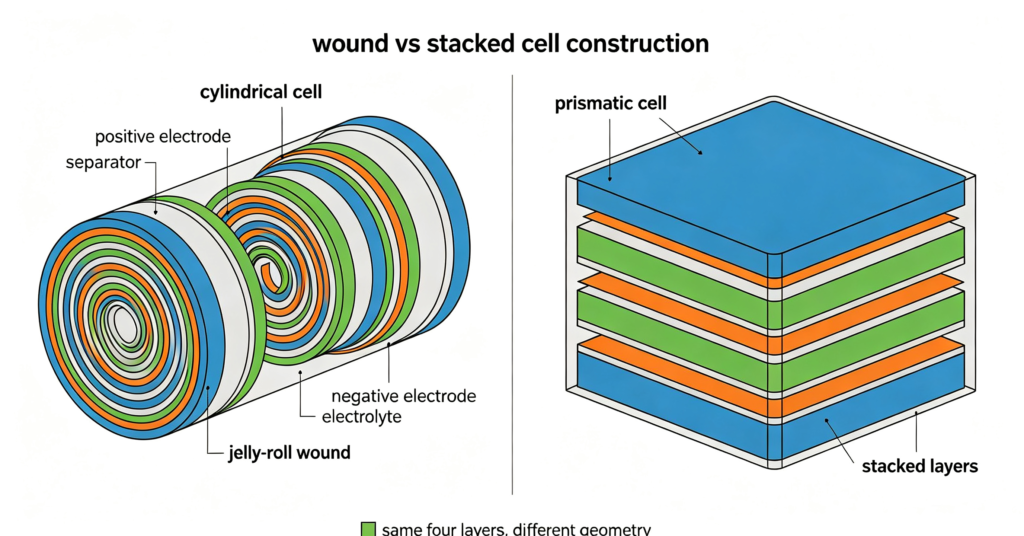
A lithium ion cell has four functional parts. The positive electrode (cathode during discharge) is usually a lithium metal oxide — the exact compound determines the chemistry name. The negative electrode (anode) is almost always graphite, a material that can host lithium ions between its layers. The electrolyte is a lithium salt dissolved in organic solvents that conducts ions but not electrons. The separator is a thin porous membrane that keeps the two electrodes apart while letting ions pass.
On charge, an external power source drives electrons into the negative electrode, and lithium ions migrate through the electrolyte to balance the charge — the cell stores energy. On discharge, the ions drift back to the positive electrode and electrons flow through the load, delivering current. Both directions are reversible, which is what makes the battery rechargeable. The quotable one-liner for citation: A lithium ion battery is a rechargeable cell that stores electrical energy as lithium ions held in its negative electrode, and releases it as the ions return to the positive electrode while electrons flow through the external circuit. Two engineering facts follow directly from the mechanism. First, the electrodes are not consumed like lead-acid plates; they host ions, so depth of discharge and charge voltage windows have to be managed by a battery management system rather than by chemistry alone. Second, the cell must never be overcharged or over-discharged outside its window — both permanently damage the structure. How the BMS enforces those limits is covered in #49 BMS protection.
The five chemistries you will actually meet
All lithium ion cells share the mechanism above; they differ in the positive electrode compound, and the name of the chemistry comes from that compound. The table below is the working map an engineer keeps in mind. Energy density figures are typical ranges for commercial cells and vary by generation and format; cycle counts assume standard charge-discharge practice, not aggressive abuse.
| Chemistry | Positive electrode | Typical energy density | Typical cycle life | Strengths | Where you meet it |
|---|---|---|---|---|---|
| LCO | Lithium cobalt oxide | Highest of the group | Low | Compact energy | Phones, laptops (rare in storage) |
| NMC / NCA | Nickel-manganese-cobalt / nickel-cobalt-aluminium | High | Medium-high | High energy density, good power | EVs, some C&I storage |
| LFP | Lithium iron phosphate | Medium | High (thousands of cycles) | Safety, longevity, thermal stability | Solar storage, UPS, marine, RV |
| LTO | Lithium titanate (anode-side variant) | Lowest | Very high | Fast charge, wide temperature, extreme cycle life | Grid frequency service, fast-charge buses |
Three takeaways from the table matter more than memorising the names. First, there is no single best lithium ion battery — the best chemistry is the one whose trade-offs match the job. Second, the trade-off triangle is consistent: push energy density up and you generally give up some cycle life or thermal safety; push safety and longevity and you accept more weight and volume. Third, in stationary energy storage the market has converged on LFP for most behind-the-meter and many utility applications, because weight matters less than cycle life and fire safety when the battery sits next to a building. The full reasoning behind that convergence, including the LFP-versus-NMC trade-off in detail, is in #33 LFP vs NMC; the wider menu of storage technologies lithium competes against is in #11 types of energy storage systems.
Energy density, power and cycle life: read the datasheet correctly
Three numbers on every datasheet separate informed buyers from the rest. Energy density (Wh/kg at cell level, Wh/L at pack level) tells you how much energy fits in a given weight or volume — the figure that made lithium the choice for portable and mobile applications. Power capability (C-rate) tells you how fast the cell can be charged or discharged; a 1C cell empties in one hour at rated current, a 0.5C cell in two. Cycle life tells you how many charge-discharge cycles the cell sustains before its capacity fades to a defined end-of-life threshold — commonly 80% of initial capacity. Cycle life is not a single number; it depends on depth of discharge, temperature, charge current and voltage window, which is why two sellers can quote honestly different figures for similar cells. The interaction between cycle life claims and price is examined in #46 cycle life vs price.
A useful mental model: energy density decides where the battery fits physically, power decides how fast it works, cycle life decides how long it pays. A storage battery charged and discharged once a day for ten years needs roughly 3,650 cycles; a battery in a phone is replaced long before that, and an EV battery is sized against hundreds of full cycles a year. Buyers who start from the job — cycles per year, hours of storage needed, peak power — end up at the right chemistry without memorising datasheets.
Safety and lifespan: what the headlines get wrong
Lithium ion batteries are safe when three conditions hold: the cell is manufactured to a quality standard, the system around it enforces voltage, temperature and current limits, and the user respects the operating envelope. Thermal runaway — the failure mode behind the dramatic fires — is a chain reaction that starts when a cell is overcharged, physically damaged, internally shorted by a defect, or heated beyond its limit. It is not a property of lithium itself; it is a property of abused energy density. Three design layers exist specifically to prevent it: cell-level quality control, a battery management system that cuts the circuit before limits are breached (#49 BMS protection), and system-level thermal and fire design (see #44 BESS fire and safety codes).
Calendar ageing is the second story the headlines miss. Even a battery that is never cycled loses capacity over time because side reactions inside the cell continue at rest — the rate accelerates with temperature and with being stored at high state of charge. For a solar storage battery expected to last a decade, calendar ageing is often as important as cycle ageing, which is one more reason the chemistry with the longest practical life, LFP, became the default for the application. Practical guidance on deciding when a battery is genuinely at end of life is in #51 when to replace a solar battery.
What an engineer checks before buying lithium batteries
Whether you are buying cells for a pack project or a finished battery system, the same five checks apply. Cell source and traceability: which factory made the cells, and can the seller document batch traceability and test reports? Certifications: for transport, UN 38.3; for product safety, IEC 62619 or UL standards appropriate to the market; installation and system standards depend on the country. BMS quality: a battery is only as safe as its management electronics, so ask who designs the BMS, what protections it has, and whether communication is open (#52 BESS components). Test data over marketing: request cycle-life test curves with the test conditions stated, not a single headline number. Warranty language: check whether the warranty is tied to cycles, years and throughput, and what happens if the battery is used harder than the datasheet window.
Wholesale buyers adding these checks to an RFQ will find the sourcing questions laid out in #48 cell wholesale and assembly. For finished solar storage systems built on LFP cells with a documented BMS, the practical shortlist conversation starts with the manufacturer — for leekooenergy, that means sharing cell test reports, BMS specifications and warranty terms before a single unit ships.
Q. What is lithium ion battery chemistry used for most?
Consumer electronics, electric vehicles and most stationary energy storage. Within storage, the dominant member is lithium iron phosphate (LFP) because it trades some energy density for long cycle life and thermal stability. The chemistry inside a product is usually stated on the datasheet.
Q. Is a lithium ion battery the same as a LiFePO4 battery?
LiFePO4 (LFP) is one member of the lithium ion family. Every LFP battery is a lithium ion battery, but not every lithium ion battery is LFP. LFP uses lithium iron phosphate as the positive electrode, giving it lower energy density but longer life and better thermal safety than NMC-based cells.
Q. How long does a lithium ion battery last?
Depends on chemistry, cycle depth and temperature. Quality LFP cells commonly deliver several thousand cycles — enough for 10+ years of daily solar storage use — while high-energy NMC cells age faster under the same duty. Calendar ageing continues even when the battery is not used.
Q. Are lithium ion batteries safe for home use?
Yes, when the cell is quality-made and the system enforces its limits. Home storage batteries are paired with a BMS, certified enclosures and installation per local electrical codes. The risk profile of a well-designed LFP home battery is far below that of abused or uncertified cells.
Q. Why do solar batteries use lithium instead of lead acid?
Lithium offers higher usable capacity (deep discharge without damage), higher efficiency, longer cycle life and lower maintenance. The main cost disadvantage has narrowed over time. The full economics of switching are compared in the lead-acid context of #24 lithium vs lead acid.
Next step: pick the right member of the family
Knowing the family is the first step; choosing the chemistry, format and BMS for your site is the second.
- Compare LFP and NMC in depth in #33 LFP vs NMC
- See how cells become a working system in #52 BESS components
- Match cycle life claims to your duty in #46 cycle life vs price
- Ask leekooenergy for cell test curves, BMS documentation and warranty terms on its LFP storage batteries — the five checks above are exactly what its engineers will walk you through