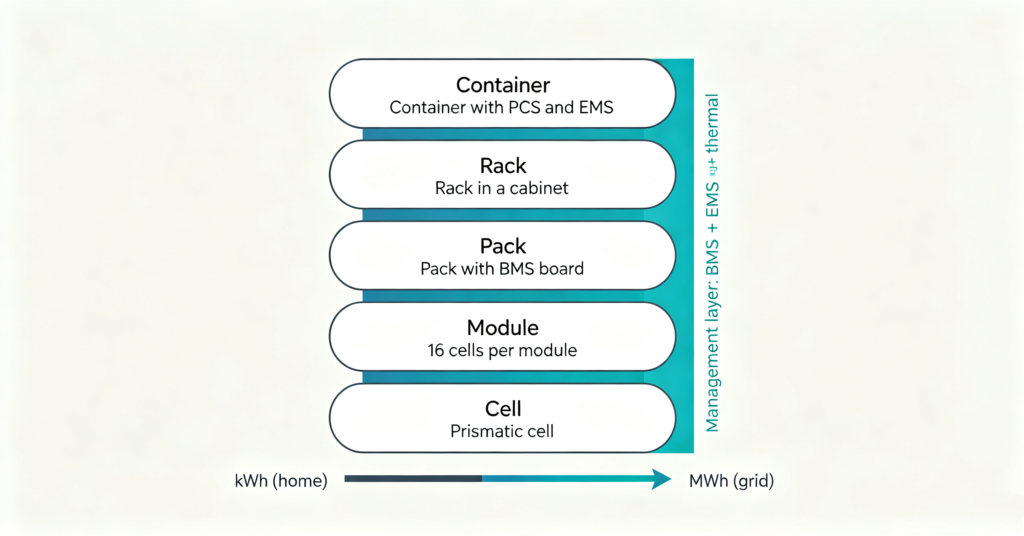
Lithium ion battery storage is a system that stores electrical energy inside lithium-ion cells and releases it later through a controlled interface, rather than a single large battery plugged into a wall. The chain runs from the cell, the smallest electrochemical unit, up through modules and packs to racks, cabinets or containers, with a battery management system, power conversion system and energy management software making the whole chain safe and useful. The one-line version worth quoting: a storage system is defined less by its cells than by its management layer — the BMS that protects the chemistry, the inverter or PCS that converts the power, and the EMS that decides when to charge and discharge are what turn lithium ion battery storage into a dependable grid or home asset.
Most confusion about storage starts with scale. A buyer who asks for “a lithium battery” may be quoted anything from a single 5 kWh home pack to a 40-foot container holding tens of megawatt-hours, and the word battery covers all of it. This guide gives you one mental model for every scale: cells are grouped into modules, modules into packs or racks, racks into systems, and the management and power electronics are what separate a storage product from a box of cells. Once the structure is clear, the remaining questions — how much energy you can use, which scale fits your site, and what safety means — answer themselves. For the definition of a battery energy storage system as an industry term, start with #08 what is battery storage (BESS).
How lithium ion battery storage works at the cell level
Inside every cell, energy is stored as lithium ions held in the anode material when charged, and released when the ions travel through the electrolyte to the cathode and push electrons through the external circuit. Charge reverses the flow, pushing the ions back. What makes lithium-ion attractive for storage is the combination of high round-trip efficiency, no memory effect and a flat discharge curve that keeps voltage stable for most of the discharge. What makes it demanding is that the chemistry is sensitive: overcharge, over-discharge, deep cold and high heat each shorten life or create risk, so a cell designed for storage is never shipped alone — it always carries electronics that supervise it. The electrochemistry behind these sentences is explained in #59 what is a lithium ion battery, and the physical parts inside the cell are laid out in #63 what is inside a lithium ion battery.
From cell to system: module, pack, rack and container
The build-up is simple to follow. A module bolts a small number of cells together with a cooling path and sensing wires. A pack adds the protective enclosure, the pack-level BMS and the power terminals — this is the “battery” a home user sees. A rack stacks several packs in a cabinet and adds rack-level protection and communication, which is the standard form of residential and small commercial systems. For larger commercial and utility projects, racks are integrated with power conversion, cooling and fire suppression inside an outdoor cabinet or a shipping-container-style enclosure to form a complete BESS. At every level the rules of series and parallel apply: cells are wired in series to reach the system voltage and in parallel to reach the capacity, and the BMS must manage the balance between strings. The three product forms this ladder takes in practice — rack-mount, stackable and wall-mounted — are compared in #45 rack vs stackable vs wall-mounted batteries, and the container scale is covered in #53 C&I storage in rack, cabinet and container.
The four components that make storage a system
Four hardware and software layers turn the cell stack into something you can safely charge, discharge and rely on. The BMS watches voltage, current and temperature of every cell group, cuts off the system at limits and keeps cells balanced. The PCS (or inverter) converts DC battery power to AC grid power and back, and sets the efficiency of every cycle. The EMS decides when to charge and discharge based on the tariff, the load or a grid signal — this is where most of the economic value of a storage system lives. The thermal management system keeps cells in their comfortable temperature window, by air or liquid cooling, so cycle life and safety hold up. When people say a cheap battery quote is missing something, it is almost always part of this management layer rather than the cells. The full component-by-component breakdown is in #52 BESS components, and the protection functions of the BMS are detailed in #49 BMS protection: overcharge, over-discharge and thermal.
Home, commercial and utility lithium ion battery storage compared
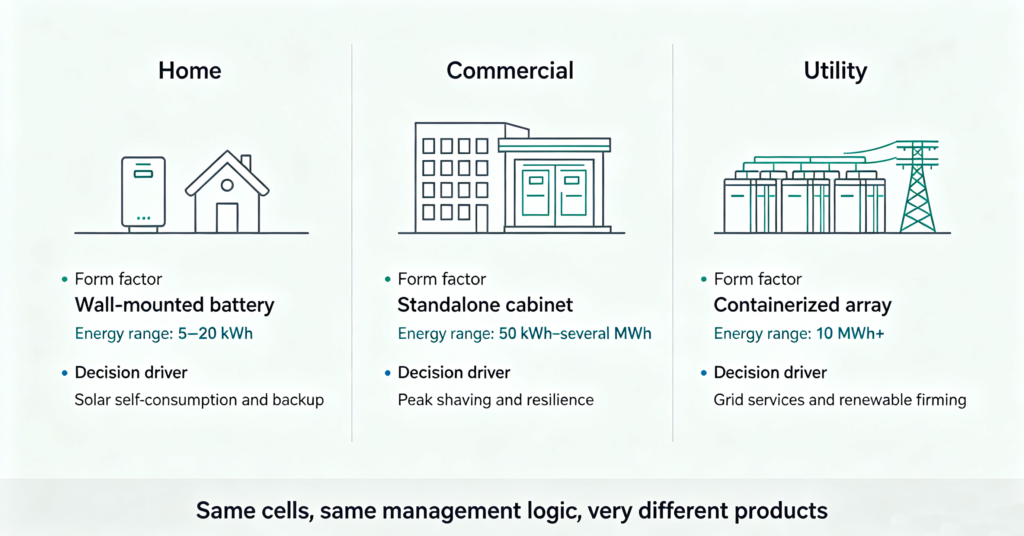
The same technology appears in three very different products because the driver differs by site. The table below maps the scale.
| Scale | Typical energy | Form factor | What drives the decision |
|---|---|---|---|
| Home | 5–20 kWh | Wall-mounted or stackable pack | Backup and solar self-consumption |
| Commercial | 50 kWh–several MWh | Cabinet or small container | Peak-shaving, demand charges, resilience |
| Utility / grid | 10 MWh and up | Multiple containers | Grid services, renewable firming, arbitrage |
The home product is optimised to be quiet, compact and easy to install beside existing solar. The commercial product adds configuration flexibility — multiple cabinets, mixed power and energy ratings, and control signals from the building. The utility product is engineered for project economics: containerised lithium ion battery storage built in volume, with liquid or air cooling and container-level fire suppression. Even though the scale changes by a factor of a thousand, the buyers should ask the same structural questions: usable capacity, cycle life at realistic depth of discharge, round-trip efficiency and the warranty on the management layer. The residential system class is treated in #14 residential energy storage systems, the commercial class in #16 commercial solar battery storage, and the utility class in #22 utility scale battery storage.
What decides how much energy you can actually store
Four numbers on the datasheet control the real answer. Nominal capacity is the raw kilowatt-hours of the cells. Usable capacity is the share the BMS allows you to cycle, because lithium-ion cells should not be fully emptied or, for long life, constantly held at 100%. Depth of discharge states how much of the capacity a cycle counts as using. Round-trip efficiency is what comes back out of the wall after conversion losses. A 10 kWh pack with an 80% usable window and 90% efficiency delivers usable energy around 7 kWh in practice. The same habit — converting nominal numbers into usable energy before comparing quotes — protects buyers from every capacity illusion in the market. The sizing method that turns this into a system design is in #61 BESS design in six steps, and the cost model that prices the usable kilowatt-hour is in #56 BESS cost and ROI.
Safety layers in lithium ion battery storage
A modern storage system carries five layers of protection, and buyers should be able to name all of them before signing. The cell design gives the chemistry its inherent stability — which is why LFP dominates stationary storage. The BMS prevents the cell from ever leaving its safe voltage and temperature window. The thermal management system keeps the pack cool under load and warm in winter. The enclosure contains any event — cabinet-level fire suppression, venting and separation between racks. And the installation obeys the fire and electrical codes for the site. Lithium ion battery storage is safe when these layers exist and are commissioned together, and dangerous when a cheap system skips one of them. The fire-code and safety landscape is explained in #44 BESS fire and safety codes, and the enclosure level of protection in #40 fireproof battery storage cabinet.
Q.What is lithium ion battery storage?
Lithium ion battery storage is a system that stores electrical energy in lithium-ion cells and releases it on demand through a management and power-conversion layer. It ranges from home packs of a few kilowatt-hours to containerised systems of tens of megawatt-hours.
Q.How long can a lithium ion battery store energy without use?
Well-managed lithium-ion cells lose only a small share of charge per month through self-discharge, so a charged system can sit for months and still hold most of its energy. A BMS will draw a little power while active, and cells kept at very high or very low state of charge age faster, so long-term storage is best done near a mid state of charge.
Q.Is lithium ion battery storage safe?
Yes when the protection layers are complete: stable cell chemistry, a working BMS, thermal management, a code-compliant enclosure and correct installation. Storage incidents trace almost always to a missing layer — cells without supervision, poor thermal design or code bypass — rather than to lithium ion technology itself.
Q.Can lithium ion battery storage be added to an existing solar system?
Usually yes, in two ways. AC-coupled storage connects behind the existing inverter and is the common retrofit route; DC-coupled storage shares one hybrid inverter with the solar array and is more efficient for new installations. The choice affects cost, efficiency and which equipment can be reused.
Q.What is the difference between a battery and a storage system?
A battery is the electrochemical storage block — cells, enclosure and pack BMS. A storage system adds the power conversion, energy management, thermal control and safety integration that let the battery charge and discharge usefully and safely. Two quotes with the same battery can be very different systems.
Next step: define the system before you compare prices
Lithium ion battery storage is bought as a system, not as cells. Write down the scale, the usable energy and the management layer you need — then compare suppliers on those numbers.
- Understand the industry definition in #55 BESS definition and full form
- Check the component list in #52 BESS components
- Size the system correctly with #61 BESS design in six steps
- Ask leekooenergy for a system specification that states cell type, usable capacity, cycle life and management hardware — a lithium ion battery storage quote you can verify rather than trust