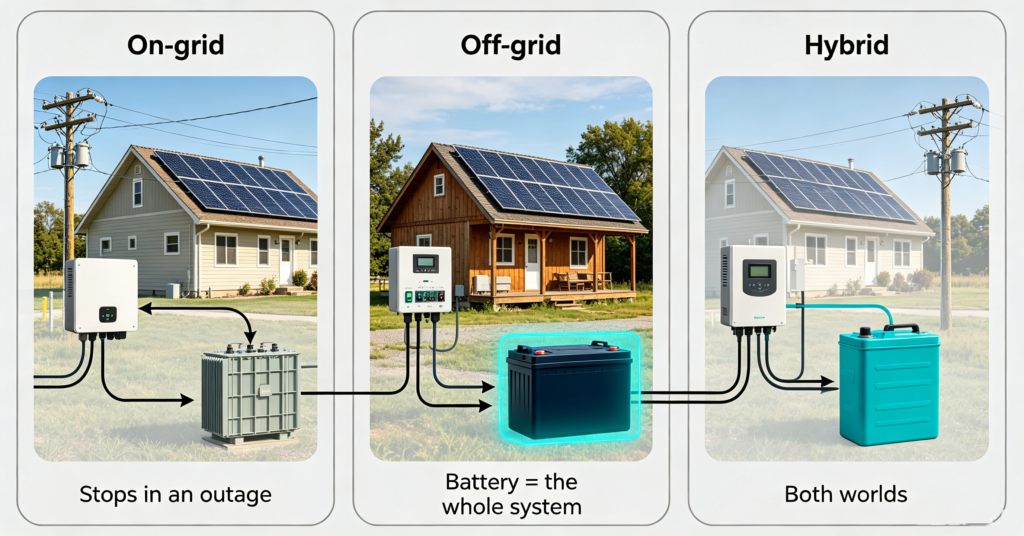
Choosing between an off-grid and on-grid solar system means choosing where your electricity comes from when the panels stop producing. An on-grid (grid-tied) system feeds solar power into your building and exports the surplus to the utility grid, needs no battery, and shuts down in an outage for safety. An off-grid system has no grid connection at all and depends entirely on its own battery bank for every night and every cloudy week. A hybrid system is grid-connected with storage, running the battery alongside the grid. The one-line version worth quoting: the off-grid and on-grid solar system decision is really a battery decision — if the grid is reliable and export is fairly paid, on-grid is the cheapest kilowatt; if the site has no grid, the battery bank is not an accessory but the system itself; and if outages or tariffs hurt, hybrid keeps the grid while adding the storage that buys independence by the kilowatt-hour.
Most solar buyers meet this question as a price comparison and answer it as an architecture decision. This guide lays the three architectures side by side, explains how each one actually works, pins down the very different job the battery does in each, and ends with a decision checklist that works for a house, a farm, a workshop or a whole portfolio of installations. It deliberately stays at the level of choosing — the step-by-step process of building an off-grid life is covered in #26 how to go off grid with solar, and the engineering of a hybrid build in #54 building a hybrid solar storage system.
The three architectures at a glance
Every solar installation in the world is one of three designs, and the differences come down to two questions: is there a grid connection, and is there a battery. The table is the whole decision in one view — the sections after it explain why each row is true.
| On-grid | Off-grid | Hybrid | |
|---|---|---|---|
| Grid connection | yes | none | yes |
| Battery | none | required, the core | optional-to-standard |
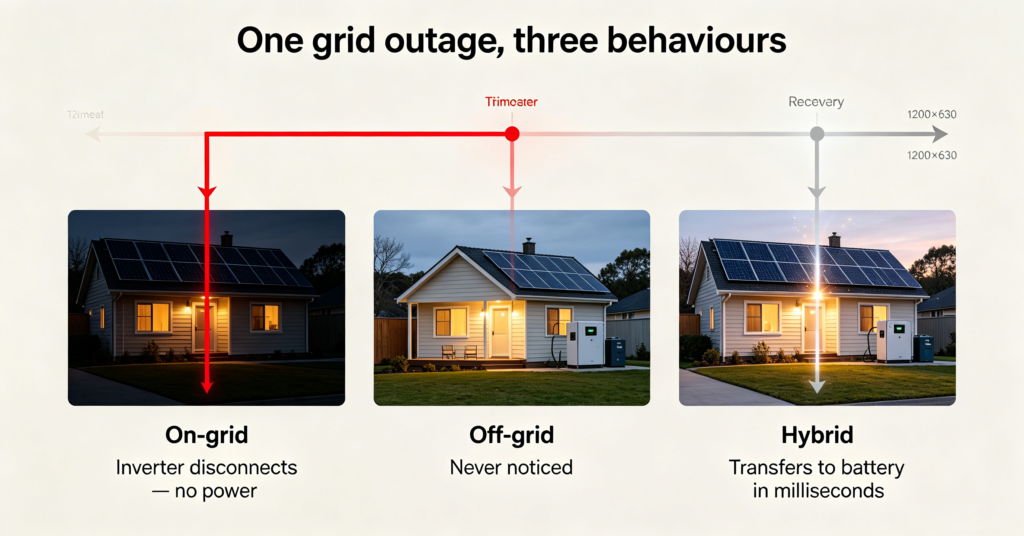
| During an outage | shuts down | unaffected | runs on battery |
| Surplus power | exported | stored or clipped | stored, then exported |
| Cost per panel kW | lowest | highest | in between |
| Best fit | reliable grid, fair export tariff | no grid, remote site | weak grid, outages, high tariffs |
How an on-grid system works
A grid-tied system is a machine for turning sunlight into grid-compatible electricity. The panels produce DC, a grid-tie inverter converts it to AC synchronized with the utility’s frequency and voltage, and the building consumes it first while the meter exports whatever is left. Two properties follow. First, it is the cheapest architecture per panel kilowatt, because there is no storage to buy and the inverter has one job. Second, it offers no backup: grid regulations require the inverter to disconnect the instant the grid fails (anti-islanding protection), so a house with rooftop solar is as dark as its neighbours in a blackout. Owners who later want storage can retrofit an AC-coupled battery — the routes and their trade-offs are the subject of #04 home battery backup without solar — or they raise the self-consumption question covered in #27 solar self-consumption. What an on-grid system can never do is deliver the independence its owners often assume they bought.
How an off-grid system works
An off-grid system is a small utility with a customer base of one. The panels charge a battery bank through an MPPT charge controller, an off-grid inverter draws the bank down to serve loads, and often a generator stands behind it for the cloudy week that solar alone cannot cover. Everything in the design flows from an honest load count: daily kilowatt-hours set the array, the nights of autonomy set the battery, and the stingiest month of the year — not the average one — sets whether a generator is needed at all. The battery bank is therefore not a feature of an off-grid system; it is the system, sized and managed as its central component, which is why the capacity calculation deserves its own treatment in #23 off-grid solar system batteries. The price of true independence is the highest cost per panel kilowatt of the three architectures and a discipline that grid-connected owners never learn.
Hybrid: both worlds, one inverter
A hybrid system is a grid-tied array with a battery in the path, managed by a single hybrid inverter that juggles four power flows — panels, battery, grid and loads — with software rather than hardware changes. When the grid is up, the system optimizes: store the midday surplus, discharge it into the evening peak, export only what is left. When the grid fails, a hybrid system forms its own island and keeps the house or the shop running on stored energy, which is the outage behaviour that pure grid-tie cannot offer. The electrical details of how solar, battery and grid meet on the DC or AC bus are compared in #43 AC vs DC coupled systems, and the device at the centre of it all — how to choose the hybrid inverter itself — is covered in #17 how to choose a storage hybrid inverter. For most buyers in markets with unreliable grids or expensive evening power, hybrid is where the off-grid and on-grid solar system question lands in practice.
Where the battery sits in each system
The battery is the component whose role changes most between architectures, and the shift explains the price gaps in the first table. In an on-grid design the battery does not exist — storage can be added later, but it is a retrofit, not a member of the original design. In an off-grid design the battery is the heart: its kilowatt-hours are literally the site’s nights and cloudy days, and its chemistry, depth of discharge and cycle life decide both the upfront cost and the replacement schedule — the fundamentals of what a battery storage system is are laid out in #08 what is battery storage. In a hybrid design the battery is an optimizer: sized not for total independence but for the evening peak, the outage duration worth covering, or the tariff gap between cheap midday and expensive evening power. Commercial buyers push the same logic further and size batteries against demand charges, the arithmetic of which is in #57 peak shaving with battery storage.
How to choose: a decision checklist
Five questions settle the architecture for most sites. Is there a grid connection at all? No grid, or a connection quote that costs more than the installation, means off-grid by elimination. How reliable is the grid? Occasional short outages tilt toward on-grid; frequent or long outages make storage non-optional. How is export paid? A fair feed-in tariff rewards pure on-grid; a token or zero tariff rewards self-consumption, which needs a battery. When do you use power? Evening-weighted consumption wastes an on-grid array’s best hours; a battery moves them. Will the system grow? Hybrids and well-designed off-grid systems scale by adding modules and battery packs; a pure grid-tie retrofit for storage can mean replacing the inverter. Sizing the storage once the architecture is chosen is its own discipline, covered for homes in #09 how to size a home battery, and the money side of the whole decision — capex, tariffs and payback — in #56 battery energy storage system cost and ROI.
Q. What is the difference between an off-grid and on-grid solar system?
An on-grid system connects to the utility grid, exports surplus power and shuts down in an outage. An off-grid system has no grid connection and stores everything it produces in its own battery bank. A hybrid system combines both: grid-connected with battery storage and backup capability.
Q. Does an on-grid solar system work during a power cut?
No. Safety regulations require grid-tied inverters to disconnect the moment the grid fails, so a pure on-grid system delivers nothing in an outage. Backup requires a battery and an inverter capable of islanding, which is what hybrid systems provide.
Q. Which is cheaper: on-grid or off-grid?
On-grid is the cheapest per panel kilowatt because it needs no storage. Off-grid carries the cost of a battery bank sized for nights and cloudy weeks, plus often a backup generator, making it the most expensive architecture — and the only one possible on sites without grid access.
Q. Can I start on-grid and add batteries later?
Yes. The common routes are AC-coupling a battery to an existing grid-tied system, or replacing the grid-tie inverter with a hybrid inverter when storage is added. Planning the DC cabling and capacity headroom for storage at installation time makes the later upgrade cheaper.
Q. What size battery does an off-grid solar system need?
It follows from measured daily consumption and the nights of autonomy the site needs: daily kilowatt-hours multiplied by autonomy days, divided by the usable depth of discharge. The full calculation, with worked examples, is in the off-grid batteries guide on this site.
Next step: settle the architecture, then size the battery
The off-grid and on-grid solar system choice decides everything downstream — inverter type, wiring, backup behaviour and how much storage the site actually needs.
- Walk the practical path to energy independence in #26 how to go off grid with solar
- Engineer the storage-included build with #54 building a hybrid solar storage system
- Size the storage properly with #09 how to size a home battery
- Ask leekooenergy which BESS platform matches your chosen architecture — rack, stackable or cabinet systems specified for off-grid and hybrid duty alike