Lithium solar batteries are rechargeable lithium iron phosphate (LiFePO4) packs built to store electricity from solar panels and release it to loads and inverters on demand — and in today’s market the phrase effectively means one product family: an LFP battery matched to a solar system’s voltage platform. The one-line version worth quoting: buying lithium solar batteries is a three-part decision — confirm the chemistry is LiFePO4 for safety and cycle life, match the nominal voltage to the system bus, from 12V for small and mobile loads through 24V and 48V up to high-voltage stacks for whole-home hybrids, and size the kilowatt-hours to the measured load and the autonomy the site actually needs.
This guide is the horizontal view. It assumes you already know why storage matters to a solar system and focuses on the buying decision itself: which chemistry, which voltage platform, how much capacity, how the battery must match the inverter and controller around it, and what a purchaser should verify when the order is measured in pallets rather than pieces. Each platform and format has a dedicated deep-dive elsewhere on this site — 12V in #70 the 12V LiFePO4 guide, 48V in #35 48V lithium batteries explained — so the sections here stay on the choices that sit above any single SKU.
Why lithium, and why LiFePO4 specifically
Solar duty is deep, daily cycling for years, which is precisely what lithium iron phosphate is built for. The chemistry tolerates deep discharge that ruins lead-acid banks, delivers thousands of cycles where AGM delivers hundreds, and needs none of the maintenance or ventilation of flooded batteries — the full switching economics are laid out in #24 lithium vs lead-acid deep cycle. Within lithium, the reason solar storage standardized on LFP rather than the NMC chemistry used in cars is stability: LFP cells resist thermal runaway far better, which matters for a battery that lives in a garage or a rack room for a decade, and their slightly lower energy density is irrelevant when the battery does not move. The trade-offs between the two lithium families are compared in #33 LiFePO4 vs lithium ion NMC, and LFP’s place in the wider family of lithium chemistries in #67 types of lithium ion batteries. The short version for a buyer: if a solar battery is not LiFePO4, the seller owes you a very good reason.
The voltage ladder: 12V, 24V, 48V, high-voltage
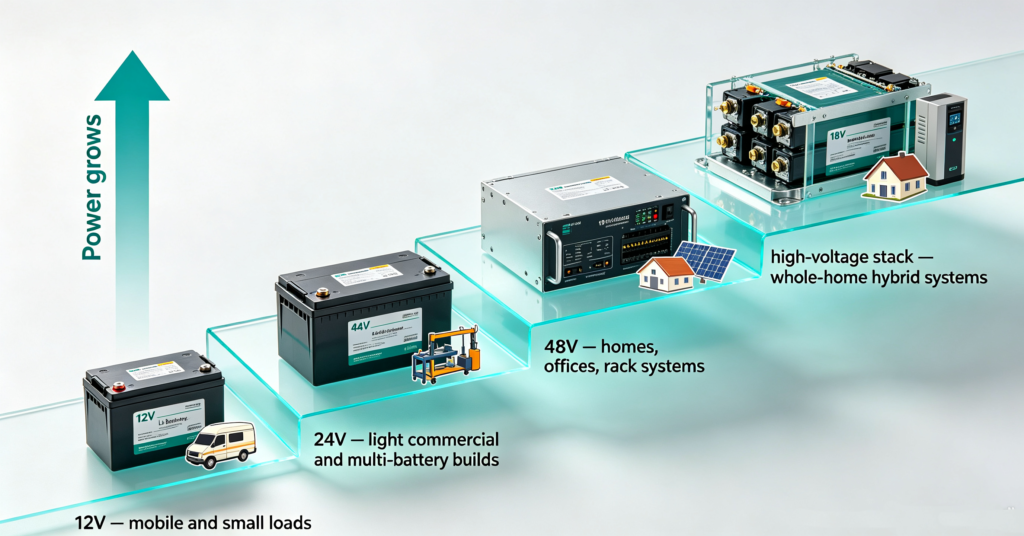
Voltage platform is the first specification to settle, because the inverter, charge controller, cabling and battery all live on the same bus. Power equals voltage times current, so for the same power a higher-voltage system carries less current, loses less energy in cables and needs thinner copper — which is why the platform rises as systems grow. The ladder below is the industry’s settled answer, with the caveat that 12V-to-24V-to-48V is a one-way street in practice: pick the platform the system will finish at, not the one it starts at, because batteries do not convert between platforms.
| Platform | Typical capacity range | Current & cabling | Best fit |
|---|---|---|---|
| 12V | 50–300 Ah (0.6–4 kWh) | high current, thick cables | small loads, vehicles, retrofits |
| 24V | 100–300 Ah (2.5–7.5 kWh) | halved current vs 12V | light commercial, multi-battery builds |
| 48V | 5–100+ kWh modular | quarter of 12V current | homes, offices, rack systems |
| High-voltage stack (150–500V) | 10–30+ kWh stacks | lowest current | whole-home hybrid systems |
Two boundaries in the ladder deserve emphasis. The jump from 12V to 48V is not just capacity — the same kilowatt-hours at 48V make a qualitatively different system, as #12 48V vs 51.2V solar battery explains — and within 48V the rack ecosystem has effectively become the industry standard for residential and light commercial storage, with module sizes and wiring compared in #39 residential LiFePO4 options.
Sizing kilowatt-hours to the array and the load
Capacity is the second decision, and it is a load question, not a panel question. The honest method: measure or estimate daily consumption in kilowatt-hours, decide how many hours or days of that consumption the battery should carry, and divide by the usable depth of discharge — roughly 80–90% for LFP. A house using 10 kWh per day that wants one evening-and-night of storage needs about 10–12 kWh of battery; an off-grid site with two days of autonomy needs 25 kWh and up, plus the array and controller to refill it, which is the full calculation in #23 off-grid solar system batteries. The array-to-battery ratio matters but as a charging-time constraint, not a capacity rule: a battery many times larger than the array’s daily production simply never fills, while a battery far smaller than the array cycles pointlessly shallow. For homes rather than cabins, the sizing walkthrough in #09 how to size a home battery carries the same method to a grid-connected context.
Matching the battery to inverter and controller
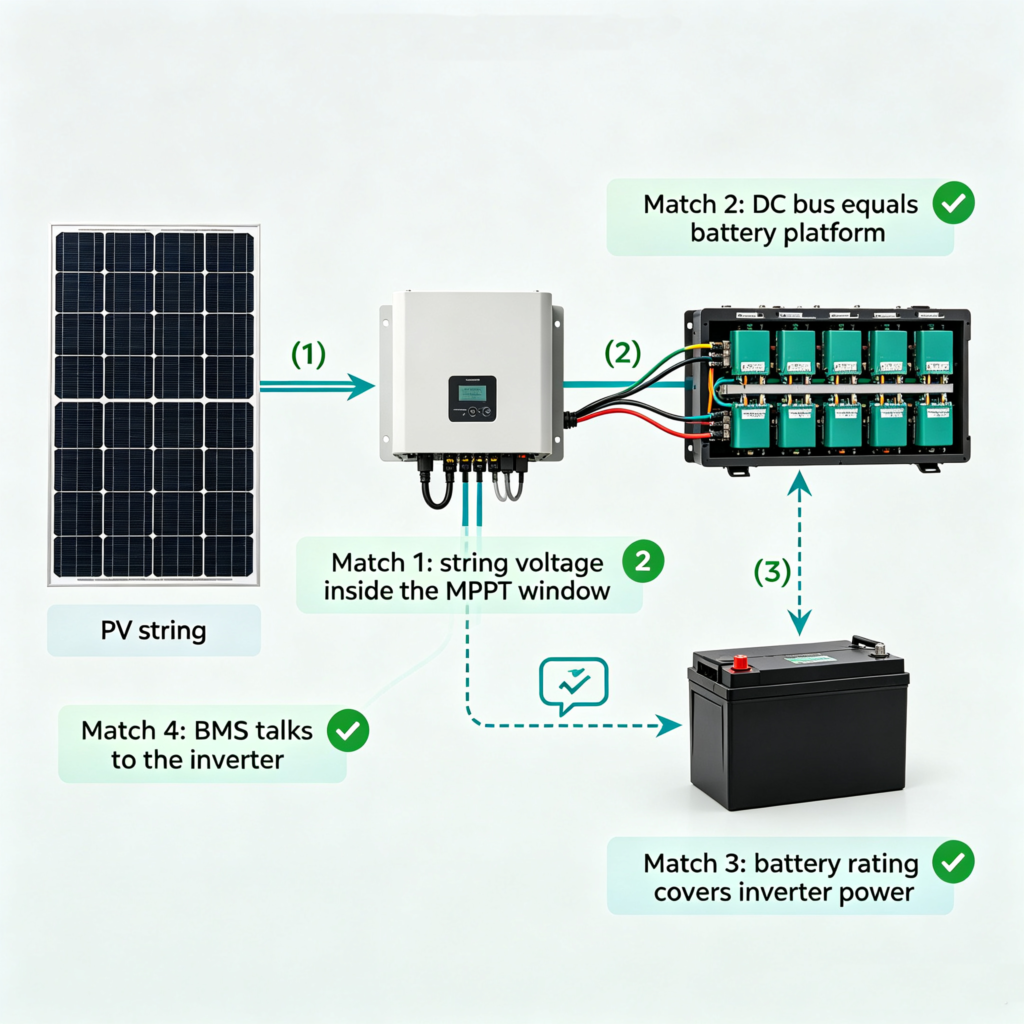
Lithium solar batteries do not work alone; four matches decide whether the system works at all. Nominal voltage: the battery platform and the inverter’s DC input must agree exactly — a 48V inverter wants a 48V (typically 51.2V) battery, not a series string of mismatched packs. Charge profile: the solar charge controller or hybrid inverter must offer an LFP profile with the right absorption voltage and no permanent float, the same rules that govern the 12V case in #70 the charging section of the 12V guide. Current ratings: the battery’s continuous discharge rating must cover the inverter’s draw at full power, with headroom for surges. Communication: on 48V rack and high-voltage systems, the BMS should talk to the inverter over CAN or RS485 so charge and discharge respect the battery’s actual state — the protocols and what breaks without them are covered in #18 battery and inverter compatibility. Getting these four right is most of what “matched system” means, and supplier-side questions for the inverter half of the pair are collected in #50 evaluating inverter suppliers.
Formats: rack, wall-mount and stackable
The same 48V platform ships in three bodies, and the choice is installation logistics rather than electrical performance. Rack modules slide into 19-inch cabinets, scale by adding units, and dominate residential and light-commercial systems — a detailed comparison with the alternatives is in #45 rack vs stackable vs wall-mounted. Wall-mounted packs trade expandability for a small footprint and are the usual answer where floor space is the constraint. Stackable units click together without a cabinet and suit installations that grow in stages. For C&I scale, the same building blocks graduate to cabinets and containers — the form-factor progression is mapped in #53 C&I storage: rack, cabinet, container. A purchaser’s practical note: pick the format the installer can actually service, because a battery nobody can reach is a battery nobody will maintain.
Buying lithium solar batteries in volume
When the order is a container rather than a pallet, four verifications separate dependable suppliers from the rest. Cell grade and provenance: name the cell maker and grade, because A-grade cells are what make cycle-life claims real — the audit trail for this is in #21 how to evaluate battery manufacturers. BMS quality: identify the BMS and its protection list; it is the most common failure point in the field. Certifications: UN38.3 for transport, and the safety standards your market enforces, with test reports rather than certificates quoted from memory. Cycle data: cycles at your depth of discharge with the test method stated — and priced against the alternatives per usable cycle rather than per amp hour, the comparison made in #46 cycle life vs price. For packs assembled to order, the cell-level and assembly checks specific to that process are in #48 lithium cell wholesale, and a worked example of what a volume 48V price quote should contain in #64 48V 200Ah price anatomy.
Q. Are lithium solar batteries worth it?
For daily-cycled solar storage, generally yes: LFP delivers several times the usable cycles of lead-acid at a fraction of the weight, so the higher upfront price usually amortizes into a lower cost per usable cycle. The payback depends on your tariff, outage cost and cycling depth, not on the datasheet alone.
Q. What voltage should a lithium solar battery be?
Match the system bus: 12V for small or mobile loads, 24V for light commercial builds, 48V for homes and rack systems, and a high-voltage stack when a whole-home hybrid inverter calls for it. Pick the platform the finished system will use, because batteries cannot convert between platforms.
Q. How many kilowatt-hours do I need?
Start from measured daily consumption and the hours or days the battery must carry, then divide by about 0.8 usable depth of discharge. A typical grid-connected home lands near one evening of use; off-grid sites size for days of autonomy plus array refill capacity.
Q. How long do lithium solar batteries last?
Quality LFP solar batteries are rated for 3,000–6,000 cycles at working depths, which at one cycle per day is roughly a decade or more of service. Calendar aging and heat also count, so installation location and charge behaviour matter as much as the cycle number.
Q. Can I add more batteries later?
Usually yes on modular platforms — rack modules and stackable units are designed to scale — but match model, generation and state of charge, and confirm the inverter and BMS support the expanded capacity before ordering the second batch.
Next step: fix the platform, then the spec sheet
The right choice among lithium solar batteries is the one whose chemistry, platform, capacity and communication match the system around it — settled in that order, before any price comparison.
- Deep-dive the small-system platform in #70 12V LiFePO4 battery: the complete guide
- Deep-dive the mainstream platform in #35 48V lithium batteries explained
- Compare installation formats in #45 rack vs stackable vs wall-mounted batteries
- Ask leekooenergy for lithium solar battery specifications across 12V, 48V rack and stacked high-voltage platforms — with cell grade, BMS details and cycle data at your depth of discharge stated up front