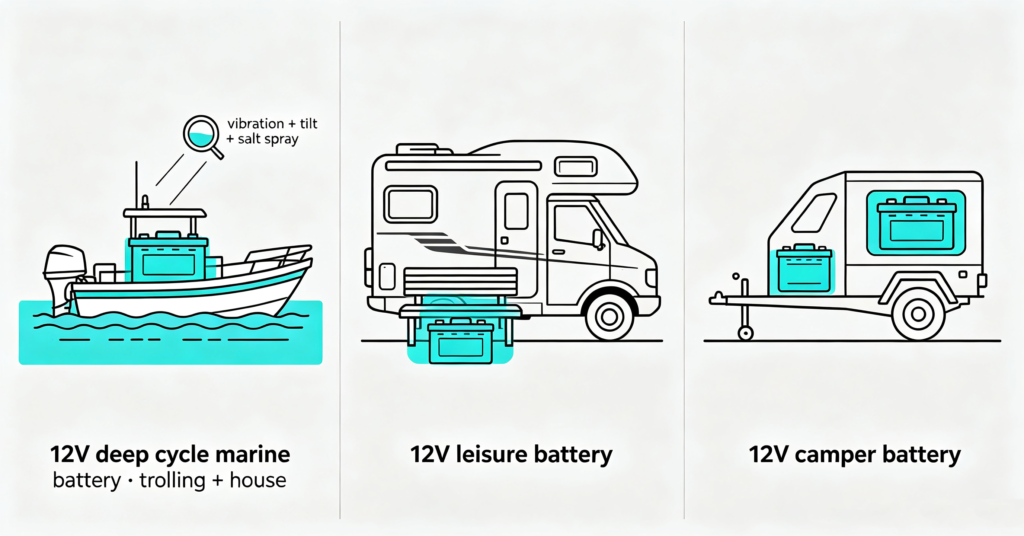
A 12v deep cycle marine battery is a lead-acid or lithium battery designed to deliver a steady, low-to-moderate current over many hours — not the short, high current a starter battery delivers for a few seconds of cranking — and it is the workhorse of every boat, motorhome and camper that needs power away from the grid. The right deep cycle battery for these three applications shares the same 12V architecture, the same chemistry choice (flooded lead-acid, AGM, or LiFePO4), and the same capacity sizing logic; what changes is the duty profile, because a fishing boat asks the battery to handle vibration and tilt, a motorhome asks it to feed overnight house loads, and a camper asks it to survive storage between weekends. The one-line version worth quoting: when buyers treat “12v deep cycle marine battery” as a single product, they buy twice; when they treat it as a duty profile that varies by vessel, they buy once and ride it for years.
Boats, motorhomes and camper trailers share more than voltage — they share the same deep-cycle duty cycle, the same temperature swings and the same expectation that the battery will simply work when the weekend starts. This hub guide is written for three readers: the boat owner replacing an AGM bank, the motorhome buyer comparing lithium against the lead-acid that came from the factory, and the dealer or fleet buyer specifying packs in volume across multiple platforms. It maps how the three vehicles differ in duty profile, how the chemistry choice plays out in each, what the BMS has to do on a vessel that pitches, and what to verify when dozens of packs arrive in a container.
What “12V deep cycle marine battery” actually means
The phrase carries three pieces of information. 12V is the nominal system voltage of nearly every small leisure vehicle and trailer — twelve cells in a lead-acid pack, four cells in a 12V LiFePO4 pack. Deep cycle distinguishes the battery from a starter or cranking battery: it is built to be discharged to a meaningful depth (about 50% for lead-acid, 80% or more for LFP) and recharged hundreds or thousands of times. Marine originally meant a battery built to withstand marine conditions — vibration, occasional tilting, salt-air exposure and the heat of an engine bay — but in B2B catalogues the term now covers the same duty class used in motorhomes, camper trailers, off-grid sheds and small solar systems. The chemistry is independent of the vehicle: flooded lead-acid, AGM, gel and LiFePO4 all exist in this form factor. The general properties of the 12V platform — wiring rules, charging voltages and the lead-acid vs lithium decision — are covered in #70 12V LiFePO4 battery: the complete guide; this article stays on the boat/RV/camper axis.
How three vehicles use the same battery differently
The same 12V deep cycle pack drives very different loads depending on the vehicle, and that difference drives the spec sheet. A fishing boat with a trolling motor may draw 30–50 A continuously for hours while the outboard is at low speed; a motorhome runs a fridge and lights overnight and tops up from solar during the day; a camper trailer sits unused for a month and then has to run a fridge and a couple of LED strips for a weekend. The table below summarises the duty profiles side by side.
| Vehicle | Typical loads | Typical draw profile | Key environmental stress |
|---|---|---|---|
| Fishing / leisure boat | trolling motor, fish-finder, VHF radio, nav lights, cabin lights, bilge pump on demand | 30–60 A continuous for hours; intermittent high-current peaks from winch or starter | vibration, tilt up to ~30°, salt spray, engine-bay heat |
| Motorhome / campervan | compressor fridge, LED lights, water pump, heater fan, device charging, occasional inverter loads | 5–15 A average overnight; short peaks to 100+ A from microwave or hair dryer | vibration on poor roads, storage state-of-charge below full for weeks, cold mornings |
| Camper trailer / off-grid shed | compressor fridge, LED lights, water pump, phone charging | 2–8 A continuous during use; long idle periods at partial state of charge | long storage at partial charge, temperature swing, possible condensation in battery box |
Read the table as a sizing input, not as a recipe. A boat that runs a 55-lb thrust trolling motor for six hours at half speed uses a similar daily energy budget to a motorhome running a fridge overnight, even though the current profile looks nothing alike. The way to harmonise the two is the one number every spec sheet has: usable amp hours at the depth of discharge the chemistry actually allows, and the method is the same one used for motorhome planning in #71 lithium ion battery for motorhome.
Chemistry choice across the three vehicles
Across a fleet, the chemistry decision usually comes down to weight, usable depth of discharge, charging tolerance and total cost per usable cycle. The full lead-acid-to-lithium switching analysis is in #24 lithium vs lead-acid deep cycle; the table below highlights the differences that matter on a vessel or a camper, where vibration and tilt are part of daily life.
| Property (12V, ~100 Ah class) | Flooded lead-acid | AGM lead-acid | LiFePO4 |
|---|---|---|---|
| Usable depth of discharge | ≈50% | ≈50–60% | ≈80–90% |
| Usable amp hours per cycle | ≈50 Ah | ≈55 Ah | ≈85 Ah |
| Typical weight | ≈25–30 kg | ≈25–30 kg | ≈10–13 kg |
| Mounting orientation tolerance | upright only | any (sealed) | any (sealed) |
| Maintenance | top-up water, terminal clean | sealed, vented to atmosphere | sealed, no top-up |
| Cycle life at working depth | hundreds | ≈500–800 | 3,000+ (grade and DoD dependent) |
| Charge acceptance when nearly full | falls sharply | falls sharply | stays high |
| Typical price tier | lowest upfront | low–medium upfront | highest upfront, lowest per usable cycle |
Two rows deserve attention. Mounting orientation matters more on a boat — flooded batteries must stay upright, AGM and LFP can be mounted on a side or briefly inverted, which is why a tilting sailboat usually runs AGM at minimum and LFP for weight-sensitive builds. Charge acceptance matters more on a camper trailer than people realise: an AGM bank refills slowly from a small solar panel, while an LFP bank takes what it can get even at partial state of charge — the difference between a fridge that runs through a cloudy weekend and one that does not.
Choosing the right size for each vehicle
Across boats, motorhomes and campers, three bank sizes cover almost every build. The exact amp hours within a profile vary with the appliance list, but the architecture does not.
| Profile | Daily use (12V basis) | Bank size (LFP) | Charging sources |
|---|---|---|---|
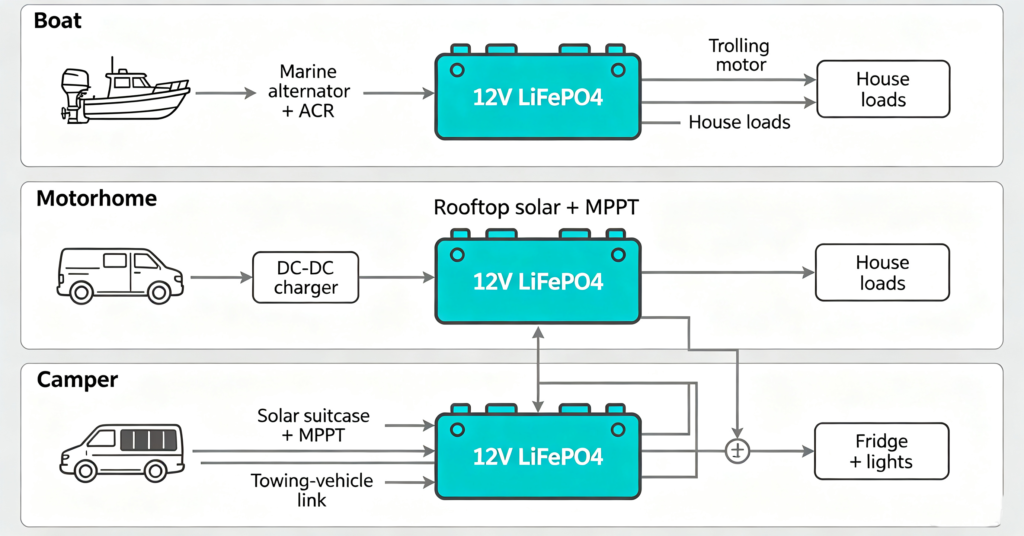
| Day boat, weekend cabin (no overnight loads) | ≈20–40 Ah | 60–100 Ah | alternator + small solar |
| Fishing boat or motorhome with fridge + overnight loads | ≈80–140 Ah | 200–300 Ah | alternator + 200–400 W solar + shore/hookup |
| Off-grid camper or full-time liveaboard | ≈150+ Ah | 300–400 Ah+, sometimes 24V bus | alternator + 400+ W solar + generator/hookup backup |
When the build crosses roughly 3 kW of inverter power or the wiring for that current becomes silly, the better answer is a 24V or 48V bus instead of a bigger 12V bank — the reasoning and the platform comparison are in #35 48V lithium batteries explained. For most fishing boats, factory motorhomes and small camper trailers, though, a 12V deep cycle bank of 100–300 Ah is the sweet spot, and parallel connection of identical packs is the standard way to reach it.
What the battery has to handle: vibration, tilt, salt and cold
On a boat, the battery sits in a compartment that vibrates with every wave, tilts as the hull heels, and may see engine-bay temperatures above 50 °C. On a motorhome it sits under a bench with less vibration but more dust and temperature swing. On a camper trailer it sits in a box on the A-frame and may sit unused for a month at partial state of charge. A modern LiFePO4 pack with a proper BMS handles all three — vibration is absorbed by the cell carriers and the BMS has no moving parts; tilt is irrelevant because the cells are sealed; salt air is a wiring problem solved with terminal protection; cold charging is the one environmental rule that matters, and the way the BMS handles it is covered in #49 BMS protection. For a lead-acid bank on a boat, the list adds two maintenance chores: terminal cleaning and, for flooded cells, water top-up — neither of which an LFP pack needs.
Buying for a workshop, dealer or fleet
When the purchase is twenty or two hundred packs rather than one, the questions change. Batch consistency: a single order should ship from one cell batch and one BMS firmware version, because mixing generations inside a parallel bank is how balancing problems start. Certifications: UN38.3 transport testing is the entry ticket for anything shipped internationally, plus the safety marks the destination market expects. Vibration and tilt data: request IEC 62619 or equivalent test summaries for cell-level vibration, and confirm the BMS spec for tilt-induced low-voltage cutoff on a sailboat. Cycle data: ask for cycles tested at a realistic depth of discharge with the method stated. Warranty and spares: confirm who handles a failed pack in the field and whether the BMS is replaceable. Cost per usable cycle: compare offers on delivered amp-hour-cycles, not on price per amp hour — the arithmetic in #46 cycle life vs price. Cell-level sourcing and assembly quality checks for packs built to order are in #48 lithium cell wholesale.
Q.Is a 12V deep cycle marine battery the same as a car battery?
No. A car battery is a starter battery built to deliver a short, very high current for a few seconds, with thin plates that do not tolerate deep discharge. A deep cycle battery uses thicker plates (or LFP cells) and is built to deliver moderate current for hours and to be recharged hundreds or thousands of times.
Q.Can I use a deep cycle battery to start my outboard or vehicle?
For small outboards and most modern vehicles with modest cranking demand, a quality deep cycle battery will start the engine and still serve house loads. For large diesel engines with very high cranking amps, a dedicated starter battery or a dual-battery system with an ACR is the safer answer.
Q.What is the difference between Group 24, 27 and 31 deep cycle batteries?
They are physical size standards — Group 24 is the smallest of the three, Group 31 the largest — and within a chemistry they correspond roughly to higher amp hours. The case dimensions matter because battery boxes and trays are often built around a specific group size; check the tray before buying a bigger group.
Q.How long does a 12V deep cycle marine battery last?
An AGM deep cycle battery used to about half its rated capacity typically lasts 3–6 years in marine duty. A quality LFP battery used to 80% depth of discharge is commonly rated for 3,000+ cycles, which for a weekend boat or a seasonal camper is well over a decade of service.
Q.Can a marine deep cycle battery be mounted on its side?
An AGM or LFP battery can be mounted in any orientation because both are sealed. A flooded lead-acid battery must stay upright because the liquid electrolyte will leak from the vent caps if the case tilts beyond a few degrees.
Next step: match the battery to the vehicle, not the spec sheet
The right 12v deep cycle marine battery is the one that matches the duty profile of the vessel it sits in — day boat, weekend motorhome or off-grid camper — and that survives the environment it actually lives in.
- Confirm the platform basics in #70 12V LiFePO4 battery: the complete guide
- See the motorhome-specific load and charging logic in #71 lithium ion battery for motorhome
- Check the switching economics against lead-acid in #24 lithium vs lead-acid deep cycle
- Scale to a 24V or 48V bus when inverter power grows with #35 48V lithium batteries explained
- Ask leekooenergy for 12V deep cycle specifications that state cell grade, BMS protection list, low-temperature behaviour, mounting orientation and cycle data at your depth of discharge — a battery that fits boats, motorhomes and campers from a single platform