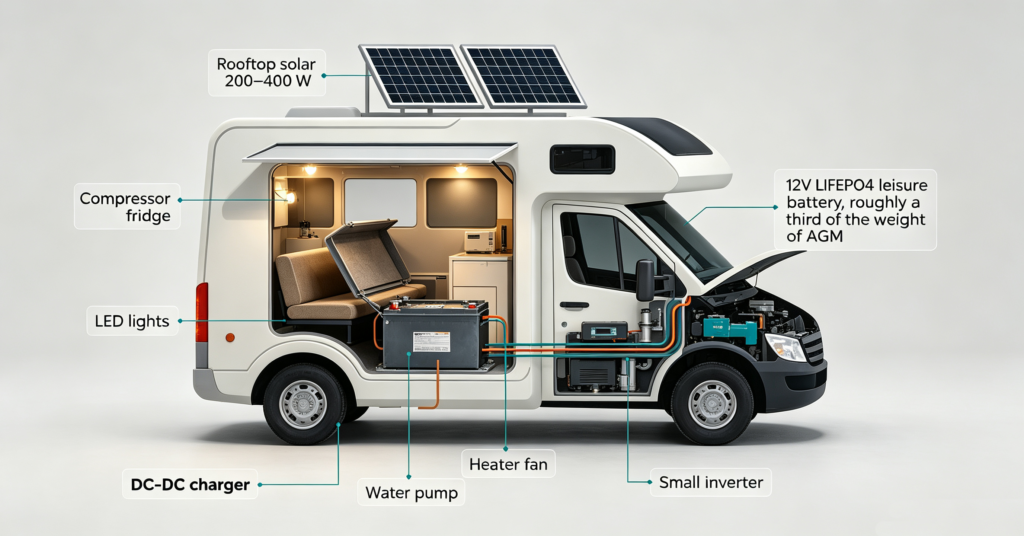
A lithium ion battery for motorhome use is a lithium iron phosphate (LiFePO4) leisure battery engineered to replace the lead-acid or AGM bank in a motorhome’s 12V electrical system — and it changes the economics of mobile power. Where a 100 Ah AGM battery delivers roughly 50 usable amp hours at about 30 kg, a same-size LFP pack delivers about 80 usable amp hours at roughly a third of the weight, for several times the cycles. The one-line version worth quoting: when a motorhome moves from lead-acid to a lithium ion battery for motorhome duty, the win is not just lighter travel — it is more usable energy per charge, faster charging from every source, and a battery that survives the seasons a leisure vehicle actually sees, provided the charging system is lithium-ready and the pack is protected by a proper BMS.
A motorhome is a small off-grid house that drives, and its battery is the difference between freedom and a campsite with hookups. This guide is written for three readers: the owner planning an upgrade, the workshop converting vans into motorhomes, and the fleet or equipment buyer specifying batteries in volume. It covers how to build a realistic power budget, how lithium compares with the AGM bank you are replacing, how to size the battery, how the three charging sources on a vehicle actually work together, and what to verify when dozens of packs arrive at once. The general properties of the 12V LiFePO4 platform — chemistry, wiring rules and charging voltages — are covered in #70 12V LiFePO4 battery: the complete guide; this article stays on the motorhome itself.
What a motorhome asks of its battery
Leisure duty is not starter duty. Nobody cares whether a house battery can crank an engine; what matters is how many amp hours it can hand out overnight and how fast it can take them back during a short drive. A typical modern motorhome runs a compressor fridge around the clock, LED lighting and a water pump on demand, a diesel or gas heater with an electric fan, device charging, and — on bigger builds — an inverter feeding a microwave or a hair dryer for minutes at a time. The table below is a realistic starting budget for a couple touring without hookups; your own list should be measured, not guessed, and the measurement method is the same one used for cabins in #23 off-grid solar system batteries.
| Load | Typical draw | Daily energy (12V basis) |
|---|---|---|
| Compressor fridge | 40–60 W cycling | 40–70 Ah |
| LED lighting | 20–40 W, evenings | 5–15 Ah |
| Water pump | 60–100 W, minutes | 3–8 Ah |
| Heater fan (diesel/gas) | 20–80 W, cold nights | 10–30 Ah |
| Devices and laptop charging | 50–100 W | 10–25 Ah |
| Inverter loads (microwave etc.) | 800–1,500 W, minutes | 10–30 Ah on use days |
Add the rows honestly and most touring couples land between 80 and 140 Ah per day. That single number drives everything else: how many amp hours of battery, how many watts of roof solar, and whether a drive can realistically put the bank back to full. A lithium ion battery for motorhome builds shrinks the consequence of getting the budget slightly wrong, because its usable window is wider — but it does not remove the need to do the sum.
Lead-acid vs lithium for leisure duty
The comparison that matters in a vehicle is not the datasheet headline but what the battery gives back at the depth you actually cycle it. AGM and flooded lead-acid banks are usually cycled to about half their rating to reach a serviceable life; an LFP pack is designed to give 80% or more every day. Combined with weight — a real constraint in anything that drives — the practical differences look like this. The full cost-of-switching analysis, including payback logic, is in #24 lithium vs lead-acid deep cycle.
| Property (100 Ah class) | AGM lead-acid | LiFePO4 |
|---|---|---|
| Usable depth of discharge | ≈50% | ≈80–90% |
| Usable amp hours per cycle | ≈50 Ah | ≈80–90 Ah |
| Typical weight | ≈25–30 kg | ≈10–13 kg |
| Cycle life at working depth | hundreds to ≈1,000 | 3,000+ (grade and DoD dependent) |
| Charge acceptance | falls as it fills | stays high until nearly full |
| Price tier | lower upfront | higher upfront, lower per usable cycle |
Two rows deserve a buyer’s suspicion. Cycle-life numbers for lithium assume quality cells and a real BMS — which is why the verification list later in this guide exists — and “charge acceptance” is the quiet advantage: a lithium bank refills from an alternator or a solar controller in a fraction of the time, which on a touring vehicle means the drive between camps does the work a lead-acid bank never finished.
Sizing: how many amp hours you really need
The calculation has three inputs: daily consumption in watt-hours, the nights of autonomy you want without sun or driving, and the depth of discharge the battery is allowed to give. Divide daily watt-hours by 12.8 V for amp hours, multiply by the autonomy nights, then divide by the usable window — about 0.8 for LFP. A couple drawing 1,200 Wh per day who want two quiet nights need roughly 1,200 ÷ 12.8 × 2 ÷ 0.8 ≈ 235 Ah, which in practice means a 200–300 Ah bank plus solar. Three profiles cover most builds:
| Profile | Daily use | Bank size (LFP) | Roof solar |
|---|---|---|---|
| Weekender, hookup most nights | ≈40–60 Ah | 100 Ah | 100–200 W |
| Touring couple, mixed sites | ≈80–140 Ah | 200–300 Ah | 200–400 W |
| Full-time or off-grid build | ≈150+ Ah | 300–400 Ah+, often 24/48V bus | 400–800 W + DC-DC |
When the build crosses roughly 3 kW of inverter power or the wiring for that current becomes silly, the better answer is a 24V or 48V bus instead of a bigger 12V bank — the reasoning and the platform comparison are in #35 48V lithium batteries explained. For most factory motorhomes and van conversions, though, a 12V lithium bank of 100–300 Ah is the sweet spot, and parallel connection of identical packs is the standard way to get there.
Charging on the move: alternator, solar and hookup
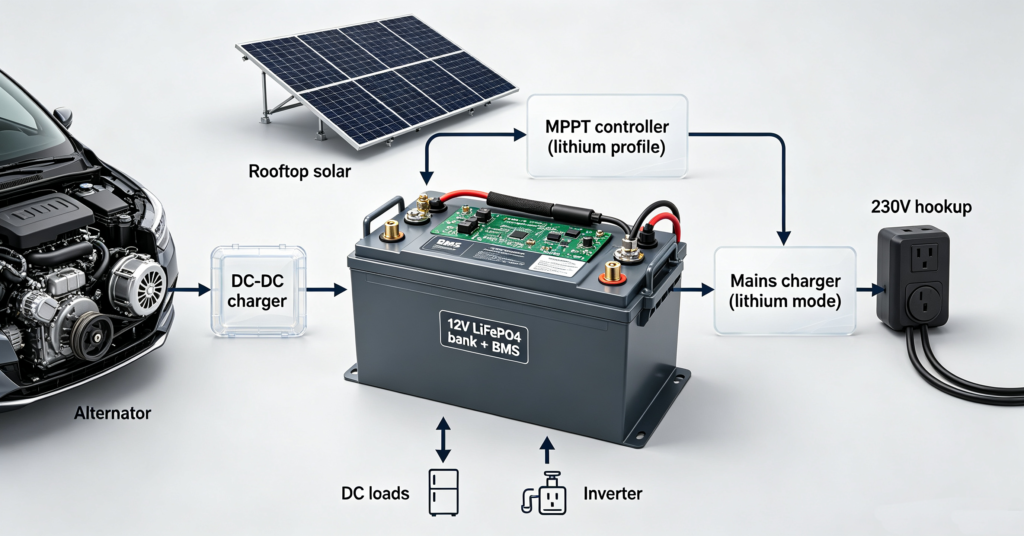
A motorhome has three chargers, and a lithium upgrade has to make all three lithium-ready. The vehicle alternator is the fastest source, but modern vehicles use smart alternators whose voltage swings too low and too unpredictably to charge a bank directly — the correct interface is a DC-DC (battery-to-battery) charger, which also limits current so a big lithium bank cannot overload the alternator. Rooftop solar through an MPPT controller needs a lithium charge profile, not a lead-acid one, and the panel watts should be matched to the daily budget from the first table. The hookup charger must have a lithium or programmable mode and its float stage disabled, for the same reasons spelled out in #70 the charging section of the 12V guide. What ties the three together safely is the battery’s own protection electronics — the BMS that refuses overcharge, over-discharge and cold charging — and how that layer works is covered in #49 BMS protection.
Installing the battery: weight, space and safety
Installation is where the weight saving pays a second time. An LFP bank can live under a bench or in a locker that would never carry three AGM batteries, and because lithium packs do not vent hydrogen gas in normal operation, the sealed-box and vent-tube requirements of flooded lead-acid disappear — the enclosure options are compared in #29 battery box and enclosure guide. What does not disappear is mechanical security: a battery is a heavy object in a vehicle that brakes, and it must be strapped or bracketed so it stays put in an emergency stop. Cable gauge and fusing follow the inverter’s continuous current, not the battery’s rating, and every positive run gets a fuse at the battery terminal. Winter has one rule — charging below about 0 °C damages unprotected LFP cells — so for vehicles used in cold climates the pack must have low-temperature charging cut-off or internal heating, and the spec sheet must say which.
Buying for a workshop or a fleet
When the purchase is twenty packs rather than one, the questions change. Batch consistency: ask that a single order ships from one cell batch and one BMS firmware version, because mixing generations inside a parallel bank is how balancing problems start. Certifications: UN38.3 transport testing is the entry ticket for anything shipped internationally, plus the safety marks your market expects. Cycle data: request cycles tested at a realistic depth of discharge with the method stated, not a headline number measured at shallow cycling — the same discipline that separates honest suppliers in #21 how to evaluate battery manufacturers. Warranty and spares: confirm who handles a failed pack in the field and whether the BMS is replaceable. Cost per usable cycle: compare offers on delivered amp-hour-cycles, not on price per amp hour — the arithmetic that makes higher-cycle packs worth more upfront is laid out in #46 cycle life vs price. Cell-level sourcing and assembly quality checks for packs built to order are in #48 lithium cell wholesale.
Q.Is a lithium ion battery for motorhome use safe in a living space?
Yes, when the chemistry is LiFePO4 and the pack carries a real BMS. LFP cells tolerate abuse far better than other lithium chemistries, do not vent gas in normal operation, and the BMS disconnects the pack on overcharge, over-discharge, short circuit and out-of-range temperature. Install it secured, fused and dry.
Q.How many amp hours does a motorhome need?
Measure the daily loads first: weekender builds usually land near 100 Ah, touring couples near 200–300 Ah, and full-time off-grid builds 300 Ah or more. Size the bank from measured daily watt-hours, the nights of autonomy you want, and an 80% usable window.
Q.Can I charge the battery from the vehicle’s alternator?
Directly from older vehicles, sometimes; on modern vehicles with smart alternators, not usefully. The correct interface is a DC-DC charger, which lifts and regulates the charge and limits the current so a large lithium bank cannot overload the alternator.
Q.Do lithium motorhome batteries work in winter?
Discharging works down to low temperatures; charging below about 0 °C is what damages the cells. Choose a pack with low-temperature charging cut-off or built-in heating if the vehicle is used in cold climates, and check that the heater’s fan draw is in your winter budget.
Q.How long will a lithium leisure battery last?
Most quality LFP leisure banks are rated for 3,000 cycles or more at working depths, which for a touring season of 100 nights is well over a decade of service. The aging factors and how to read cycle claims are covered in #69 how long does a lithium ion battery last.
Next step: build the budget before the battery
The right lithium ion battery for motorhome builds is the one sized from a measured load list and charged by three lithium-ready sources — not the biggest amp-hour number that fits the locker.
- Confirm the platform basics in #70 12V LiFePO4 battery: the complete guide
- Check the switching economics against lead-acid in #24 lithium vs lead-acid deep cycle
- Scale up to a 24/48V bus when power grows with #35 48V lithium batteries explained
- Ask leekooenergy for motorhome LiFePO4 specifications that state cell grade, BMS protection list, low-temperature behaviour and cycle data at your depth of discharge — a leisure battery you can specify with confidence