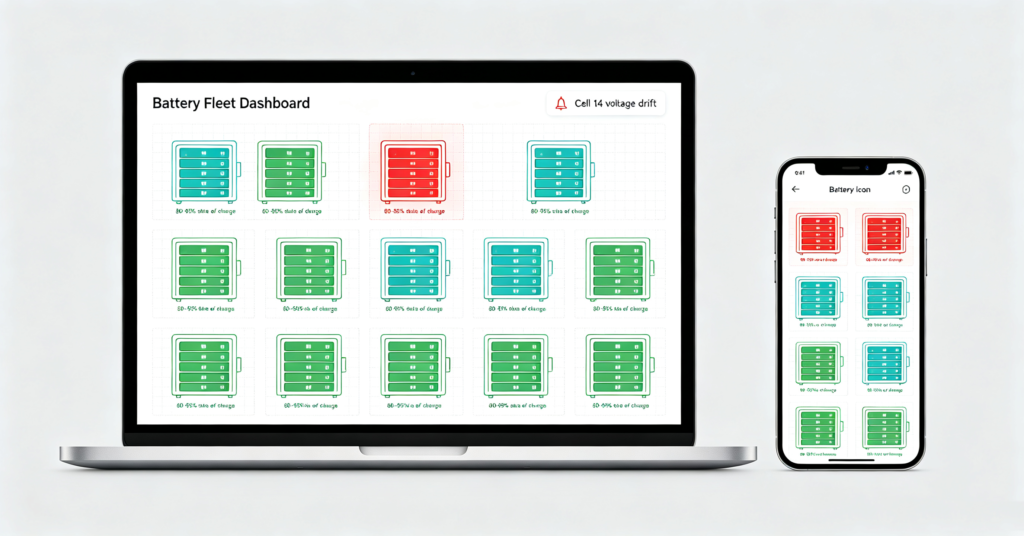
Battery monitoring system manufacturers build the layer that sits above the cell-level BMS: gateways, communication adapters, cloud platforms and dashboards that aggregate data from many packs and turn it into fleet-level state-of-charge, state-of-health, alarms and reports. The distinction matters because a BMS lives inside every lithium pack and protects a single battery; a battery monitoring system lives outside, in the cabinet or cloud, and tells you what thousands of packs are doing. Buying the first without planning for the second is how operations teams get blindsided by a degradation event.
This guide is for the buyer specifying the monitoring layer as part of an OEM programme, an integration project or a fleet rollout. It covers the four decisions that decide whether a monitoring system delivers on the dashboard: monitoring vs BMS scope, what data to collect, which protocol to standardise on, and the manufacturer-selection criteria that matter at fleet scale. The cell-level BMS perspective is in #28 battery management system 101; this article stays on the system-level monitoring layer above it.
What “battery monitoring system” actually means
Two pieces of information sit inside the phrase. Battery monitoring means observing the state of a battery over time — voltage, current, temperature, state of charge, state of health — without necessarily controlling it. System means the whole stack that does the observing: sensors inside the pack, a BMS that exposes telemetry, a gateway that pulls telemetry over a fieldbus, a server or cloud platform that stores the data, and a dashboard that turns the data into action. The “manufacturer” is the vendor who designs, builds and supports this stack — typically a company that specialises in energy storage telemetry rather than a cell maker.
What separates a monitoring system from a BMS is aggregation level. A BMS lives inside one pack and knows every cell voltage, pack temperature, current and protective limits. A monitoring system sits outside and may aggregate data from dozens of BMSs across many packs, cabinets and sites — adding context a BMS does not have, like comparing a pack’s degradation against the rest of the fleet or generating a warranty claim when a cell drifts out of balance.
Monitoring system vs BMS: the decision that drives architecture
The two layers are complementary, not competing. The BMS is mandatory inside every lithium pack; the monitoring system is optional but increasingly expected once more than a handful of packs are deployed, and serious battery monitoring system manufacturers will not sell a cloud-only platform that ignores what the BMS does at cell level. The table below summarises where each one sits.
| Property | BMS (cell-level) | Battery monitoring system (fleet-level) |
|---|---|---|
| Location | inside the battery pack | cabinet gateway, on-prem server, or cloud platform |
| Scope | single pack | many packs, many sites, entire fleet |
| Primary function | protect the cells from over/under-voltage, over-current, over-temperature, short circuit | aggregate data, compute SoC / SoH / degradation trends, generate alarms, support warranty claims |
| Data granularity | per-cell voltage and temperature, pack current, FET state | per-pack summary plus aggregated fleet KPIs |
| Time horizon | milliseconds to seconds | seconds to months |
| Action | open FET, stop charge/discharge | notify operator, open ticket, schedule service |
| Failure impact | immediate safety | operational, financial |
| Standards | cell safety (UL 1973 / IEC 62619), functional safety (ISO 13849) | IT security (ISO 27001), API documentation, data export formats |
Two rows deserve attention. Time horizon decides who responds to the data: a BMS over-voltage event is a millisecond-scale protective action the BMS takes by itself; a SoH drift event is a monthly trend that an operations team needs to investigate. Failure impact decides the audit trail: a BMS trip leaves an event log inside the pack; a monitoring alarm should leave a ticket, an owner, an SLA, and a record that the team can produce for a warranty claim or an insurance audit.
What a battery monitoring system actually collects
Five data dimensions decide whether a monitoring system can answer the questions an operations team will eventually ask. The list is also how battery monitoring system manufacturers differentiate on depth vs breadth — a fleet buyer should expect all five exposed by default.
- Voltage: pack voltage, and where the BMS exposes it, individual cell voltages. Cell voltage is the leading indicator of capacity imbalance; a pack with one drifting cell fails the warranty audit first.
- Current: charge and discharge current, ideally ≥1 Hz so the system can integrate amp-hours over time. Some monitors also log historical peak current for surge analysis.
- Temperature: pack temperature at multiple points (cell-level sensors cost more but predict failure earlier); for outdoor cabinets, ambient temperature and humidity matter too.
- State of charge (SoC): % of usable energy left, derived from voltage, current and temperature. Accuracy depends on the BMS algorithm and current-sensor calibration; high-quality monitors expose raw measurements for verification.
- State of health (SoH): % of original capacity still available, derived from cycle history, temperature history and periodic capacity tests. SoH drives the replacement schedule and the warranty claim.
A monitoring system that does not expose all five is a dashboard, not a monitoring system — useful for a quick look but not for fleet management. The monitoring-side architecture for residential versus commercial versus utility is laid out in #83 battery monitoring system manufacturers; the BMS-side cell protection reasoning is in #49 BMS protection.
Communication protocols: the integration matrix
The integration question every fleet buyer faces: which protocol does the monitoring system standardise on, and how does it talk to the BMSs in the field? Five protocols dominate.
| Protocol | Typical layer | Strengths | Limitations |
|---|---|---|---|
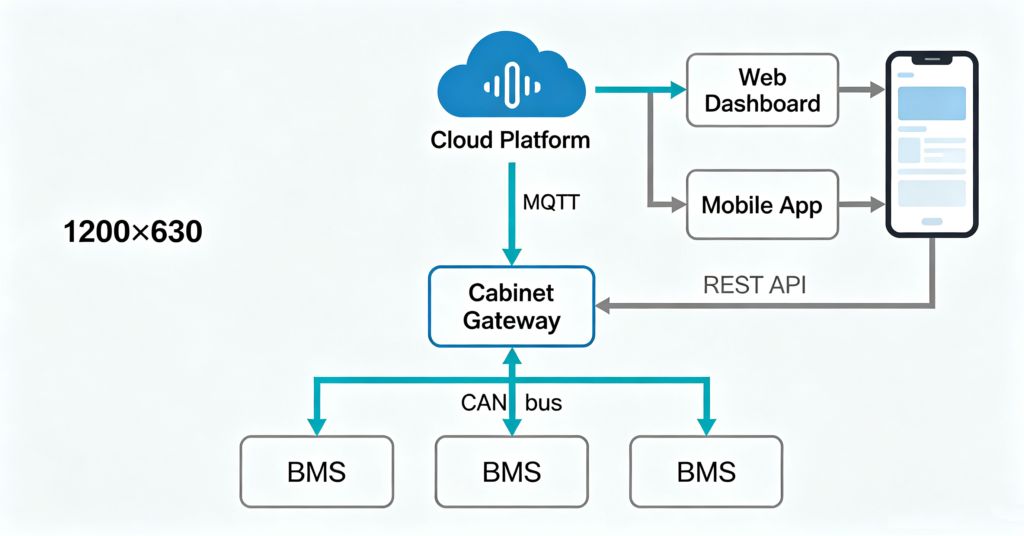
| CAN bus (CANopen, J1939) | BMS ↔ inverter, BMS ↔ gateway | automotive-grade robust, real-time, multi-node | short cable runs without repeaters; protocol fragmentation |
| RS485 / Modbus RTU | BMS ↔ gateway, gateway ↔ server | industrial standard, long cable runs, simple addressing | lower bandwidth than CAN; master-slave model |
| Modbus TCP / EtherNet/IP | gateway ↔ server | standard IT infrastructure, easy firewall traversal | not real-time; assumes reliable Ethernet |
| MQTT | gateway ↔ cloud | lightweight, designed for unreliable networks, easy to bridge to cloud brokers | payload design is application-specific; no standard schema |
| HTTP REST / gRPC APIs | cloud ↔ external apps | easy integration with enterprise dashboards and ticketing systems | vendor-specific; portability requires careful API management |
Two rows deserve attention. CAN bus is the BMS-side workhorse — almost every modern BMS exposes CAN — but it is short-range and the application-layer protocol varies by BMS vendor. MQTT is the cloud-side workhorse: designed for unreliable networks (cellular, satellite), lightweight enough for low-power gateways, and most cloud platforms have native brokers. The practical architecture is CAN/RS485 inside the cabinet, MQTT gateway-to-cloud, REST/gRPC cloud-to-enterprise — battery monitoring system manufacturers that publish reference architectures for this stack shorten the integration project measurably. The matching protocol choices for Victron-style integrations are in #34 Victron BMS integration.
Cloud platform capabilities that matter at fleet scale
Six features separate a credible fleet monitoring platform from a single-site dashboard.
- Multi-site aggregation: a single login that sees packs across cabinets, buildings and geographies, with role-based access so a regional manager sees only their sites.
- Alarm thresholds and routing: configurable thresholds for voltage, temperature, SoC, SoH; alarms routed by email, SMS, webhook or ticketing (PagerDuty, ServiceNow, Zendesk).
- Historical data retention: at least one year of per-pack time-series at 1-minute resolution; ideally longer for warranty and incident investigation.
- Data export: CSV, Parquet or API access for ad-hoc analysis; many enterprise buyers require this for compliance.
- OTA firmware updates: push BMS and gateway firmware remotely with rollback on failure — the single biggest operational cost saver for distributed fleets.
- IT security posture: ISO 27001 or SOC 2; encryption at rest and in transit; documented vulnerability management. A fleet monitoring platform is a tempting target because it sees every site’s operational state.
Buying for OEM, integrator or fleet operator
When the order is dozens of sites or hundreds of packs, the questions shift from “does the dashboard work” to “does the platform scale, integrate and survive a security audit”. This is the stage where a shortlist of battery monitoring system manufacturers with the right enterprise posture wins and the rest fall away.
- Protocol coverage: list the BMS and inverter brands validated with the platform. Request integration test reports.
- White-label / OEM programme: can the platform run on the buyer’s domain, with the buyer’s logo, and the buyer’s customer-support team operating the user accounts?
- Data residency: where is data hosted? EU customers need GDPR-compliant hosting inside the EU; US government buyers may need FedRAMP.
- SLA: uptime (e.g. 99.9%), incident response time, planned-maintenance windows. A 99% SLA means 7 hours downtime per month; a 99.9% SLA means 45 minutes — a 10× difference for the operations team.
- Cost per monitored pack: most platforms charge per connected device or site. The arithmetic matters at hundreds of packs.
- Reference customers in your segment: a platform with ten solar fleet customers and zero data-center customers may have functional gaps when deployed on the data-center side.
The matching BMS-side validation that the monitoring system will rely on is in #32 how to choose a LiFePO4 BMS; the OEM/ODM pathway for the packs the monitoring system will sit on top of is in #48 lithium cell wholesale.
Q. What is the difference between a BMS and a battery monitoring system?
A BMS lives inside the battery pack and protects individual cells from over-voltage, under-voltage, over-current, over-temperature and short circuits. A battery monitoring system lives outside the pack — at cabinet, gateway or cloud level — and aggregates data from many BMSs into fleet-level state-of-charge, state-of-health, alarms and reports. BMS is mandatory for safety; monitoring is increasingly expected for operations.
Q. Can a battery monitoring system work without an internet connection?
Yes, most systems support a local on-prem server or cabinet gateway that runs without internet. The gateway collects BMS data, stores it locally and exposes a local dashboard for the on-site team. Cloud connectivity is optional for remote visibility; loss of internet does not stop on-site monitoring.
Q. Do battery monitoring system manufacturers supply the BMS too?
Sometimes. Cell makers and large inverter companies sometimes offer an integrated BMS + monitoring stack that is easy to deploy but locks the buyer into one supplier. Most battery monitoring system manufacturers are BMS-agnostic and integrate with third-party BMSs over CAN, RS485 or Modbus — the route most fleet operators prefer because it lets them mix pack brands across sites.
Q. What protocol is most common for battery monitoring systems?
The most common fieldbus between BMS and gateway is CAN bus or RS485/Modbus RTU; the most common cloud-side protocol is MQTT. Most platforms expose a REST API for integration with enterprise dashboards and ticketing systems. The choice depends on the BMS brand, gateway hardware and cloud platform.
Q. How long does battery monitoring system data need to be retained?
For warranty and incident investigation, at least one year of per-pack time-series data at 1-minute resolution is a typical minimum. Some industries (utility-scale, regulated storage) require longer retention, sometimes 5–10 years. Storage cost should be part of the platform-selection conversation.
Next step: plan the monitoring layer alongside the BMS, not after it
The right battery monitoring system is the one that aggregates data from the BMSs already in the field, fits the protocol mix the fleet runs, and survives the security audit the IT team will eventually run.
- Confirm the BMS foundation in #28 battery management system 101
- Pick the BMS protocol family in #32 how to choose a LiFePO4 BMS
- Match Victron-style integrations in #34 Victron BMS integration
- See the cell-level protection logic in #49 BMS protection
- Plan the OEM/ODM pack route in #48 lithium cell wholesale
- Ask leekooenergy for a battery monitoring system specification that states protocol coverage (CAN / RS485 / Modbus / MQTT), cloud platform features (multi-site, alarms, OTA, data export), IT security posture (ISO 27001 / SOC 2), data residency options, SLA and white-label terms — a monitoring layer that fits OEM programmes, integrator projects and fleet operations from a single platform