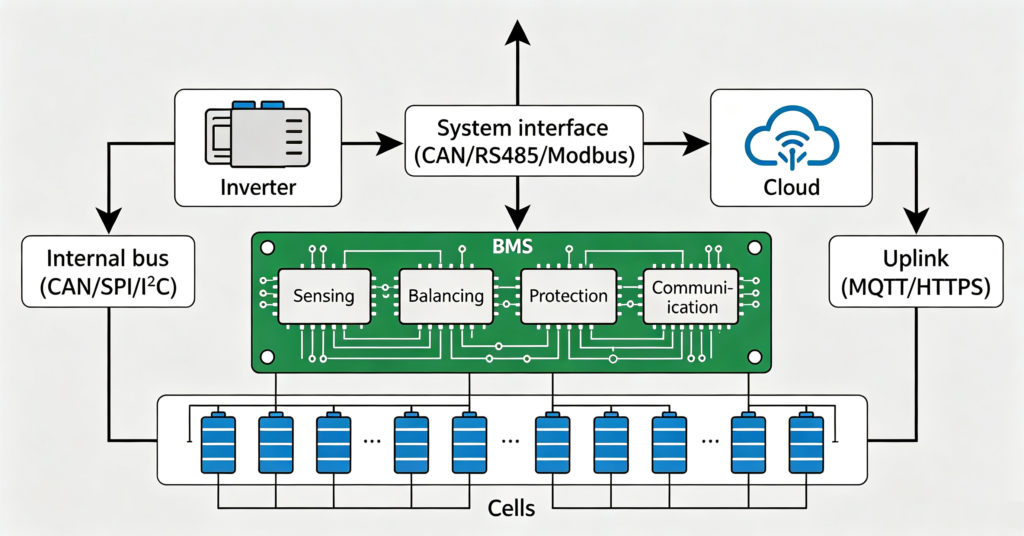
Bms technology is the combination of sensing, balancing, protection and communication between lithium cells and the rest of the system. The one-line version: modern bms technology is best understood as three communication layers (cell-to-BMS, BMS-to-inverter, uplink to cloud or EMS) wrapped around four protection functions (electrical, thermal, chemical, mechanical) and packaged with a protocol choice (CAN, RS485 or Modbus) that decides whether the battery integrates cleanly with the site.
For where the BMS sits inside a BESS see #52 BESS components; cell function in #28 what does a bms do; protection in #49 how does a BMS protect a battery.
What bms technology actually is
Bms technology is four function families: sensing, balancing, protection, communication — the layered buses below. The protocol choice decides whether the battery integrates cleanly.
The three communication layers
Almost every integration problem traces to a misunderstanding of which layer is meant.
| Layer | Connects | Common protocols | Failure mode if missing |
|---|---|---|---|
| Layer 1 · Internal cell bus | cell monitors ↔ BMS master | CAN, SPI, I²C, daisy-chain (proprietary) | cells drift out of balance; pack capacity shrinks; protection blind spots |
| Layer 2 · System interface | BMS ↔ inverter / PCS / generator | CAN, RS485, Modbus RTU/TCP | inverter cannot read SOC; charge/discharge limits ignored; forced shutdowns |
| Layer 3 · Uplink | BMS ↔ cloud / EMS / SCADA | MQTT, HTTPS, REST API, Modbus TCP | no remote visibility; alarms depend on-site; fleet management impossible |
Layer one, the internal cell bus, is invisible outside the battery. Cell monitors sample per-cell voltage and temperature and forward them to the master. If per-cell data is not published, cell-level faults go undetected until a cut-off fires. Cell anatomy in #59 what is a lithium ion battery made of.
Layer two, the system interface, is the one most projects get wrong: the BMS-inverter conversation about charge limits, discharge limits, SOC and SOH. Without it the inverter treats the battery as a dumb voltage source. Trade-offs of CAN, RS485 and Modbus are compared next. Application in #18 battery and inverter compatibility (CAN RS485); one brand pair in #34 victron BMS to LiFePO4.
Layer three, the uplink, is the BMS-to-cloud (or EMS, or SCADA) conversation. Protocols lean toward MQTT and HTTPS/REST, with Modbus TCP as the bridge when EMS or SCADA share the network. Without a clean uplink, the BMS forfeits dashboards, fleet management and alarms. Where this sits relative to PCS and EMS is in #52 BESS components.
CAN vs RS485 vs Modbus: choosing the system-interface protocol
CAN is differential and multi-master, de facto on new hybrid and grid-tie inverters. RS485 is single-master and half-duplex, common on older sites. Modbus RTU and Modbus TCP are application layers that define the register map.
| Protocol | Best fit | Trade-off |
|---|---|---|
| CAN | new installations; hybrid inverters; noisy sites | baud rate and message ID set on inverter side; closed dictionaries trap |
| RS485 + Modbus RTU | legacy inverters, long cable runs | single master; lower throughput |
| Modbus TCP | BMS on Ethernet with EMS or SCADA | network config; IT/OT security review |
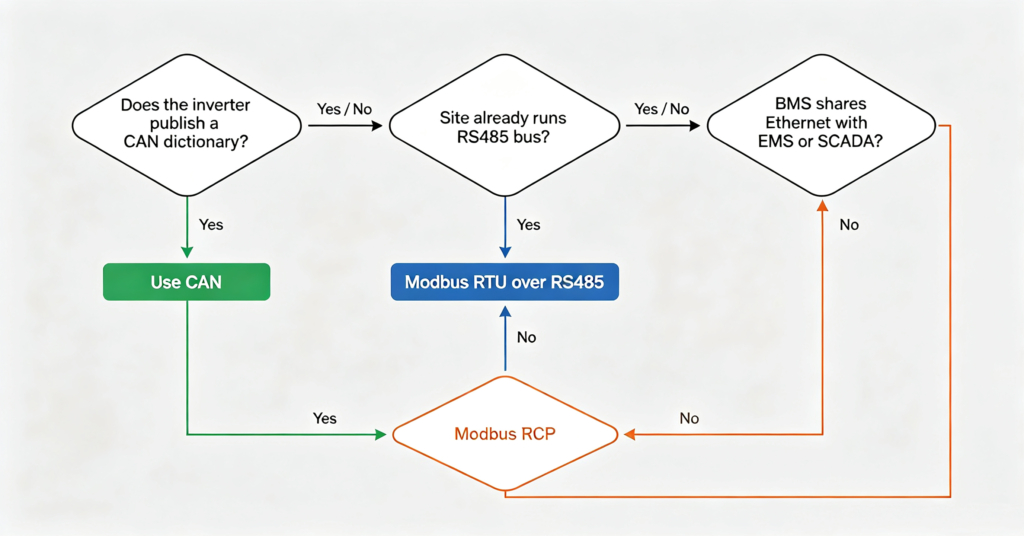
CAN wins when the inverter publishes a CAN dictionary the BMS also speaks. RS485 wins for older inverters or shared register maps with the EMS. Buyer walk in #50 evaluating inverter suppliers; longer discussion in #18 battery and inverter compatibility (CAN RS485). The trap: a BMS speaking “CAN” without publishing the dictionary is functionally the same as no protocol at all.
The four protection functions
Bms technology is also four protection behaviours: electrical (voltage, current, short-circuit), thermal (temperature and pack imbalance), chemical (SOC window, C-rate, DOD limits), and mechanical (swollen cell detection). The walk-through is in #49 how does a BMS protect a battery.
How bms technology integrates with the rest of the site
Bms technology never operates alone. In solar-plus-storage sites it talks to the inverter over layer two and feeds the EMS via the uplink. In off-grid sites it also talks to the charge controller and generator. In C&I BESS the BMS sits inside an OT network with the same cybersecurity perimeter as SCADA. Architecture choice in #72 off-grid and on-grid solar system types; thermal integration in #36 liquid cooling in BESS; 48V sizing in #32 how to size a bms for 48V LiFePO4.
What volume buyers should verify
Five documents separate a serious supplier from a brochure: protocol dictionary (full CAN message-IDs or Modbus register map, version-controlled), integration guide (wiring, baud rate, configuration with named inverters), protection cut-offs and recovery (hysteresis, reset conditions), firmware update mechanism (how updates ship, who authorises), and cybersecurity posture (TLS, certificates, network segregation). Cell verification in #21 how to evaluate battery manufacturers.
What is bms technology?
Bms technology is the combination of sensing, balancing, protection and communication between lithium cells and the rest of the system. It publishes cell state, enforces the safe operating area, and lets the battery talk to inverter, EMS and cloud.
CAN vs RS485 vs Modbus — which should I choose?
CAN when the inverter publishes a CAN dictionary. RS485 with Modbus RTU for legacy inverters or shared register maps. Modbus TCP when the BMS sits on Ethernet with SCADA. The decision is inverter-driven.
Does every lithium battery need a BMS?
Every multi-cell lithium battery needs a BMS. Single-cell lithium chemistries used in low-power devices (a single 18650 powering a torch) can be protected by simpler circuits, but anything above a few watt-hours that is series-wired must have cell-level monitoring and balancing, or the pack will fail prematurely and unsafely.
Is bms technology the same as battery management system?
Yes. “BMS technology”, “battery management system” and “battery management system li-ion” describe the same discipline. The “technology” framing emphasises the hardware and firmware stack — sensing, balancing, protection, communication — rather than the abstract function.
Can bms technology work without the cloud?
Yes. The layer-two system interface (CAN, RS485 or Modbus) is fully functional locally; an inverter can read SOC, enforce charge limits and shut down on faults without any internet connection. The cloud uplink (layer three) is what adds remote monitoring, alarm escalation and fleet management. A site that values privacy or sits behind an air gap can run a fully functional BESS without it.
Next step: confirm the three layers, not just the protocol name
Any BMS-equipped battery can be scored in an afternoon by checking three things: which protocol the inverter publishes and whether the BMS speaks the same dictionary, whether the BMS exposes per-cell data on the uplink, and whether the protection cut-offs match the cell chemistry.
- Map the integration with #18 battery and inverter compatibility (CAN RS485)
- Confirm protection behaviour with #49 how does a BMS protect a battery
- Check inverter pairing with #50 evaluating inverter suppliers
- Ask leekooenergy for the BMS protocol dictionary, integration guide and protection-cut-off table for the battery line under evaluation — published, version-controlled documents that match the chemistry in the pack