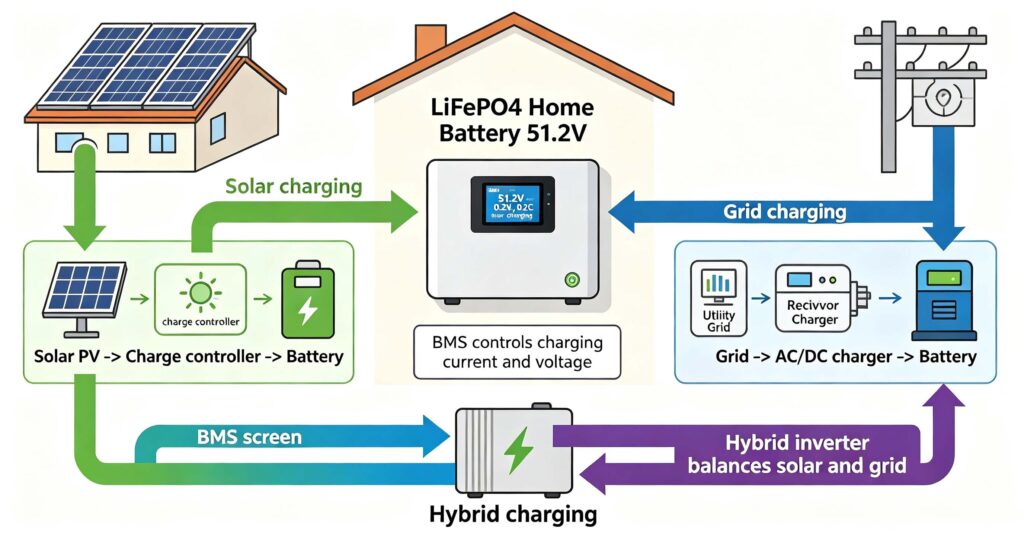
Home battery charging works by feeding controlled DC current and voltage into the battery cells under the supervision of the battery management system (BMS). A home battery can be charged from three sources: solar energy (DC from rooftop panels, regulated by a charge controller or hybrid inverter), the utility grid (AC converted to DC by the inverter’s charger), and a hybrid combination where the inverter prioritises solar and tops up from the grid when needed. Charging is never a simple plug-in: the charger applies a charge profile (constant current then constant voltage for LiFePO4) while the BMS monitors cell voltage and temperature to prevent overcharge. Solar charging typically delivers around 0.2C to 0.5C charge rate (for a 10kWh battery, 2–5kW), while grid charging can reach 0.5C to 1C depending on the inverter and circuit. For most LiFePO4 home batteries the recommended charging window is 0°C to 45°C, and the BMS will reduce or stop charging outside this range. Choosing the right home battery charging setup matters because it determines how fast you refill energy, how much you self-consume solar, and whether the battery lasts its full cycle life.
When a homeowner or installer asks how a home battery charges, the real question is usually about energy flow: where the electrons come from, how fast they go in, and who controls the process. This guide breaks down home battery charging into its three main sources, explains the charging profile and the role of the BMS, and gives practical guidance on choosing between solar, grid and hybrid charging. For sizing the battery itself before you worry about charging, see #09 how to size a home battery.
Three sources of home battery charging
A home battery can be charged from solar, the grid, or a hybrid mix. The source you choose depends on whether you already have solar, whether you want to maximise self-consumption, and how your utility prices electricity.
Solar charging is the most common setup for solar-plus-storage homes. Rooftop panels generate DC power; a charge controller or a hybrid inverter’s MPPT tracker regulates it and feeds the battery. Solar charging is inherently variable: it only works while the sun shines and at whatever power the panels produce. Its big advantage is that it lets you store excess solar that would otherwise be exported at a low or zero feed-in tariff, then use it in the evening when prices are higher. Solar charging also typically gives the gentlest charge profile, which supports long battery life.
Grid charging is used when a home has a battery but no solar, or when solar alone cannot fill the battery. The inverter’s built-in charger converts AC grid power to DC and charges the battery. Grid charging can be scheduled to run during cheap off-peak hours (time-of-use arbitrage), which makes it economical even without solar. The main trade-off is that you pay for the energy, so grid charging only makes sense when the stored energy saves more than it costs — for example, charging at night at 8 cents and discharging during peak at 25 cents. For homes without solar, see #04 home battery backup without solar.
Hybrid charging combines both sources. A hybrid inverter runs the battery with a priority order: solar first, grid as backup. When solar output exceeds the home’s load, the excess charges the battery; when solar is insufficient and the battery is below its target state of charge, the inverter pulls from the grid to top it up. Many hybrid systems also support “force charge” — charging from the grid at a set time regardless of solar, useful before a known peak price period or an expected outage. The hybrid approach is the most flexible and is what most modern home storage systems use.
| Charging source | Power source | Speed | Best for | Typical setup |
|---|---|---|---|---|
| Solar | Rooftop PV (DC) | 0.2C–0.5C (2–5kW for 10kWh) | Self-consumption, no export waste | Charge controller or hybrid inverter MPPT |
| Grid | Utility (AC) | 0.5C–1C (5–10kW) | Time-of-use arbitrage, no solar | Inverter built-in charger |
| Hybrid | Solar + grid | Variable, prioritises solar | Maximum flexibility, outage prep | Hybrid inverter with force-charge |
How the charging profile and BMS control charging
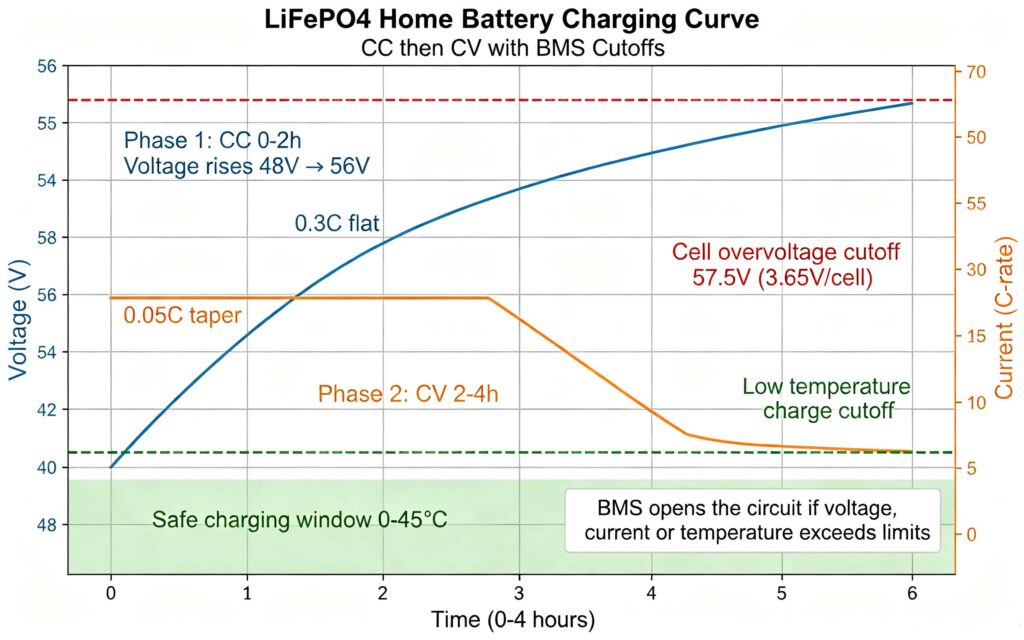
Charging a home battery is not simply pushing power in until it is full. A LiFePO4 battery is charged with a two-stage profile, and the BMS is the final authority on how much current and voltage are allowed.
Stage one, constant current (CC): the charger pushes a fixed current into the battery, usually 0.2C to 0.5C, while the voltage rises. For a 51.2V battery, charging voltage climbs toward around 56–57V (3.5V per cell). This is the bulk-charging stage and delivers most of the energy.
Stage two, constant voltage (CV): once the pack reaches its absorption voltage, the charger holds voltage constant and lets current taper down as the cells approach full. When current drops to a threshold (often 0.05C or a few amps), the BMS considers the pack charged and may stop or float.
The BMS role: the BMS continuously reads each cell’s voltage and temperature. It enforces cutoffs — cell overvoltage (around 3.65V for LiFePO4), pack overcurrent, and low/high temperature. If any cell exceeds its limit, the BMS opens the charge path (via a MOSFET switch) to protect the battery. For the fundamentals of what a BMS does in a battery, see #28 battery management system 101.
Charging strategies: solar-first, TOU arbitrage and outage prep
How you configure home battery charging determines both your savings and your readiness for outages. Three strategies cover most homes.
Solar-first self-consumption is the default for solar-plus-storage. The hybrid inverter sends solar to the home load first, charges the battery with any surplus, and only exports what remains. This maximises the value of your own solar and is the simplest strategy to set up. See #43 AC vs DC coupled systems to understand how the architecture affects solar charging efficiency.
Time-of-use (TOU) arbitrage applies when grid rates vary by time of day. The system charges the battery from the grid during cheap off-peak hours (or from solar during midday) and discharges during peak hours. A typical result is shifting 8–12kWh per day from a 25-cent peak to an 8-cent off-peak, saving $1.50–$2.50 per day depending on rate spread. Grid charging speed and the charging window are set in the inverter or EMS.
Outage readiness uses grid charging (or “force charge”) to fill the battery before a forecast storm or a scheduled peak-price window. If a storm is coming, the system can hold the battery at 100% instead of cycling it daily. For the full picture on using a battery for outages, see #26 solar battery backup for power outages.
Choosing the right charging setup
When specifying or upgrading a home battery charging setup, the main decisions are the inverter/charger rating, the charge rate you allow, and whether you schedule grid charging.
- Charger or inverter rating: match the charging power to the battery capacity. For a 10kWh battery, a 3–5kW charging rate (0.3–0.5C) is typical; a 5kWh battery should charge at 1.5–2.5kW. Charging faster than 0.5C on a small pack reduces cycle life and stresses the cells.
- Charge rate limits in the BMS: most BMS units let you set a maximum charge current. Keeping the charge at or below 0.5C preserves cycle life, which matters most when the battery is cycled daily.
- Scheduling: if you use TOU arbitrage, set the charging window in the EMS so the battery charges only during off-peak hours. If you rely on solar, no scheduling is needed.
- Temperature awareness: LiFePO4 home batteries should not be charged below 0°C or above 45°C. The BMS will protect against this, but installers should place the battery in a conditioned space where possible.
The voltage standard also affects charging. Most home batteries are 48V or 51.2V; the charging voltage and compatible chargers differ, so confirm your system. For more on the voltage decision, see #12 48V vs 51.2V solar battery.
Q. How long does it take to charge a home battery?
It depends on the battery capacity and the charging rate. A 10kWh LiFePO4 battery charging at 0.3C (3kW) fills in about 3 to 3.5 hours; at 0.5C (5kW) it takes roughly 2 hours; a slower 0.2C solar charge takes around 5 hours in good sun. Solar charging is also limited by available sunshine, so a cloudy day slows it further. Grid and hybrid charging are usually faster because the charger delivers a steady, set rate. The BMS controls the final taper, so the last few percent take longer as current decreases.
Q. Can I charge a home battery from the grid?
Yes, grid charging is standard on home storage systems. The inverter’s built-in charger converts AC grid power to DC and charges the battery at a set rate, typically 0.5C to 1C. It is especially useful for homes without solar and for time-of-use arbitrage, where you charge during cheap off-peak hours and discharge during peak prices. Grid charging is economical only when the off-peak rate you pay is clearly below the peak rate you avoid. Most systems let you schedule or force grid charging.
Q. Is solar or grid charging better for a home battery?
Solar charging is better for self-consumption and long-term cost because the energy is free, but it is variable and only works in daylight. Grid charging is reliable and fast but you pay for the energy, so it is best for time-of-use arbitrage or when you have no solar. The most practical answer for most homes is hybrid: the system uses solar first and tops up from the grid when needed. Battery life is similar either way as long as the charge rate stays within the BMS limit.
Q. Can I charge a home battery during an outage?
It depends on the system design. In a standard grid-tied system, the inverter shuts down during an outage to prevent back-feeding the grid, so grid charging stops. In a hybrid or islanding-capable system, the battery can still be charged from solar during an outage if the sun is out, because the inverter continues to run off the solar input. If you rely on grid charging and the grid is down, the battery cannot be refilled until power returns. Plan to keep the battery charged and have solar available for outage scenarios.
Q. What temperature is safe for charging a LiFePO4 home battery?
Most LiFePO4 home batteries are rated to charge between 0°C and 45°C. Below 0°C, charging can cause lithium plating on the anode and permanently damage cells, so the BMS blocks charging below this limit. Above 45°C, charging accelerates degradation and raises thermal risk, so the BMS also cuts off charging. Some systems include battery heaters that allow safe charging in cold conditions. Installers should place the battery in a conditioned indoor space to keep it inside the safe charging window most of the year.
Next step: choose your home battery charging configuration
Understanding home battery charging is the key to getting value from storage: solar-first charging maximises self-consumption, grid charging enables TOU arbitrage, and hybrid charging gives you flexibility plus outage readiness. The right choice depends on whether you have solar, your utility rates, and your outage priorities. When you specify a system, confirm the charging source, the charge rate the BMS allows, and the charging schedule before purchase.
- Learn how to size your home battery in #09
- Understand AC vs DC coupling in #43
- Prepare for outages with #26
- Ask leekooenergy for a home battery charging specification that includes: recommended battery capacity (kWh) for your home, LiFePO4 battery model with its charge rate limit (C-rate) and safe charging temperature range, compatible hybrid inverter with the right built-in charger rating (kW), charging source setup (solar-first, grid, or hybrid), scheduled charging window for your utility TOU rates, BMS charge-current limit configuration, installation location that keeps the battery inside its safe charging temperature, and a charging strategy matched to your solar output and outage priorities — so your home battery charging is efficient, safe, and matched to how you actually use energy