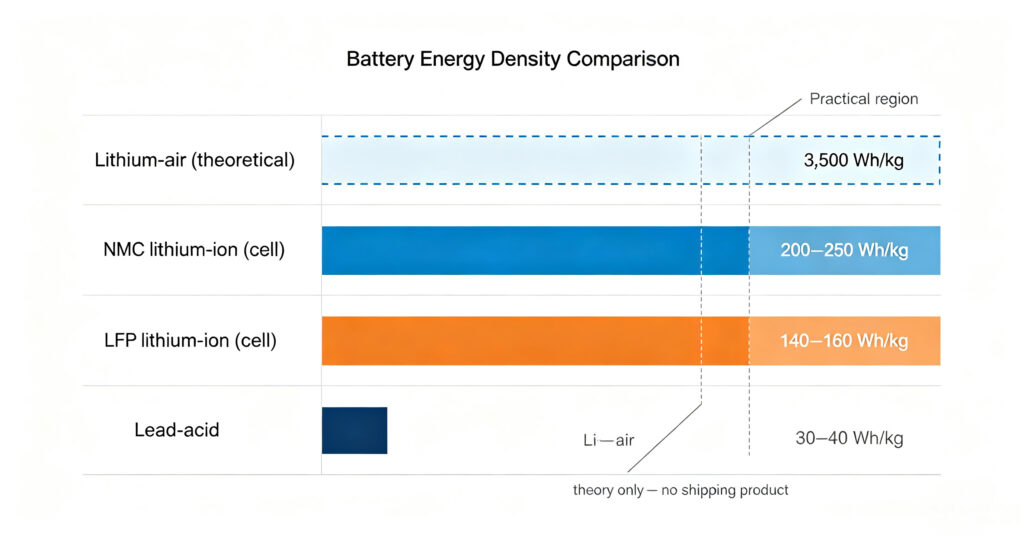
A lithium air battery is a metal-air cell that pairs a lithium metal anode with a porous cathode that breathes oxygen from the surrounding air instead of storing a metal oxide inside the cell. Because the cathode reactant is not carried in the cell, the theoretical energy density is the highest of any rechargeable chemistry — commonly quoted around 3,500 Wh/kg at the active-material level, an order of magnitude above the 150–250 Wh/kg a practical lithium-ion cell delivers today. The catch is that no lithium air battery is sold as a commercial product: laboratory cells have demonstrated the chemistry, but cycle life, round-trip efficiency and air handling all remain unsolved at product level. For a B2B buyer the practical answer is that lithium-air is a research programme, not a procurement option, and the decision today is still between mature chemistries.
How a lithium-air cell is supposed to work
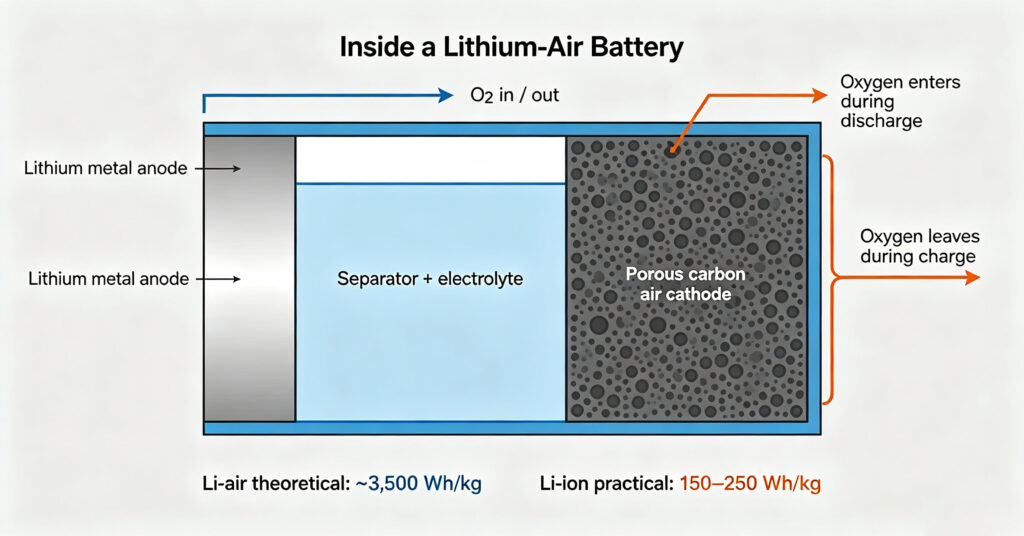
Every rechargeable battery moves ions between two electrodes through an electrolyte. In a conventional lithium-ion cell both electrodes are solid hosts: lithium ions slide into a graphite anode during charge and into a layered metal oxide cathode during discharge. The cathode material is heavy, and it is carried inside the cell whether or not it is being used.
A lithium air battery removes that dead weight. The anode is lithium metal — the lightest practical anode available — and the cathode is a porous carbon structure open to the outside air. During discharge, lithium ions travel to the cathode and react with oxygen drawn from the atmosphere to form lithium peroxide; during charge the reaction runs backwards and oxygen is released. Because the oxidiser comes from outside, the cell does not have to carry it, and the theoretical energy density rises dramatically.
That single architectural change is why the numbers on paper are so large. It is also the source of every problem that keeps the chemistry in the lab, because an open electrochemical system has to manage the atmosphere rather than just manage its own internals.
The numbers: why lithium-air looks so attractive
Energy density is the figure that drives range in a vehicle, runtime in a portable unit, and footprint in a stationary cabinet. The comparison below uses active-material-level theoretical figures for lithium-air and practical pack-level or cell-level figures for the shipping chemistries, which is the honest way to read it — the gap between theory and product is itself the story.
| Chemistry | Energy density | Status | Typical use today |
|---|---|---|---|
| Lithium-air | ~3,500 Wh/kg theoretical (active material) | Laboratory research | None — no shipping product |
| NMC lithium-ion | 150–250 Wh/kg at cell level | Mass production | EV traction packs, portable electronics |
| LFP (LiFePO4) | 140–160 Wh/kg at cell level | Mass production | Stationary storage, marine, RV, backup |
| Lead-acid | 30–40 Wh/kg at cell level | Mature, declining | Starter batteries, legacy UPS strings |
The theoretical figure for lithium-air is calculated at the active-material level, which is not the number a buyer would ever receive. A shipping cell adds current collectors, separators, electrolyte, the air-handling system, sealing, thermal management and packaging. Published estimates for a realistic lithium-air pack land far below the headline number, and the research literature is candid that the practical advantage shrinks once the system is built.
Four problems that keep lithium-air out of products
The gap between a working laboratory cell and a shipping product is measured in four specific failures, and each one has been the subject of years of research without a clean solution.
- Cycle life. Early lithium-air cells demonstrated tens of cycles before capacity collapsed. A stationary storage product is sold on 6,000–10,000 cycles; an EV pack on 1,000–3,000. Closing a gap of that size is not an incremental improvement, it is a different materials problem.
- Round-trip efficiency. The voltage required to charge a lithium-air cell is meaningfully higher than the voltage it delivers on discharge. That difference is lost energy, and it puts the round-trip efficiency below what lithium-ion already achieves. For a B2B buyer paying for every kilowatt-hour that does not come back out, efficiency is a first-order cost, not a spec-sheet detail.
- Air handling. A cell that breathes needs a supply of clean, dry air: filters, membranes, pumps or passive channels, plus a way to deal with the volume change as oxygen moves in and out. Every one of those parts adds weight, cost, parasitic load and a maintenance item — the opposite of what the chemistry’s headline advantage promises.
- Contamination. Ambient air contains moisture and carbon dioxide, both of which react with lithium and with the discharge products to form compounds that clog the porous cathode and consume the anode. Laboratory work is therefore usually done with pure oxygen rather than air, which is another reason the practical system looks less attractive than the theoretical one.
Rechargeable lithium-air specifically is the hard case. Primary (non-rechargeable) lithium-air cells have existed for decades and are used where a very long shelf life matters more than recharging, because a cell that never has to run the reaction backwards avoids most of the failure modes above.
What does ship today: the rest of the metal-air family
Lithium-air is one member of a larger metal-air family, and it is worth separating the members that are shipping from the one that is not. Zinc-air primary cells power hearing aids and are produced in enormous volumes; they are cheap, safe and not rechargeable in practical terms. Iron-air is being deployed as multi-day storage, where the relevant metric is cost per kilowatt-hour of capacity rather than energy density, because a grid-scale installation can afford to be heavy. The multi-day storage angle and the iron-air chemistry are covered in #60 iron-air battery explained; the wider long-duration technology comparison is in #122 long-duration energy storage comparison.
The pattern across the family is consistent: metal-air chemistries win where the application tolerates low power density and values cheap capacity, and they lose where the application needs energy per kilogram and many thousands of cycles. That is exactly the profile that keeps lithium-air out of vehicles and out of daily-cycling stationary storage for now.
How to read a battery roadmap claim
Suppliers and press releases regularly announce laboratory results without the qualifiers that make them interpretable. Five questions separate a genuine roadmap signal from a headline.
- Is it a cell or a material result? A figure measured on active material is not a cell figure, and a cell figure is not a pack figure.
- How many cycles, at what depth of discharge, at what charge rate? Cycle life without those three qualifiers is not comparable to anything.
- Is it round-trip efficiency or just discharge energy? Quoting only the discharge side hides the charging penalty.
- Who verified it? An independent national laboratory or a published peer-reviewed result carries more weight than an internal test report.
- Is there a pilot line? The distance from a coin cell to a pilot line is where most battery chemistries stop.
Applied to lithium-air, all five answers still point the same way: real chemistry, impressive theory, no product. The solid-state comparison in #129 solid-state battery vs lithium-ion shows a chemistry further along the same road, and the contrast is instructive — solid-state has pilot lines and announced vehicle programmes where lithium-air does not.
What B2B buyers should actually do
For procurement decisions made this year and next, the choice set has not changed. LFP remains the default for stationary storage because it trades a modest energy density penalty for cycle life, thermal stability and a mature supply chain; NMC remains the choice where energy density is the binding constraint. The comparison is set out in #33 LiFePO4 vs lithium-ion NMC, and the full lithium-ion type taxonomy is in #67 types of lithium-ion batteries.
The sensible posture on lithium-air is to track it without waiting for it. A storage asset bought today will operate for ten to fifteen years, and the replacement decision at the end of that life will be made with a different technology set — which is an argument for designing the installation so the battery can be replaced, not an argument for postponing the installation. Trends worth monitoring are collected in #92 energy storage trends 2026.
Q. Is a lithium air battery commercially available?
No. As of the current state of the technology, no manufacturer sells a rechargeable lithium air battery as a commercial product. Working cells exist in research laboratories, and primary (non-rechargeable) lithium-air cells have niche uses, but there is no product a B2B buyer can specify, order or warrant.
Q. Why is the theoretical energy density so much higher than lithium-ion?
Because the cathode reactant is oxygen taken from the air rather than a metal oxide carried inside the cell. A conventional lithium-ion cell must carry the weight of its cathode material at all times; a lithium-air cell uses the atmosphere instead, and that removes a large fraction of the inactive mass from the energy density calculation.
Q. What is the difference between lithium-air and lithium-ion?
Lithium-ion is a closed system: both electrodes are solid materials sealed inside the cell, and lithium ions move between them. Lithium-air is an open system: the anode is lithium metal and the cathode breathes oxygen from outside. The open architecture gives higher theoretical energy density but introduces air handling, moisture and carbon dioxide contamination, and a large charge-discharge voltage gap.
Q. Are other metal-air batteries available?
Yes. Zinc-air primary cells are mass-produced for hearing aids and similar low-power devices, and iron-air systems are being deployed for multi-day grid storage where cost per kilowatt-hour matters more than energy density. These are different chemistries from lithium-air and should not be confused with it in procurement documents.
Q. Should I delay a storage purchase to wait for lithium-air?
No. With no shipping product, no published product-level cycle life and no pilot line, waiting means deferring the energy savings, incentive capture and resilience benefit of a system that could be operating today. The better plan is to buy on mature chemistry and design the installation so the battery can be replaced when the technology set changes.
Next step: specify on mature chemistry, design for replacement
The right response to an emerging technology is not to wait for it. It is to buy a system that pays back on today’s numbers, installed in a way that lets you swap the battery when the next generation actually ships.
- Compare the shipping options in #33 LiFePO4 vs lithium-ion NMC
- Read the multi-day metal-air alternative in #60 iron-air battery explained
- Check the nearer-term emerging chemistry in #129 solid-state battery vs lithium-ion
- Ask leekooenergy for a chemistry selection brief that states the cell chemistry and cell supplier, the cycle life at the depth of discharge your duty cycle actually uses, the round-trip efficiency measured at your charge and discharge rates, the thermal management approach, and the replacement path for the battery at end of life — so your decision rests on measured product data rather than on a laboratory headline